


Ball Valve Selection Guide: Floating vs Trunnion
How to choose the right ball valve — floating vs trunnion, full vs reduced port, body materials, Cv sizing and common mistakes for industrial, water and oil & gas applications.
* Standard lead time depends on order quantity and destination country. 5–10 days to Southeast Asia, 15–20 days to the Middle East.
⚡ Quick Answer
For 90% of industrial, water and HVAC applications ≤ DN200 (8″) and ≤ ANSI 600#, choose a floating ball valve with full port, PTFE seat, and 316 stainless body for coastal/chloride service or WCB for oil & gas. Switch to trunnion only when size exceeds DN250, pressure exceeds ANSI 600#, or you need fire-safe / emergency shutdown certification.
Never use a ball valve for throttling — it is an on/off isolation valve only. For coastal or seawater service, always specify CF8M (316), not CF8 (304).
🔑 Key Takeaways
- Floating vs trunnion boundary: Floating for ≤ DN200 / ≤ ANSI 600# general service · trunnion for ≥ DN250 / ≥ ANSI 600# or critical oil & gas shutdown.
- Full vs reduced port: For an 180 m³/h clarified water line, required Cv ≈ 658 — full-port DN150 (Cv ≈ 900+) works; reduced-port DN150 (Cv ≈ 450) does not, even though it is 30-40% cheaper.
- Body for coastal / seawater: Always CF8M (316 stainless) for chloride exposure — CF8 (304) pits and fails within 1-2 years in salt spray or seawater.
- On/off only: Ball valves are isolation valves, not control valves — never partially open a ball valve for throttling; seat erosion and cavitation will destroy it within months.
On This Page
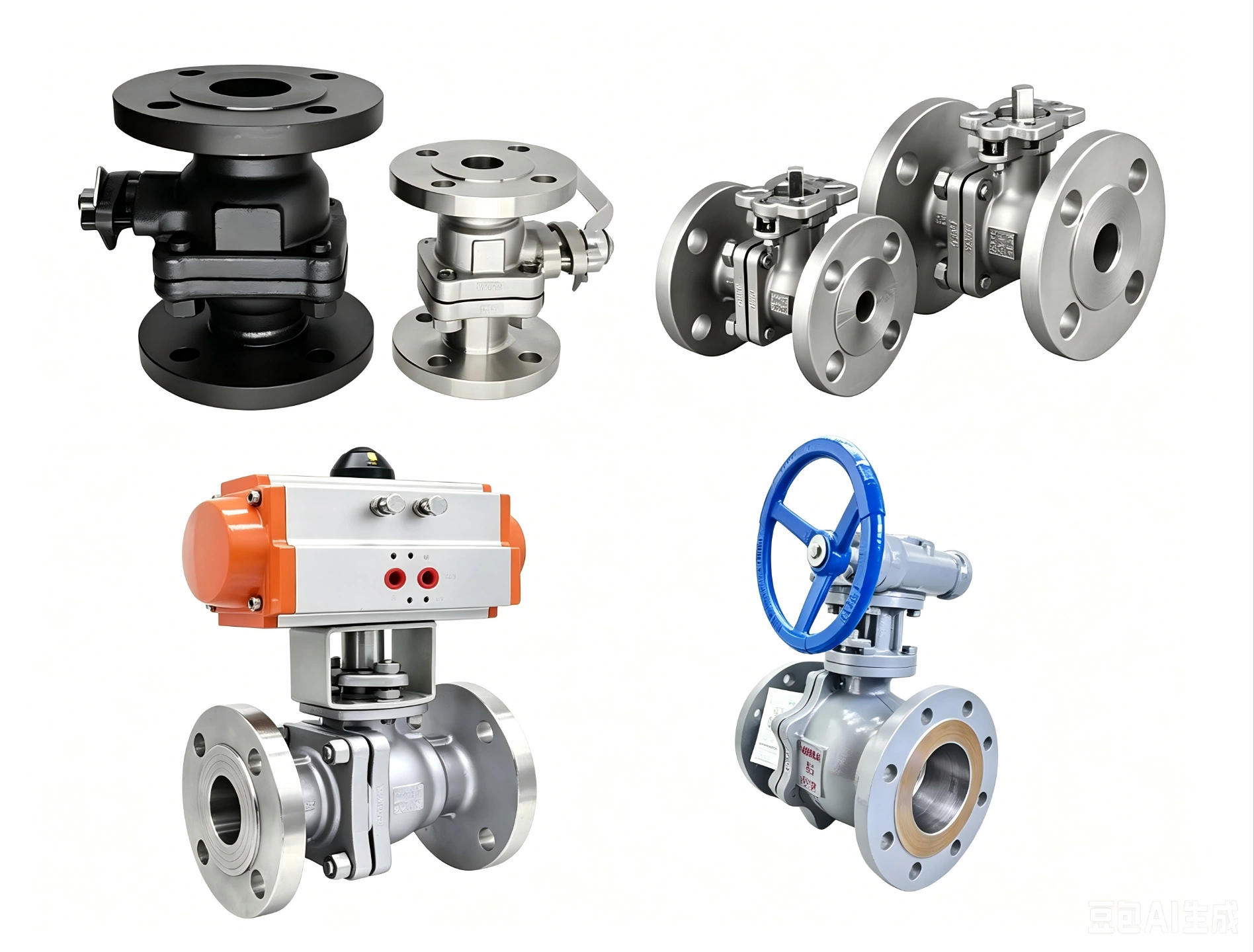
A ball valve is the most commonly used shut-off valve in industrial piping — and also the easiest to spec incorrectly. Most engineers just match the pipe size and move on, but choosing between floating and trunnion design, full port vs reduced port, and the right body material can mean the difference between 10 years of trouble-free service or repeated leaking.
In this guide, we break down the two main ball valve designs, when to use full vs reduced port, and how to pick the right material — based on our experience supplying flanged ball valves to oil & gas, water treatment and food processing plants across Southeast Asia and the Middle East.
1. Floating Ball vs Trunnion Ball: What’s the Difference?
The ball inside a ball valve either floats (moves slightly under pressure) or is held in place by a trunnion (a shaft at the bottom and top). This single design choice changes everything about performance, cost and application range.
| Floating Ball Valve | Trunnion Ball Valve | |
|---|---|---|
| How it works | Ball floats between two seats, pushed against downstream seat by line pressure | Ball is anchored by top and bottom trunnions, seats move against ball |
| Size range | 1/2″ – 8″ (DN15 – DN200) | 4″ – 48″ (DN100 – DN1200) |
| Pressure rating | Up to ANSI 600# | Up to ANSI 2500# |
| Torque to operate | Low (small sizes) | High (needs bigger actuator) |
| Best for | General industrial, water, HVAC, small sizes | High pressure, large diameter, oil & gas, critical service |
| Cost | Lower | Higher |
2. When to Choose Floating Ball
Choose a floating ball valve if:
- Your line size is 8″ or smaller (DN200 and below)
- Pressure is ANSI 600# (PN100) or lower
- The fluid is clean water, oil, gas, or non-corrosive chemicals
- You want the lowest cost for standard on/off service
Most of our customers in water treatment, HVAC and general industry use the floating type flanged ball valve — it’s cheaper, simpler and perfectly adequate for 90% of applications.
3. When to Choose Trunnion Ball
Choose a trunnion ball valve if:
- Line size is 10″ (DN250) or larger
- Pressure exceeds ANSI 600# (PN100)
- You have high temperature service (over 200°C / 400°F)
- The application is critical (emergency shutdown, gas pipelines)
- You need fire-safe or anti-static certified design
Trunnion valves are heavier and more expensive, but they handle the extreme conditions that would crush or warp a floating ball. For oil & gas gathering lines and high-pressure gas pipelines, trunnion is the only safe choice.
4. Full Port vs Reduced Port: Does It Matter?
Full port (also called full bore) means the ball opening is the same diameter as the pipe. Reduced port (standard port) means the opening is one size smaller. Here’s how to choose:
Choose full port if:
- Flow rate is critical (low pressure drop required)
- You need to pig the pipeline (cleaning with a pig)
- The fluid is viscous or contains solids
- Future flexibility matters (you might upsize later)
Choose reduced port if:
- Cost is the main concern (reduced port is 30-40% cheaper)
- Pressure drop is not critical
- Space is tight (reduced port valve is smaller and lighter)
For most general industrial applications, reduced port is fine. We supply both full port and reduced port threaded ball valves for small piping systems.
5. Body Material Selection
| Material | Best For | Common Applications |
|---|---|---|
| Cast Iron (GG25) | Water, low pressure HVAC | Building water systems, fire protection |
| Ductile Iron (GGG40) | Higher pressure water, wastewater | Water treatment plants, irrigation |
| Carbon Steel (WCB) | Oil, gas, steam, high temperature | Oil & gas pipelines, steam systems |
| Stainless 304 (CF8) | Corrosive chemicals, food | Chemical plants, food processing |
| Stainless 316 (CF8M) | Sea water, chlorides, harsh chemicals | Marine, desalination, pharmaceutical |
Mistake we see often: using 304 stainless for sea water or chloride service. 304 will pit and fail within 1–2 years in salt water. Always use 316 (CF8M) for marine or seawater applications.
International Standards Reference
| Standard Category | US / ANSI | European / EN | Japanese / JIS |
|---|---|---|---|
| Design | API 6D / API 608 | EN 12266 | JIS B2002 |
| Face-to-Face | ASME B16.10 | EN 558 / ISO 5752 | JIS B2002 |
| Flange | ASME B16.5 (Class 150/300/600) | EN 1092-1 (PN16/40/63) | JIS B2220 (10K/20K) |
| Pressure Rating | ANSI Class 150–600 | PN16–PN100 | 10K–20K |
| Testing | API 598 / ISO 5208 | EN 12266-1 | JIS B2003 |
| Fire Safe | API 607 / API 6FA | ISO 10497 | — |
| Actuator Mounting | ISO 5211 | ISO 5211 | ISO 5211 |
Note: API 6D covers pipeline ball valves for oil & gas transmission; API 608 covers general industrial metal ball valves with flanged, threaded or welding ends.
Worked Example: Sizing a Ball Valve for a Water Treatment Plant
Let’s size an isolation ball valve for a clarified water discharge line at a municipal water treatment plant in Surabaya, Indonesia.
Step 1 — Design flow rate
Clarified water discharge: 180 m³/h (792 GPM). Water at 25°C, clean, no solids.
Step 2 — Select pipe size
Target velocity for water: 2.5 m/s. Required pipe area A = Q ÷ v = 0.05 m³/s ÷ 2.5 m/s = 0.02 m².
Pipe diameter d = √(4A ÷ π) = √(4 × 0.02 ÷ 3.1416) ≈ 0.16 m → choose DN150 (6″) pipe.
Step 3 — Check valve Cv requirement
Allowable pressure drop across isolation valve (when fully open): ΔP = 0.1 bar ≈ 1.45 psi (isolation valves should have minimal drop).
Required Cv = Q(GPM) ÷ √ΔP(psi) = 792 ÷ √1.45 ≈ 658.
A full-port DN150 (6″) stainless steel ball valve has Cv ≈ 900+ at full opening — well above requirement. A reduced-port DN150 ball valve has Cv ≈ 450 — insufficient. This confirms a full-port DN150 ball valve is required.
Step 4 — Select valve configuration
• Body: CF8M (316 stainless) — coastal location, chloride exposure
• Ball: 316 stainless
• Seats: PTFE (universal compatibility, water service)
• Pressure: PN16 / ANSI 150#
• Ends: Flanged EN1092 PN16
• Operation: Lever handle for manual isolation; ISO 5211 pad for future automation
💡 Why Water Treatment EPCs Choose Chuanglan
Floating & trunnion ball valves from DN15 to DN300, 304/316/WCB bodies in stock
ISO 9001:2015 certified factory, 100% factory pressure tested, EN 10204 3.1 MTC included
MOQ: 1 piece — sample valves for pilot plants before bulk EPC order
Need Help Sizing Your Ball Valve?
Send us your pipe size, pressure rating, fluid type and connection standard — our engineers will recommend the right model and quote within 24 hours.
Get Free Sizing Report →6. Common Sizing Mistakes
Mistake 1: Just matching the pipe size. Ball valves are available in multiple pressure ratings (PN16, PN40, ANSI 150#, ANSI 300#). A PN16 valve will not work on a PN40 system. Always match the pressure class to your system design.
Mistake 2: Ignoring the end connection standard. European flanges (EN1092), American flanges (ANSI B16.5) and Japanese flanges (JIS) are not interchangeable. Confirm which flange standard your piping uses before ordering.
Mistake 3: Forgetting about the actuator. If you plan to automate the valve later, buy a valve with an ISO mounting pad now. Retrofitting an actuator onto a non-ISO valve is expensive and often impossible.
For automated applications, we supply pneumatic and electric actuated ball valves pre-assembled and tested.
Mistake 4: Using reduced port for viscous fluids. Reduced-port ball valves create unnecessary turbulence and pressure drop on viscous fluids (oil, syrup, sludge). Always use full port for viscous or solids-laden service.
Southeast Asia & Middle East Market
Ball valves are specified across a huge range of projects in Southeast Asia — Indonesia, Malaysia, Thailand, Vietnam and Singapore — and the Middle East: Saudi Arabia, UAE, Qatar and Oman. Two regional factors drive material selection:
- Coastal corrosion (Southeast Asia + Gulf): Projects in Jakarta, Surabaya, Kuala Lumpur, Bangkok, Jeddah, Dammam and Dubai sit in high-humidity, salt-laden air. Carbon steel (WCB) bodies need heavy epoxy coating; critical valves should use 316 stainless (CF8M) bodies and balls to avoid pitting within 2-3 years.
- High-temperature process (Gulf): Oil & gas and petrochemical projects in Saudi Arabia and UAE often run at elevated temperatures. Specify PTFE seats rated to 180°C, or RTFE (reinforced PTFE) for higher pressure-temperature combinations.
Chuanglan Valve directly supplies floating and trunnion ball valves to EPC contractors, MEP consultants and oil & gas operators across Southeast Asia and the Middle East, with factory-direct pricing and 7–15 day delivery for standard sizes.
Serving EPC Contractors Across Southeast Asia & Middle East · ISO 9001:2015 Certified · 15+ Years Factory Experience
FAQ
What is the difference between floating and trunnion ball valves?
Floating ball valves have the ball held between two seats with no mechanical anchor — line pressure pushes it against the downstream seal. Trunnion ball valves have the ball anchored top and bottom by shafts, allowing them to handle much larger sizes (DN250+) and higher pressures (up to ANSI 250#).
When should I choose a full port vs reduced port ball valve?
Choose full port when low pressure drop, pigging, viscous fluids or future upsizing matters. Choose reduced port when cost is the priority and pressure drop is not critical — typical reduced port is 30-40% cheaper.
What body material should I use for seawater service?
Always use 316 stainless (CF8M) for seawater or chloride exposure. 304 stainless (CF8) will pit and fail within 1-2 years in salt water. For critical marine applications, super duplex (F51) is available but rarely needed for standard ball valves.
What is the standard pressure rating for industrial ball valves?
PN16 / ANSI 150# is the most common for water, HVAC and general industry. PN40 / ANSI 300# is used for oil & gas and higher temperature service. Always match the valve rating to your system design pressure with a 1.5× safety margin.
Can ball valves be used for throttling?
No. Ball valves are designed for on/off isolation only. Partially opening a ball valve causes seat erosion, cavitation and premature failure. Use a globe valve or control valve for throttling applications.
How do I calculate the correct Cv for a ball valve?
Cv = Q(GPM) ÷ √ΔP(psi), where Q is your flow rate in gallons per minute and ΔP is the allowable pressure drop in psi. Then select a valve whose full-open Cv exceeds this value by at least 20%.
What is your MOQ and lead time for ball valves?
MOQ is 1 piece for standard flanged and threaded ball valves. Lead time is 7–15 days for standard sizes in stock; custom materials (316, duplex) and actuated configurations take 15–30 days.
References & Standards
- API 6D: Specification for Pipeline and Piping Valves
- API 608: Metal Ball Valves (Flanged, Threaded and Welding Ends)
- ASME B16.34: Valves — Flanged, Threaded, and Welding End
- EN 12266: Industrial valves — Pressure testing of metallic valves
- ISO 5211: Industrial valves — Part-turn actuator attachments
Related Products
Continue Reading
Get a Quote for Your Ball Valve Project
MOQ: 1 piece · ISO 9001:2015 certified · 3.1 MTC included · 100% factory pressure tested
Southeast Asia: Indonesia, Malaysia, Thailand, Vietnam, Singapore, Philippines, Myanmar
Middle East: Saudi Arabia, UAE, Qatar, Kuwait, Oman, Bahrain
Other Regions: Europe, North America, South America, Africa, Australia
Delivery: 5–10 days to Southeast Asia · 15–20 days to the Middle East · 25–35 days to Europe / the Americas
Payment: T/T 30% deposit + 70% before shipment · L/C at sight · Warranty: 12 months after shipment for material and manufacturing defects · Packing: export plywood case / fumigation-free pallet · Shipping: FOB Ningbo/Shanghai · Documents: EN 10204 3.1 MTC + packing list + commercial invoice · Third-party inspection welcome: SGS / Bureau Veritas / Intertek
Get Free Quote »Need a quote or datasheet? Tell us size, pressure class and material – reply within 24 hours.
Request a Quote