

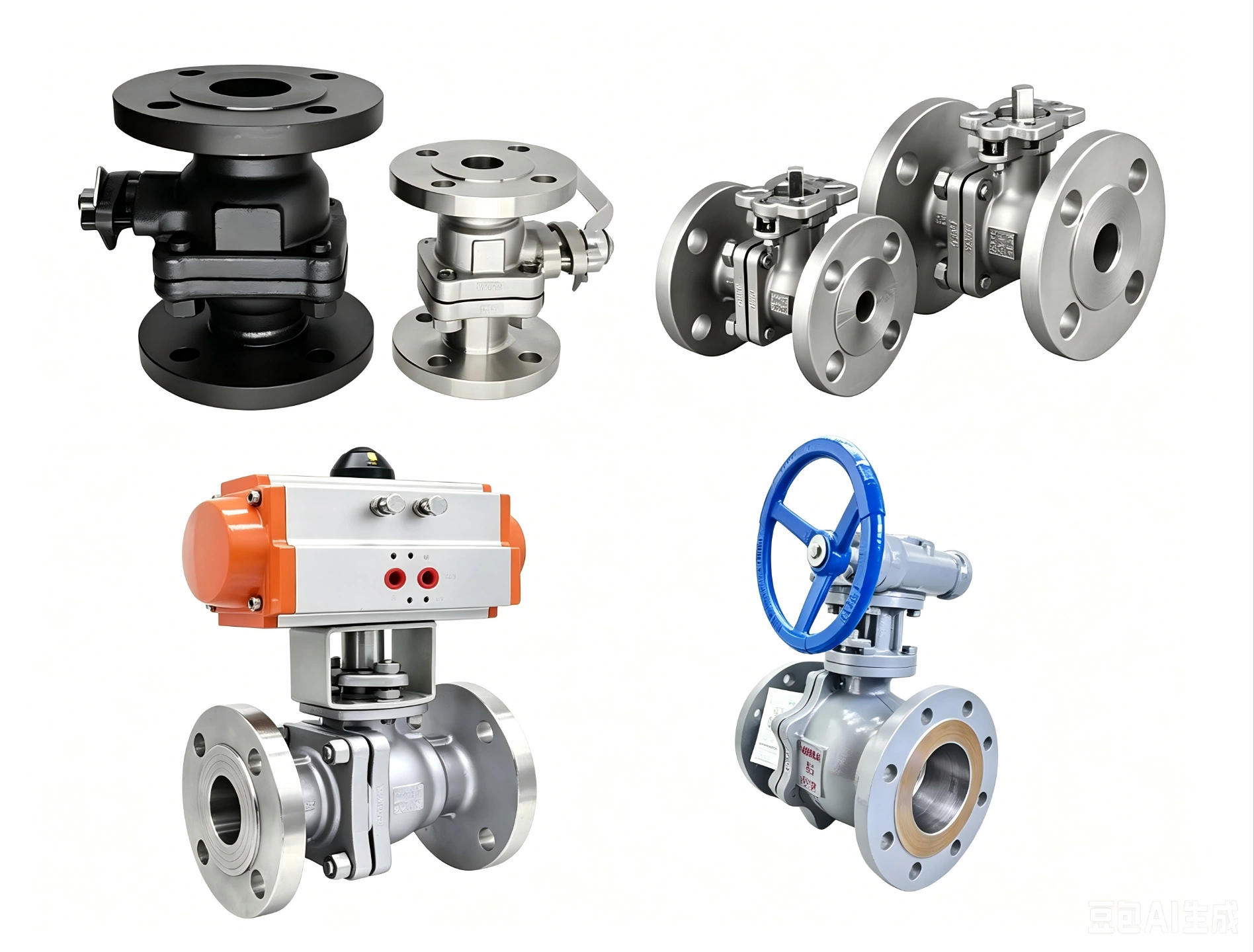
A flanged ball valve is a quarter-turn shut-off valve that uses a perforated spherical ball to control flow. The ball rotates 90° around the stem to open or close the valve. It provides tight shut-off, low torque, and compact design — making it the most widely used valve in industrial piping systems.
Chuanglan manufactures 2-piece and 3-piece flanged ball valves in both floating and trunnion designs, with stainless steel CF8 (304) and CF8M (316) as our premium range. WCB carbon steel is available for oil, gas and water service. We supply DN15 to DN250 (1/2″ to 10″) for PN16/40 and ANSI 150#/300# pressure classes. For small threaded piping, see our threaded NPT/BSPP ball valve. For automated operation, see our pneumatic / electric actuated ball valve.
The main advantage of a flanged ball valve over gate valves and globe valves is fast quarter-turn operation (90° rotation), tight shut-off, low torque and low maintenance. 2-piece ball valves are the most cost-effective choice for general isolation, while 3-piece ball valves allow in-line maintenance — you can service the ball and seats without removing the valve from the pipeline. Full port design provides unobstructed flow with minimal pressure drop, while reduced port (standard port) offers lighter weight and lower cost. We directly serve EPC contractors and valve distributors in Southeast Asia (Indonesia, Malaysia, Thailand, Vietnam) and the Middle East (Saudi Arabia, UAE, Qatar, Kuwait).
🌏 Southeast Asia & Middle East Market Notes
Indonesia / Malaysia palm oil & oleochemicals: CF8M (316) body, PTFE seat, full port for CIP/SIP cleaning. 3-piece design preferred so the center body can be removed for cleaning without disturbing the line.
Saudi Arabia & UAE oil, gas & desalination: WCB carbon steel with hydrocarbon-service trim for refineries; CF8M with RPTFE seat for SWRO desalination. ANSI Class 150 flanges specified.
Vietnam / Thailand water treatment & HVAC: WCB or CF8 2-piece body, PTFE seat, PN16 DIN flanges. Hand lever or gear operated — most cost-effective for municipal water.
Not sure whether you need 2-piece vs 3-piece, or full port vs reduced port? Send us your medium and pressure.
Get Free Sizing Report →Ball Valve vs Gate vs Globe vs Butterfly
| Feature | Ball Valve | Gate Valve | Globe Valve | Butterfly Valve |
|---|---|---|---|---|
| Operation | Quarter-turn (90°) | Multi-turn | Multi-turn | Quarter-turn (90°) |
| Shut-off | Bubble-tight | Good | Excellent (throttling) | Good (not bubble-tight) |
| Throttling | Poor (on/off only) | Poor | Excellent | Good |
| Pressure drop | Low (full port) | Low | High | Low |
| Cost (DN100) | Medium | Medium-high | High | Lowest |
| Size range | Up to DN250 floating | Up to DN1200+ | Up to DN300 | Up to DN1200+ |
| Our product | Flanged Ball | Flanged Gate | Flanged Globe | Wafer Butterfly |
Key Features & Technical Specifications
| Body Type | 2-piece / 3-piece flanged |
| Ball Type | Floating (DN15–DN200) / Trunnion (DN250+) |
| Port Type | Full port / Reduced port |
| End Connection | DIN EN 1092-1 PN16/PN40 / ANSI B16.5 Class 150/300 / JIS 10K |
| Actuation | Manual lever / Gear / Pneumatic / Electric actuator option |
| Temperature Range | -29°C to +180°C (PTFE seat), up to +250°C (RPTFE/metal seat) |
| Testing | shell & seat pressure test per API 598; bubble-tight seat acceptance per API 598; hydrocarbon-service design option |
| Material Certificates | EN 10204 3.1 MTC per heat, included with shipment |
| Standards | API 6D, API 598 testing, EN 558 face-to-face |
Material Standards
| Part | Carbon Steel | Stainless Steel 304 | Stainless Steel 316 |
|---|---|---|---|
| Body / Bonnet | WCB (ASTM A216) | CF8 (ASTM A351) | CF8M (ASTM A351) |
| Ball | SS304 / SS316 (polished) | SS304 | SS316 |
| Stem | SS410 | SS304 | SS316 |
| Seat | PTFE / RPTFE / Nylon | PTFE / RPTFE | PTFE / RPTFE |
| Gasket | Graphite / PTFE | PTFE | PTFE |
Dimension Tables
DIN EN 1092-1 PN16 (mm): L = face-to-face per EN 558 Series 1. D = flange OD, K = bolt circle, d = seal face, c = flange thickness, n-ΦL = bolt holes. H = stem height, W = handle length.
| NPS | DN | L | D (OD) | K (Bolt Circle) | d (Seal) | c (Thk) | n-ΦL | H | W (Handle) |
|---|---|---|---|---|---|---|---|---|---|
| 1/2″ | 15 | 130 | 95 | 65 | 45 | 14 | 4-Φ14 | 65 | 115 |
| 3/4″ | 20 | 140 | 105 | 75 | 58 | 14 | 4-Φ14 | 75 | 130 |
| 1″ | 25 | 150 | 115 | 85 | 68 | 14 | 4-Φ14 | 85 | 150 |
| 1 1/4″ | 32 | 165 | 140 | 100 | 78 | 14 | 4-Φ18 | 95 | 190 |
| 1 1/2″ | 40 | 180 | 150 | 110 | 88 | 15 | 4-Φ18 | 105 | 230 |
| 2″ | 50 | 200 | 165 | 125 | 102 | 16 | 4-Φ18 | 115 | 240 |
| 2 1/2″ | 65 | 220 | 185 | 145 | 122 | 16 | 4-Φ18 | 145 | 280 |
| 3″ | 80 | 250 | 200 | 160 | 138 | 17 | 8-Φ18 | 160 | 310 |
| 4″ | 100 | 280 | 220 | 180 | 158 | 19 | 8-Φ18 | 185 | 330 |
| 5″ | 125 | 320 | 250 | 210 | 188 | 20 | 8-Φ18 | 215 | 600 |
| 6″ | 150 | 360 | 285 | 240 | 212 | 22 | 8-Φ22 | 245 | 800 |
| 8″ | 200 | 400 | 340 | 295 | 268 | 26 | 12-Φ22 | 300 | 1000 |
| 10″ | 250 | 450 | 400 | 355 | 320 | 28 | 12-Φ26 | 380 | 1200 |
ANSI B16.5 Class 150 (mm): Alternative drilling for US, Middle East and Southeast Asian EPC projects. L = face-to-face per API 6D / EN 558 Series 1 long pattern.
| NPS | DN | L | D (OD) | K (Bolt Circle) | d (Raised Face) | c (Thk) | n-ΦL | H | W (Handle) |
|---|---|---|---|---|---|---|---|---|---|
| 1/2″ | 15 | 108 | 89 | 60.5 | 35 | 12 | 4-Φ15 | 68 | 115 |
| 3/4″ | 20 | 117 | 98 | 70 | 43 | 12 | 4-Φ15 | 75 | 130 |
| 1″ | 25 | 127 | 108 | 79.5 | 51 | 12 | 4-Φ15 | 85 | 150 |
| 1 1/4″ | 32 | 140 | 117 | 89 | 64 | 13 | 4-Φ15 | 96 | 190 |
| 1 1/2″ | 40 | 165 | 127 | 98.5 | 73.2 | 15 | 4-Φ15 | 107 | 230 |
| 2″ | 50 | 178 | 152 | 120.7 | 92 | 16 | 4-Φ19 | 118 | 240 |
| 2 1/2″ | 65 | 190 | 177.8 | 139.7 | 104.7 | 18 | 4-Φ19 | 145 | 280 |
| 3″ | 80 | 203 | 190.5 | 152.5 | 127 | 19 | 4-Φ19 | 160 | 310 |
| 4″ | 100 | 229 | 229 | 190.5 | 157 | 24 | 8-Φ19 | 185 | 330 |
| 5″ | 125 | 356 | 254 | 216 | 185.7 | 26 | 8-Φ22 | 230 | 600 |
| 6″ | 150 | 394 | 279 | 241.3 | 216 | 26 | 8-Φ22 | 260 | 800 |
| 8″ | 200 | 457 | 343 | 298.5 | 270 | 29 | 8-Φ22 | 310 | 1000 |
| 10″ | 250 | 533 | 406 | 362 | 324 | 31 | 12-Φ25 | 350 | 1200 |
🧮 Worked Example: Selecting a DN100 Ball Valve for an SWRO Desalination Plant
Project: High-pressure seawater line at an SWRO desalination plant in Abu Dhabi, UAE.
Given: DN100 (4″), seawater at 64 bar, PN40 required, ANSI Class 300 flanges, 2-piece floating ball, manual operation.
Step 1 — Confirm pressure class:
Seawater at 64 bar exceeds PN16 rating. Specify PN40 / ANSI Class 300. Use RPTFE (reinforced PTFE) seat for higher pressure and temperature.
Step 2 — Select body material:
Seawater contains chloride (≈ 19,000 ppm). WCB carbon steel will corrode within months. Specify CF8M (316) body with SS316 ball. For maximum life, super duplex (2205) body is recommended but adds higher cost.
Step 3 — Select port type:
Isolation service only, not throttling. Reduced port is acceptable — lighter weight, lower cost. Specify full port only if pigging or low pressure drop is required.
Step 4 — Select flange standard:
Middle East EPC specified ANSI B16.5 Class 300. Face-to-face per API 6D: L = 292 mm for DN100 Class 300. Hydrocarbon-service documentation required for the high-pressure seawater / energy recovery area.
⚠️ 4 Common Mistakes When Selecting Flanged Ball Valves
Mistake 1 — Using PTFE seat at high temperature: Standard PTFE seat is limited to +180°C. For steam or hot oil above +180°C, specify RPTFE (up to +250°C) or metal-to-metal seat.
Mistake 2 — Carbon steel body for seawater: WCB body in seawater or chloride service corrodes within months. Use CF8M (316) for seawater, or super duplex (2205) for aggressive brine.
Mistake 3 — Using ball valve for throttling: Ball valves are designed for on/off service. Throttling at 30–70% open causes seat erosion and ball cavitation within weeks. For throttling, use a globe valve or control valve.
Mistake 4 — Specifying floating ball for large sizes: Floating ball design is limited to DN200 / 8″. For DN250 and above, use trunnion-mounted ball to reduce operating torque and seat loading.
Need Sizing Help or a Quote?
Send size (DN), pressure (PN/ANSI), material (304/316L), seat (EPDM/Viton) and quantity — we reply within 24 hours.
Get Free Quote »Applications
Oil & Gas
Refineries, pipelines, storage terminals
Power Plants
Cooling water, steam, fuel systems
Water Treatment
Potable water, wastewater, desalination
Chemical
Corrosive fluids, acid & alkali service
Quality Control Process
Raw Material
EN 10204 3.1 MTC, spectrometer check
Machining
CNC precision, in-process inspection
Assembly
Clean room, torque verification
Pressure Test
Shell & seat test per API 598
Final Inspection
Visual, dimensional, performance
📋 Commercial Terms
Payment: T/T 30% deposit + 70% before shipment; L/C at sight accepted for EPC package orders (MOQ USD 30,000+). PayPal for sample orders.
Warranty: 12 months after shipment for material and manufacturing defects — covers casting defects, ball / seat non-conformance, stem leakage, body dimensional non-conformance (face-to-face, flange drilling) and hydrocarbon-service trim non-conformance when hydrocarbon service is specified. Damage from throttling service (30–70% open), over-torque operation, wrong seat material selected for rated temperature / medium, field disassembly or re-packing by the customer, or media beyond specified limits is not covered. Always quote the valve serial number and heat number from the EN 10204 3.1 MTC when raising a claim.
Packaging: Export plywood case; fumigation-free pallet; flange faces protected, ball held in closed position, stem sealed against transit moisture.
Shipping Documents: EN 10204 3.1 MTC per heat, API 598 hydro & seat test report, packing list, commercial invoice, EN 10204 3.1 MTC on request; hydrocarbon-service test report when specified.
Shipment Port: FOB Ningbo / Shanghai, China; EXW, CIF or DAP available on request.
Third-Party Inspection: SGS / Bureau Veritas / Intertek pre-shipment dimensional, hydro and seat test inspection supported at buyer cost. Factory audit or video inspection available on request.
FAQ
What is the difference between 2-piece and 3-piece ball valves?
2-piece ball valves are split into two body halves — lower cost, good for general isolation. 3-piece ball valves have a center section that can be removed from the pipeline without disconnecting the flanges — easier maintenance and seat replacement.
What is the difference between floating and trunnion ball valves?
Floating ball design is used for sizes up to DN200 / 8″ — the ball is held by the seats. Trunnion ball design is used for larger sizes (DN250+) — the ball is mounted on a trunnion shaft, reducing torque and allowing higher pressure.
Full port or reduced port — which should I choose?
Full port has the same bore as the pipe — minimal pressure drop, ideal for slurries, pigging and pipelines. Reduced port is lighter and cheaper — suitable for general on/off service with lower flow requirements.
Can you supply hydrocarbon-service ball valves?
Yes, hydrocarbon-service ball valves are available for oil & gas, refinery and offshore applications. Antistatic design and emergency stem sealing are standard.
What body material should I use for seawater service?
CF8M (316 stainless steel) body with PTFE or RPTFE seat is recommended for seawater and SWRO desalination. For highly corrosive brine, super duplex (2205) or Hastelloy trim is available on request.
Can a ball valve be used for throttling?
No — ball valves are designed for on/off service. Throttling at 30–70% open causes seat erosion and cavitation. For throttling, use a globe valve or dedicated control valve.
What is your MOQ and lead time?
MOQ is 1 piece. Standard sizes ship in 7–20 days. Custom materials, special coatings or large sizes take 20–35 days depending on quantity.
What is your warranty period?
We provide a 12-month warranty after shipment for material and manufacturing defects. This covers casting defects, ball / seat non-conformance, stem leakage, body dimensional non-conformance (face-to-face, flange drilling) and hydrocarbon-service trim non-conformance when hydrocarbon service is specified. Damage from throttling service (30–70% open), over-torque operation, wrong seat material selected for rated temperature, or field disassembly by the customer is not covered. Always quote the valve serial number and heat number from the EN 10204 3.1 MTC when raising a warranty claim.
📚 Further reading:
• Gate Valve vs Globe Valve: Which to Choose?
• PN vs Class Pressure Rating: Quick Reference
• Y-Strainers for Pumps & Control Valves
Related Products
You May Also Need
Related Technical Guides
Flanged Ball Valve Guide · Ball Valve Pressure Rating Chart · How to Choose the Right Ball Valve
Request a Quote for This Flanged Ball Valve
Tell us the size, pressure and quantity you need. We reply within one working day.
Need a Custom Valve or Fitting?
Send us your specs: pressure, size, material and quantity — our engineers will reply within 24 hours with a detailed quotation. MOQ 1 piece.
FOB Ningbo / Shanghai · 5–10 days to Southeast Asia · 15–20 days to the Middle East · We reply within 24 hours (usually same business day)
Commercial terms: T/T 30% deposit + 70% before shipment, L/C at sight · export plywood case / fumigation-free pallet · 12 months warranty after shipment for material and manufacturing defects · EN 10204 3.1 MTC + API 598 test report + packing list + commercial invoice with every order · SGS / Bureau Veritas / Intertek pre-shipment inspection available
Get Free Quote »