


Wafer vs Lug Butterfly Valve: Which One Do You Need in 2026?
A side-by-side comparison of wafer and lug style butterfly valves — installation, cost, pressure rating, bidirectional sealing, and real-world selection rules for HVAC, water treatment and process piping.
* Standard lead time depends on order quantity and destination country. 5–10 days to Southeast Asia, 15–20 days to the Middle East.
⚡ Quick Answer
Choose wafer when cost and space matter, both sides can be drained for maintenance, and the valve is never at the end of a pipeline. Choose lug when one side must stay pressurized during maintenance, at end-of-line service, or for bi-directional tight shutoff. Lug costs roughly 30–50% more and weighs about 20–30% more than the same wafer size.
On a typical cooling-tower loop: tower inlet isolation = lug (upstream side stays pressurized), pump discharge isolation = wafer (both sides drainable) — that mix gives you reliability where it counts and saves budget everywhere else.
🔑 Key Takeaways
- End-of-line / one-side maintenance → lug. Wafer relies on flanges on both sides; at the end of a line it will blow out under pressure.
- Dead-end / both-sides-drainable → wafer. 30–50% cheaper, 20–30% lighter, shortest face-to-face — perfect for HVAC, cooling towers and general water loops.
- Real selection rule (Dubai example): DN200 cooling tower inlet = lug (tower side must stay pressurized); DN200 pump discharge = wafer (both sides drain for maintenance).
- Coastal / Gulf corrosion: ductile iron GGG40 wafer bodies rust in 2–3 years in salt spray unless epoxy-coated — specify epoxy coating or CF8M (316) body for coastal installations.
On This Page
One of the most common questions engineers ask when specifying butterfly valves is: wafer or lug? Both types look similar, but they install differently, serve different purposes, and cost different amounts. In this guide, we compare wafer vs lug butterfly valves side by side, so you can pick the right one for your project.
1. What Is a Wafer Butterfly Valve?
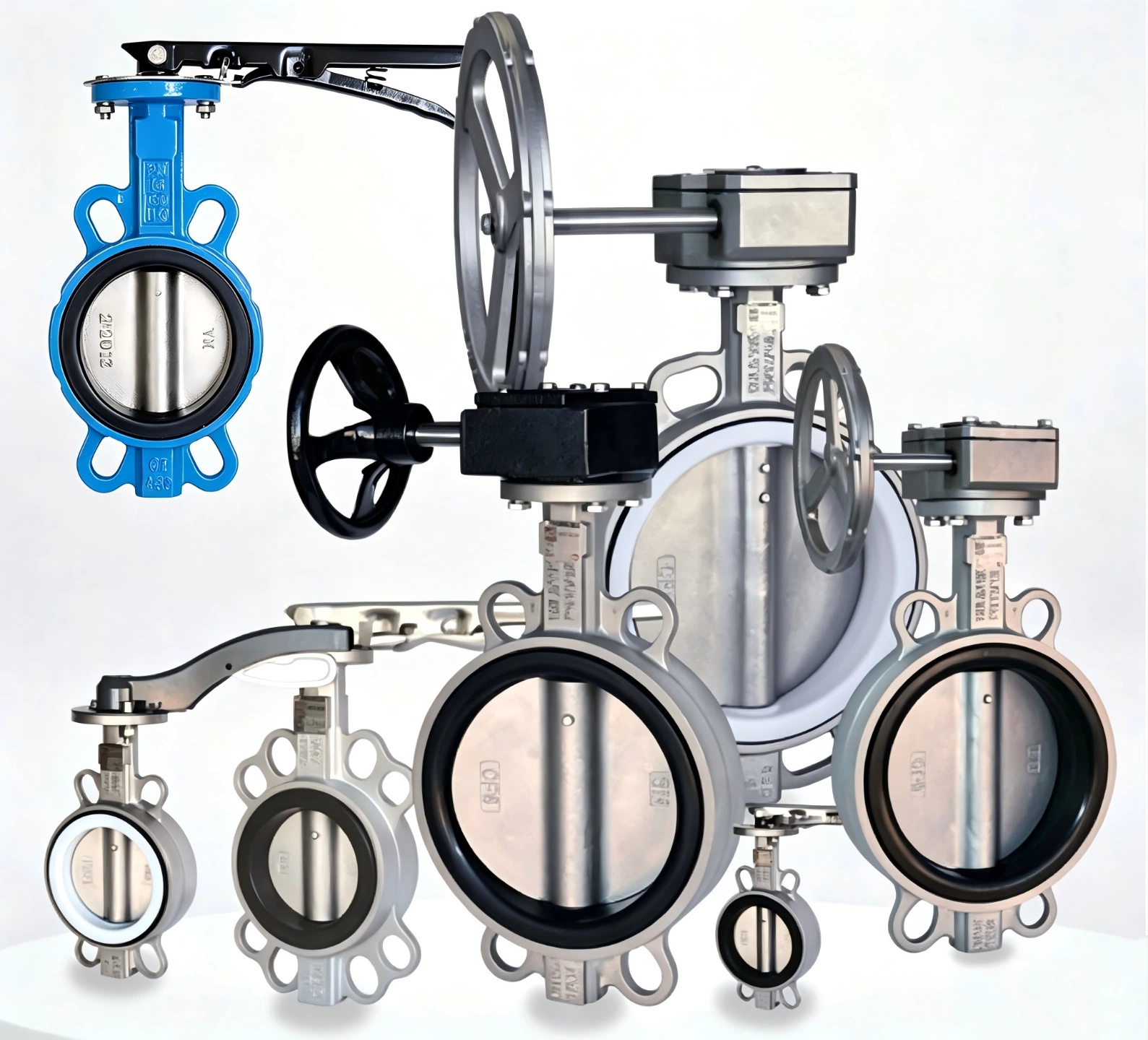
A wafer butterfly valve is the compact, lightweight version. It has no flanges of its own — it simply sits between two pipeline flanges, held together by long studs that go through the entire valve.
Key features:
- Short face-to-face dimension (saves space)
- Lightweight and low cost
- Installs between two flanges with through-bolts
- Can only be disconnected on both sides at the same time
2. What Is a Lug Butterfly Valve?
A lug butterfly valve has threaded inserts (lugs) around the flange face. This means you can bolt it to a pipeline flange from either side, independently.
Key features:
- Has threaded inserts for bolting on each side
- Can disconnect one side without disturbing the other
- Heavier and more expensive than wafer
- Bi-directional sealing (can shut off flow from either direction)
For high-duty process and automated applications, our flanged butterfly valve or pneumatic actuated wafer valve may be a better fit.
3. Side-by-Side Comparison
| Feature | Wafer Type | Lug Type |
|---|---|---|
| Installation | Between two flanges, through-bolts | Threaded inserts, bolted from each side |
| Can disconnect one side? | No — both sides must be disconnected | Yes — one side can be isolated |
| Weight | Lightest | ~20-30% heavier |
| Cost | Cheapest | ~30-50% more expensive |
| Pressure Rating | Up to PN16 / Class 150 | Up to PN25 / Class 150 |
| End-of-line service | Not allowed (will blow out) | Allowed (one side bolted only) |
| Bidirectional sealing | Limited (one direction bubble-tight) | Full (bi-directional bubble-tight) |
| Typical applications | HVAC, cooling towers, chilled water | Isolation shutoff, process, emergency shutoff |
International Standards Reference
| Standard Category | US / ANSI | European / EN | Japanese / JIS |
|---|---|---|---|
| Design | API 609 | EN 593 | JIS B2002 |
| Face-to-Face | API 609 / MSS SP-67 | EN 558-1 Series 20 (short) | JIS B2002 |
| Flange Compatibility | ASME B16.5 Class 125/150 | EN 1092-1 PN10/PN16/PN25 | JIS B2220 10K |
| Pressure Rating | ANSI Class 125–150 | PN10–PN25 | 10K |
| Testing | API 598 / ISO 5208 | EN 12266-1 | JIS B2003 |
| Seat Materials | EPDM / NBR / Viton / PTFE | EPDM / NBR / Viton / PTFE | EPDM / NBR / Viton / PTFE |
| Actuator Mounting | ISO 5211 | ISO 5211 | ISO 5211 |
Note: API 609 covers double-offset and triple-offset high-performance butterfly valves; EN 593 covers general industrial butterfly valves in wafer/lug style.
4. When to Use Wafer Type
Choose a wafer butterfly valve when:
- Cost is a top priority — wafer is the cheapest option
- Space is limited — wafer has the shortest face-to-face dimension
- Dead-end service — the valve won’t need to be disconnected while the system is running
- HVAC and general water — cooling towers, chilled water, building systems
- Low pressure — PN10/PN16 general industrial service
Common applications: pump discharge check valve protection, cooling water loops, HVAC chilled water, and Y-strainer isolation.
5. When to Use Lug Type
Choose a lug butterfly valve when:
- You need to isolate one side — for maintenance without shutting down the whole line
- Shutoff service — the valve is used for tight shutoff, not just throttling
- High pressure — PN25 or Class 150 with bi-directional sealing
- End of line service — the valve is at the end of a pipeline (wafer can’t be used here)
- Future maintenance is expected — lug valves are easier to remove and replace
6. Worked Example: Cooling Tower Selection
Let’s walk through a real selection problem from a district cooling project in Dubai, UAE.
Step 1 — Project data
Cooling tower circulation loop: DN200 (8″), flow rate 300 m³/h, pressure PN10, ambient temperature up to 50°C, fluid is treated cooling water.
Step 2 — Identify valve locations
Two valves are required on this loop: (a) inlet isolation valve at the cooling tower, and (b) discharge isolation valve at the chilled water pump.
Step 3 — Compare cost and function
Same size (DN200), same body (GGG40 ductile iron), same seat (EPDM):
• Wafer butterfly valve: lowest factory price, shortest face-to-face, but both sides must be disconnected to remove.
• Lug butterfly valve: roughly 30–50% higher price, ~20–30% heavier, but can be removed from one side while the other stays pressurized.
Step 4 — Selection decision
• Valve (a) — at the cooling tower inlet, where the tower side must remain pressurized during pump maintenance: choose lug. Through-bolt wafer would blow out if the pump side is opened.
• Valve (b) — at the pump discharge, where both sides can be drained for maintenance: choose wafer. Saves 30–50% on this valve without any functional loss.
Step 5 — Material and seat
Dubai ambient 50°C, treated water: ductile iron body + EPDM seat (rated to 120°C) is sufficient. No need for 316 stainless unless seawater is involved. For coastal Dubai installations, specify epoxy-coated body to prevent salt-spray rust within 2–3 years.
Budget logic: by mixing lug on critical isolation points with wafer on dead-end / drainable points, the contractor gets full maintenance flexibility on the tower side while cutting valve cost on the pump side — and the saving scales up directly across a multi-tower campus.
💡 Why District Cooling EPCs Choose Chuanglan
Wafer, lug and flanged butterfly valves from DN50 to DN1200 in stock
ISO 9001:2015 certified factory, 100% factory tested, EN 10204 3.1 MTC included
MOQ: 1 piece — sample valves for plant room mock-up before bulk EPC order
Not Sure Whether to Specify Wafer or Lug?
Send us your piping layout, pressure rating, and maintenance requirements — our engineers will recommend the right type with factory-direct pricing within 24 hours.
Get Free Sizing Report →7. Common Mistakes to Avoid
- Using wafer for end-of-line service: At the end of a pipeline, a wafer valve has no flange on one side — it will blow out. Use lug type here.
- Using wafer for high pressure: Wafer valves rely on the flange pressure to seal. At PN25+ or bi-directional shutoff service, lug type is safer.
- Ignoring maintenance needs: If you’ll need to remove the valve for maintenance while the line is running, spend the extra money on lug.
- Forgetting actuator mounting pad: If you plan to automate the valve later, make sure both wafer and lug versions come with an ISO 5211 mounting pad. We supply pre-assembled pneumatic wafer butterfly valves ready to install.
8. Southeast Asia & Middle East Market Notes
Butterfly valves are the workhorse of HVAC, water treatment and cooling systems across Southeast Asia and the Middle East. Two regional selection rules consistently drive spec decisions:
- Gulf district cooling (Dubai, Riyadh, Doha): District cooling networks use thousands of DN300–DN1200 lug butterfly valves in vaults and plant rooms. Lug is preferred because vaults are serviced frequently and the upstream loop must stay pressurized. Spec EPDM seats rated to 120°C for 50°C+ ambient heat.
- Southeast Asia palm oil and food plants (Indonesia, Malaysia, Thailand): Process lines often need sanitary or wash-down service. For these applications, specify sanitary butterfly valves with 316L body and EPDM or PTFE seats instead of industrial wafer types.
- Coastal salt spray: In Jakarta, Surabaya, Jeddah and Dubai coastal zones, ductile iron wafer valves will rust within 2-3 years unless epoxy-coated. Spec epoxy-coated bodies or CF8M (316) for coastal installations.
Chuanglan Valve supplies wafer, lug and flanged butterfly valves to EPC contractors, MEP consultants and pump OEMs across Southeast Asia and the Middle East, with MOQ starts at 1 piece and 7–15 day delivery from our Wenzhou factory.
Serving EPC Contractors Across Southeast Asia & Middle East · ISO 9001:2015 Certified · 15+ Years Factory Experience
FAQ
Can a wafer butterfly valve be used at the end of a pipeline?
No. A wafer valve relies on flanges on both sides to hold it in place. At the end of a line, one side is open and the pressure will push the valve out. Always use a lug type at the end of line.
Is a lug butterfly valve always better than wafer?
Not necessarily. Lug is 30-50% more expensive and heavier. For standard HVAC, cooling tower and dead-end service, a properly specified wafer valve works perfectly and saves budget.
What pressure rating is available for wafer vs lug butterfly valves?
Standard wafer types are rated PN16 (Class 150). Lug types are commonly available up to PN25 (Class 150) and sometimes PN40 for special orders. Above that, use flanged butterfly valves.
Can I use a wafer valve for bi-directional tight shutoff?
Standard wafer butterfly valves are bubble-tight in one direction only (the seat is held against one flange). For bi-directional tight shutoff, specify a lug type with a properly designed double-offset or triple-offset seat.
What face-to-face standard do wafer and lug butterfly valves follow?
Most wafer butterfly valves in our range follow EN 558-1 Series 20 (short face-to-face) and API 609. Lug types follow the same dimensions so they are interchangeable in the same piping.
How much more does a lug butterfly valve cost than the equivalent wafer?
Typically 30-50% more at factory level for the same size, body material and seat (e.g. DN200 GGG40 EPDM wafer vs lug). The lug is also about 20-30% heavier because of the threaded inserts. Exact ratio changes with size, pressure class and actuator options — send us your BOM for a precise quote.
Do you supply actuated wafer or lug butterfly valves?
Yes. We supply both wafer and lug butterfly valves pre-assembled with pneumatic or electric actuators, limit switches and solenoid valves, tested before shipment. MOQ is 1 unit.
References & Standards
- API 609: Butterfly Valves — Double-Offset, Triple-Offset, and Double-Eccentric
- EN 558-1: Industrial valves — Face-to-face and centre-to-face dimensions of metal valves
- EN 1074-2: Valves for water supply — Requirements and type tests (butterfly valves)
- AWWA C504: Standard for Rubber-Seated Butterfly Valves
- ISO 5211: Industrial valves — Part-turn actuator attachments
Related Products
Continue Reading
Request a Free Butterfly Valve Quote within 24 Hours
MOQ: 1 piece · ISO 9001:2015 certified · 3.1 MTC included · 100% factory pressure tested
Southeast Asia: Indonesia, Malaysia, Thailand, Vietnam, Singapore, Philippines, Myanmar
Middle East: Saudi Arabia, UAE, Qatar, Kuwait, Oman, Bahrain
Other Regions: Europe, North America, South America, Africa, Australia
Delivery: 5–10 days to Southeast Asia · 15–20 days to the Middle East · 25–35 days to Europe / the Americas
Payment: T/T 30% deposit + 70% before shipment · L/C at sight · Warranty: 12 months after shipment for material and manufacturing defects · Packing: export plywood case / fumigation-free pallet · Shipping: FOB Ningbo/Shanghai · Documents: EN 10204 3.1 MTC + packing list + commercial invoice · Third-party inspection welcome: SGS / Bureau Veritas / Intertek
Contact Our Engineers »Need a quote or datasheet? Tell us size, pressure class and material – reply within 24 hours.
Request a Quote