


Spring Check Valve vs Swing Check Valve 2026: Which Is Better for Your Pump?
The complete 2026 comparison — closing speed, water hammer, pressure drop, installation orientation, size range, and the decision tree for Southeast Asia and the Middle East EPC projects.
* Standard lead time depends on order quantity and destination country. 5–10 days to Southeast Asia, 15–20 days to the Middle East.
⚡ Quick Answer
Choose a swing check valve for horizontal, large-diameter (DN200+) constant-flow pipelines where low pressure drop and low cost matter most. Choose a spring-loaded check valve (wafer dual-plate, wafer single-plate, or lift) for pump discharge, vertical piping, fluctuating flow, and any service where water hammer has caused pipe or weld damage. Spring checks close in ~0.1 s vs ~1.5 s for swing, which is the single biggest difference for protecting pumps and headers.
🔑 Key Takeaways
- Closing speed: spring check closes in ~0.1 s; swing check takes ~1.5 s under gravity — that 1.4 s difference is what causes water hammer on pump trip.
- Orientation: swing check works horizontal only; spring check works in any orientation (horizontal, vertical up, vertical down).
- Pressure drop: swing check has low ΔP because the disc swings out of the flow path; spring check has higher ΔP due to spring resistance.
- Best size range: swing is cheaper and available up to DN1200+; spring checks are most cost-effective from DN25–DN600.
On This Page
1. How They Work
Check valves (non-return valves) prevent backflow in piping systems — they let flow go one way and close automatically if flow reverses. But there are two main families: spring-assisted check valves and swing check valves. They work differently, have different response times, and are best for different applications. As a valve manufacturer with 15+ years of export experience, we’ll break down the differences so you can choose the right check valve for your project.
Swing check valve: Uses a hinged disc that swings open when flow goes forward (like a door opening). When flow stops or reverses, the disc swings closed under its own weight (and backflow pressure). The hinge is on the top side of the valve body.
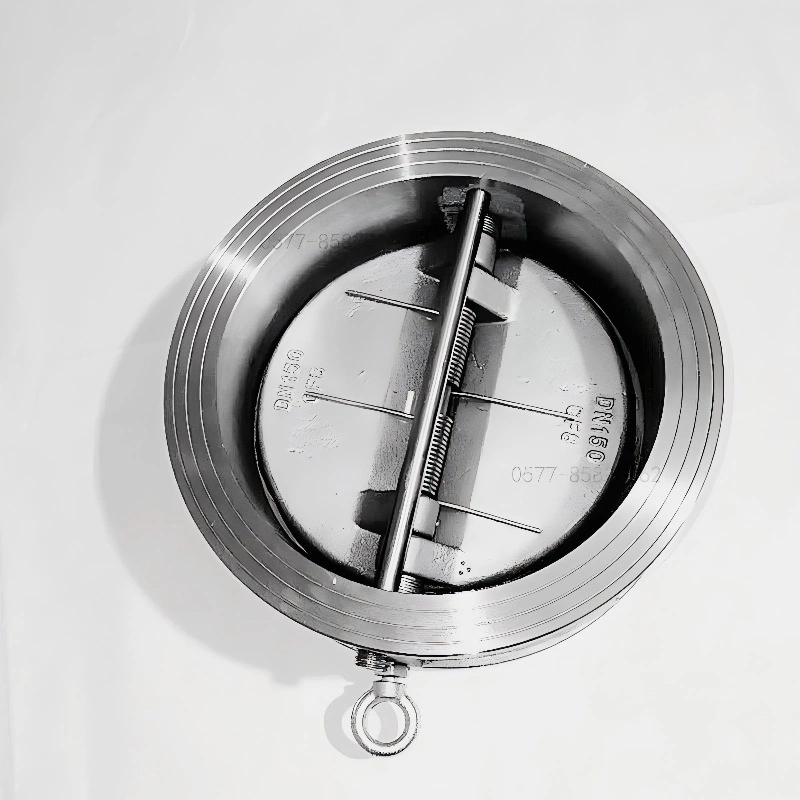
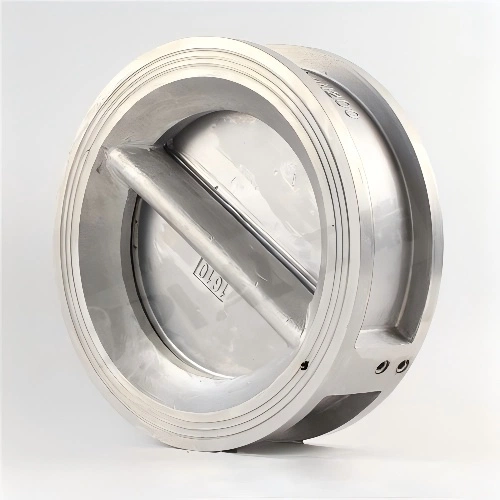
Spring check valve (lift / wafer / dual-plate): Uses a disc that’s held closed by a spring. When flow goes forward, the pressure pushes the disc up against the spring and opens. When flow stops, the spring pushes the disc back to close — much faster than gravity. Chuanglan’s wafer dual-plate check valves and wafer single-plate check valves are the most common spring-assisted designs.
2. Side-by-Side Comparison
| Feature | Swing Check Valve | Spring Check Valve (Lift / Wafer) |
|---|---|---|
| Closing speed | Slow (~1.5 s, gravity closes disc) | Fast (~0.1 s, spring closes immediately) |
| Pressure drop (fully open) | low (disc swings out of flow path) | Higher (spring resistance + disc in flow path) |
| Unit price | Lower | Higher (spring adds cost) |
| Installation orientation | Horizontal only | Any orientation (horizontal, vertical up/down) |
| Water hammer risk | High (slow closing) | Low (fast closing) |
| Typical max size | Up to DN1200 and larger | Most cost-effective DN25–DN600 |
| Shutoff tightness | Good (metal seat, minor leakage) | Better (soft seat option, tighter shutoff) |
| Low-flow performance | Poor (disc flutters at low flow) | Good (spring holds disc stable) |
3. When to Choose a Swing Check Valve
Choose a swing check valve if:
- You have horizontal piping (can’t install vertical)
- You need minimum pressure drop (fully open, disc out of the way)
- You have large line sizes (DN200 and up — swing is much cheaper per size)
- Flow is constant and steady (not fluctuating)
- Water hammer is not a major concern
- Cost is a priority
Typical applications: water pipelines and distribution, large-diameter transmission mains (DN250+), wastewater treatment plants, fire protection systems, general industry (low to medium pressure).
4. When to Choose a Spring Check Valve
Choose a spring check valve (wafer dual-plate, wafer single-plate, or lift) if:
- You have vertical piping (swing check won’t work vertical)
- Water hammer is a concern (fast closing minimizes it)
- Flow fluctuates (pumps turning on/off frequently)
- You need tight shutoff (soft seat option)
- You have small-to-medium sizes (up to DN300)
- Space is limited (wafer design is compact)
Typical applications: pump discharge (prevents backflow when pump stops), compressor discharge, vertical piping runs, HVAC chilled/condenser water, systems with water hammer problems, small-to-medium lines (DN25–DN200).
5. Worked Example: Raw Water Pump Station Retrofit (Johor Bahru, Malaysia)
Let’s walk through a real water pump station retrofit in Johor Bahru, Malaysia.
Step 1 — Problem
A 600 m³/h raw water pump station had 2 × DN200 horizontal centrifugal pumps. Each pump discharged through a swing check valve. When one pump stopped, the crew heard a loud “bang” every 15 minutes — and after 2 years, a weld on the discharge header cracked and leaked.
Step 2 — Diagnosis
Pressure trace showed a ~6 bar spike (from 4 bar operating up to 10 bar) every time the swing check closed. The slow-closing swing disc let a ~15 m water column reverse before slamming shut. That spike cracked the weld.
Step 3 — Retrofit
• Replaced 2 × DN200 flanged swing check valves with DN200 wafer dual-plate spring check valves
• Closing time dropped from ~1.5 s (swing) to ~0.1 s (dual-plate spring)
• Wafer style also came in at roughly 40% lower unit cost than the equivalent flanged swing check
• Added a small surge anticipator valve on the header for extra protection
Step 4 — Result after 6 months
• Pressure spike: from ~10 bar down to ~5 bar (within safe design range)
• Water hammer noise: completely gone
• No more weld cracks or pipe leaks
• Total retrofit cost was only a small fraction of the cost to replace the cracked discharge header — the valve change paid for itself in avoided downtime
💡 Why EPC Contractors Specify Check Valves with Chuanglan
Swing, lift, wafer single-plate and wafer dual-plate check valves in 304 / 316L, DN15–DN600, PN10–PN40 / Class 150–300
Metal seat and soft seat (PTFE / EPDM) options for water, chemical, oil and sanitary service
ISO 9001:2015 certified, 100% factory pressure tested, EN 10204 3.1 MTC, SGS / BV / Intertek inspection available
Need Help Choosing the Right Check Valve?
Send us your pipe size, pump flow, installation orientation and media — our engineers will recommend swing vs spring within 24 hours.
Get Free Sizing Report →6. Water Hammer: Why It Matters
Water hammer is the loud “bang” you hear when a valve closes suddenly. It’s caused by the momentum of flowing water suddenly stopping — it creates a pressure spike that can damage pipes, pumps, and fittings.
Swing check valve: Closes slowly (gravity swings the disc closed). When a pump stops, the water starts to flow backwards, and it takes time for the disc to swing closed. In that time, the water has already started moving backwards, then suddenly stops when the disc hits the seat — that’s water hammer.
Spring check valve: Closes fast (spring pushes disc closed immediately). As soon as flow drops below the spring force, the disc starts closing — before much backflow can happen. That minimizes water hammer dramatically.
Rule of thumb: If you have a pump that starts/stops frequently, or you hear banging noises in your pipes, use a spring check valve. If flow is constant (gravity flow, long transmission mains), swing check is fine.
7. Installation Orientation
| Valve Type | Horizontal | Vertical (Flow Up) | Vertical (Flow Down) |
|---|---|---|---|
| Swing Check | Yes (disc hangs down) | No (disc hangs open) | No |
| Lift Check (gravity) | Yes | Yes (flow lifts, gravity closes) | No (gravity keeps open) |
| Spring Check (wafer) | Yes | Yes (spring closes) | Yes (spring closes) |
Important: If you need to install a check valve vertically (any direction), you must use a spring-loaded check valve. Swing check valves only work horizontal.
8. Common Mistakes
Mistake 1: Using a swing check valve on vertical piping. Swing check valves rely on gravity to close — if you install them vertically, the disc will hang open and never close. Use a spring check valve for vertical installation.
Mistake 2: Using a swing check valve on pump discharge. When a pump stops, swing check closes slowly — water hammer can knock the pipes loose. Use a spring check valve on pump discharge.
Mistake 3: Forgetting about pressure drop. Spring check valves have higher pressure drop because of the spring resistance. For low-flow systems or weak pumps, a spring check valve might not open fully. For low-flow systems, use a swing check valve.
Mistake 4: Installing backwards. All check valves have flow direction — look for the arrow on the valve body pointing in the direction of flow. Installing backwards = no shutoff.
9. Southeast Asia & Middle East Market Notes
For clients in Southeast Asia (Malaysia, Indonesia, Thailand, Vietnam, Philippines) working on water treatment, palm oil mills and HVAC systems, spring-loaded wafer dual-plate check valves are the default on pump discharge lines. Malaysian water treatment plants in Johor and Selangor commonly specify DN50–DN300 wafer dual-plate check valves in 304/316 stainless, flanged or wafer end. Thai HVAC and chilled water systems prefer wafer single-plate for compactness.
For clients in the Middle East (Saudi Arabia, UAE, Qatar, Kuwait, Oman) working on large water transmission pipelines, power plant cooling water and oil & gas, swing check valves still dominate for DN300+ due to lower cost and low pressure drop. However, on pump discharge (especially large multi-pump stations), spring-loaded dual-plate check valves are increasingly specified to protect against water hammer — Saudi Electricity Company and SEC cooling water projects often require this.
Chuanglan Valve supplies both flanged swing check valves, wafer dual-plate check valves, wafer single-plate check valves and flanged lift check valves in 304/316L, PN10–PN40, Class 150/300. Serving EPC Contractors Across Southeast Asia & Middle East · ISO 9001:2015 Certified · 15+ Years Factory Experience · MOQ starts at 1 piece.
FAQ
Can a swing check valve be installed vertically?
No. Swing check valves rely on gravity to close the disc. On vertical piping the disc will hang open and never close — you must use a spring-loaded wafer or lift check valve instead.
Which check valve is best for pump discharge?
A spring-loaded dual-plate wafer check valve is the standard choice. It closes in ~0.1 seconds, preventing backflow and water hammer when the pump trips. Swing check valves are acceptable only on large, constant-flow pump stations where water hammer is controlled by other means.
What is the pressure drop across a wafer check valve?
Typical ΔP across a fully open wafer dual-plate check valve is 0.05–0.2 bar (0.7–3 PSI) depending on size and flow velocity. Swing check valves have lower ΔP (~0.02–0.1 bar) because the disc swings fully out of the flow path.
Are dual-plate check valves better than single-plate?
Dual-plate (double-door) check valves close faster and handle larger sizes with less water hammer. Single-plate (single-door) is lighter and cheaper for small sizes (DN50–DN150). For DN200 and above, dual-plate is standard.
Can I use a check valve on steam service?
Yes, but specify metal seats (stainless disc on 316 seat) — soft PTFE seats fail at steam temperatures. For steam, prefer lift check valves or dual-plate with stainless trim, rated for the steam temperature.
How do I know which way to install a check valve?
Every check valve body has a cast or stamped arrow. The arrow points in the direction of allowed flow (from pump side toward the system). If you can’t find the arrow, open the valve — gravity or spring will show which way the disc closes.
What is the lead time for check valves from Chuanglan?
Standard 304/316L wafer dual-plate and swing check valves (DN25–DN300, PN16/Class 150) are in stock and ship in 7–15 days. Larger sizes (DN350+) and higher pressure ratings take 15–30 days.
References & Standards
- ASME B16.34: Valves — Flanged, Threaded, and Welding End
- API 594: Check Valves — Flanged, Threaded, and Wafer Style
- AWWA C508: Control Valve for Waterworks Service
- EN 12266-1: Industrial valves — pressure testing
- EN 10204 3.1: Metallic products — inspection documents (MTC)
Related Products
Continue Reading
Get a Quote for Your Check Valve Project
MOQ: 1 piece · ISO 9001:2015 certified · 3.1 MTC included · 100% factory pressure tested
Southeast Asia: Indonesia, Malaysia, Thailand, Vietnam, Singapore, Philippines
Middle East: Saudi Arabia, UAE, Qatar, Kuwait, Oman, Bahrain
Other Regions: Europe, North America, South America, Africa, Australia
Delivery: 5–10 days to Southeast Asia · 15–20 days to the Middle East · 25–35 days to Europe / the Americas
Payment: T/T 30% deposit + 70% before shipment · L/C at sight · Warranty: 12 months after shipment for material and manufacturing defects · Packing: export plywood case / fumigation-free pallet · Shipping: FOB Ningbo/Shanghai · Documents: EN 10204 3.1 MTC + packing list + commercial invoice · Third-party inspection welcome: SGS / Bureau Veritas / Intertek
Get Free Quote »Need a quote or datasheet? Tell us size, pressure class and material – reply within 24 hours.
Request a Quote