

Wafer Check Valve vs Swing Check Valve (2026 Guide)
Size, pressure drop, installation orientation, cost and lifespan comparison. Complete 2026 guide with worked example for cooling water and oil systems.
* Standard lead time depends on order quantity and destination country. 5-10 days to Southeast Asia, 15-20 days to Middle East.
⚡ Quick Answer
Choose a wafer dual-plate check valve for tight spaces (up to 1/3 the face-to-face length), fast closure (0.05-0.1s) and vertical installation.
Choose a swing check valve for large pipes (DN300+), low pressure drop (0.03-0.08 bar) and 10-15 year service life. For a DN150 cooling water loop at 180 m³/h with limited pump-room space, a 316L wafer check valve is the right pick.
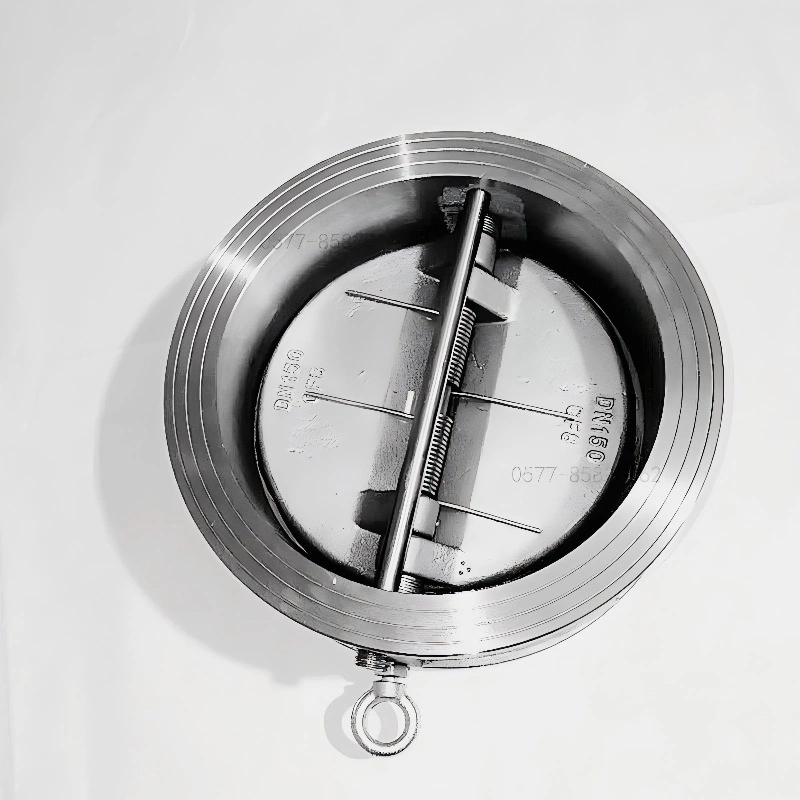
This guide compares wafer check valves and swing check valves — the two most common automatic backflow prevention valves in industrial piping. Both prevent reverse flow, but they differ in size, pressure drop, installation orientation and cost. We manufacture stainless steel wafer check valves in sizes DN15–DN300, 304/316L body, PN10–PN16. For upstream protection, we also supply y-strainers and wafer butterfly valves for isolation.
On This Page
How Each Check Valve Works
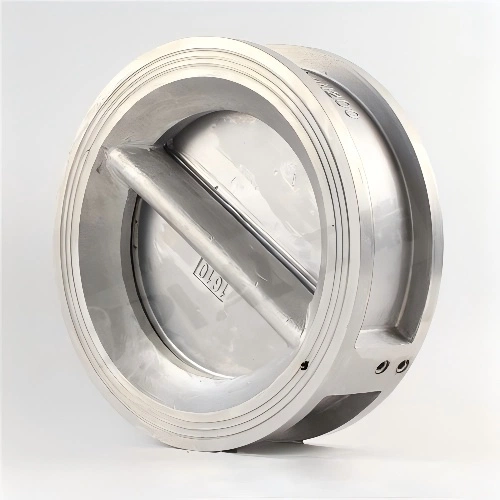
Wafer check valve: Two spring-loaded discs pivot in opposite directions. When flow pushes forward, both discs open against the spring. When flow stops or reverses, the spring closes the discs instantly — typically within 0.05–0.1 seconds, preventing water hammer.
Swing check valve: A single disc hinged at the top swings open like a door. Forward flow pushes the disc fully open; reverse flow pushes it back against the seat. Closure is slower (0.3–0.8 seconds) and depends on gravity and reverse flow velocity.
Size and Face-to-Face Comparison
The biggest physical difference is face-to-face length. Wafer check valves are designed to fit between two flanges with no bolt holes of their own, making them 1/3 the length of a swing check valve.
| Feature | Wafer Check Valve | Swing Check Valve |
|---|---|---|
| Face-to-face length | Short (1/3 of swing) | Long |
| Connection style | Wafer (between flanges) | Flanged ends |
| Size range | DN15–DN300 (1/2″–12″) | DN25–DN600+ |
| Pressure rating | PN10 / PN16 | PN16 / PN40 |
| Closure speed | Fast (0.05–0.1s) | Slow (0.3–0.8s) |
| Weight per DN100 | 3–5 kg | 8–12 kg |
International Standards Reference
| Standard Category | US / ANSI | European / EN | Japanese / JIS |
|---|---|---|---|
| Design | API 594 | EN 12334 | — |
| Face-to-Face | ASME B16.10 | EN 558 / ISO 5752 | JIS B2002 |
| Flange | ASME B16.5 (Class 150/300) | EN 1092-1 (PN10/16/25/40) | JIS B2220 (10K/20K) |
| Pressure Rating | ANSI Class 150–600 | PN10–PN40 | 10K–20K |
| Testing | API 598 / API 6D | EN 12266-1 | JIS B2003 |
| Fire Safe | API 607 / API 6FA | ISO 10497 | — |
| Waterworks | AWWA C508 | EN 12334 | — |
Note: ANSI Class and PN ratings are not directly interchangeable — always verify pressure-temperature rating tables. Our check valves are manufactured to meet all three standards above.
Pressure Drop and Flow Efficiency
Wafer check valve: Higher pressure drop because the spring-loaded discs partially restrict flow even when fully open. Typical ΔP at design flow: 0.1–0.3 bar. For large pipelines, this adds pumping energy cost over time.
Swing check valve: Lower pressure drop because the disc swings fully out of the flow path. Typical ΔP: 0.03–0.08 bar. For DN300+ cooling water lines in power plants, this 0.2 bar difference can save thousands of dollars in pumping energy annually.
✅ Swing wins for large, high-flow pipes where energy efficiency matters. Wafer check valves are fine for small to medium lines (DN15–DN150) where ΔP is negligible.
Installation Orientation
Wafer check valve: Works in horizontal, vertical (upflow), or even tilted installations. The spring-assisted closure works regardless of gravity. This makes wafer check valves ideal for tight pump rooms, vertical risers and offshore skids.
Swing check valve: Must be installed horizontally with the hinge pin on top. Vertical installation only works for specific tilting-disc designs and is not recommended for standard swing checks — gravity won’t close the disc reliably.
✅ Wafer wins for space-constrained or vertical piping.
Cost and Lifespan Comparison
| Factor | Wafer Check Valve | Swing Check Valve |
|---|---|---|
| Unit cost (DN100, 316L) | ~30–50% lower than swing | Baseline (higher upfront) |
| Installation cost | Low (lightweight, 1 person) | Higher (heavy, crane support) |
| Maintenance | Seat replacement only | Hinge pin + seat + disc |
| Typical lifespan | 5–8 years | 10–15 years |
Worked Example: Cooling Water System
Problem: A cooling water system in Jakarta, Indonesia. Design flow 180 m³/h, pipe DN150, pressure 8 bar, water 30°C, space in pump room is tight. Need backflow prevention between pump and heat exchanger.
Step 1: Calculate velocity
Pipe area = π × (0.15/2)² = 0.0177 m²
Velocity = 180 m³/h ÷ 3600 s/h ÷ 0.0177 m² = 2.83 m/s
✅ Acceptable for cooling water (optimum 1.5–3.0 m/s).
Step 2: Estimate pressure drop
Wafer check ΔP ≈ 0.15 bar at 2.83 m/s — acceptable.
Swing check ΔP ≈ 0.05 bar — slightly better, but space is tight.
Step 3: Choose type
Space is tight in pump room → wafer style preferred (short face-to-face).
ΔP acceptable (0.15 bar across wafer check) → spring wafer OK.
Cost sensitive → wafer is ~40% lower upfront than swing.
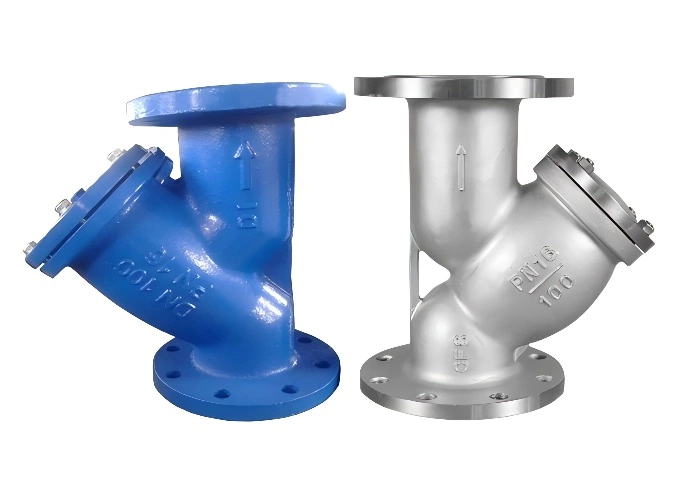
Result: Select DN150 PN16 wafer check valve, 316L body, 316 discs, EPDM seat. Lower upfront cost and lighter one-person install. Add a y-strainer upstream to protect the seat from debris.
💡 Why Engineers Choose Chuanglan
✅ 15+ years OEM/ODM for European & Southeast Asian distributors
✅ 304/316L body material, ISO 9001:2015 certified factory, 100% factory pressure tested
✅ MOQ: 1 piece — small trial orders welcome
Not Sure Which Check Valve Fits Your System?
Send us your pipe size, flow rate and installation orientation — we’ll recommend the right valve, free.
Get Free Sizing Report →Southeast Asia & Middle East Applications
We export wafer check valves and swing check valves to Southeast Asia and Middle East markets:
- Indonesia & Malaysia palm oil mills: Wafer check valves on cooling water pumps — compact, cheap and easy to install in tight pump rooms.
- Thailand & Vietnam food processing: Wafer check valves on CIP return lines — easy to install vertically, 316L resists cleaning chemicals.
- UAE & Saudi Arabia desalination plants: Swing check valves on large seawater lines (DN300+) — low pressure drop is critical for high-volume systems.
- Qatar, Kuwait, Oman, Bahrain: Swing check valves on EPC projects — long 10–15 year lifespan reduces maintenance shutdowns.
Serving EPC Contractors Across SEA & Middle East · ISO 9001:2015 Certified · 15+ Years Factory Experience
FAQ
Can I install a wafer check valve vertically?
Yes. Wafer check valves work in any orientation because spring-assisted closure doesn’t rely on gravity. Swing check valves must be installed horizontally with the hinge on top.
Which has lower pressure drop — wafer or swing check valve?
Swing check valves. The disc swings fully out of the flow path, while wafer discs partially restrict flow even when open. For large pipes, this 0.2 bar difference matters.
Is a wafer check valve cheaper than swing?
Yes, typically 30–50% cheaper for the same size. They are also lighter and faster to install, reducing labor cost.
Which type lasts longer?
Swing check valves (10–15 years) outlast wafer check valves (5–8 years) because they have simpler moving parts and no spring fatigue over time.
Can I use a wafer check valve for steam?
Not with standard EPDM seat. Wafer check valves with EPDM seats are for water and oil service up to 120°C. For steam above 150°C, use a swing check valve with metal seat.
What size range do wafer check valves cover?
DN15 to DN300 (1/2″ to 12″). Above DN300, swing check valves are more economical and have lower pressure drop.
References & Standards
- API 594: Check Valves — Butterfly, Double Plate, Swing, Wafer, and Lug Type
- EN 12334: Industrial valves — Cast iron check valves
- AWWA C508: Standard for Swing Check Valves for Waterworks Service
- MSS SP-71: Stainless Steel Check Valves (Flanged, Threaded, and Welding Ends)
- ISO 5752: Metal valves for use in flanged pipe systems — Face-to-face and centre-to-face dimensions
Related Products
Continue Reading
Request a Free Check Valve Quote within 24 Hours
Send us your pipe size, flow rate, fluid type and installation orientation — we will reply with factory direct pricing.
Southeast Asia: Indonesia, Malaysia, Thailand, Vietnam, Philippines, Myanmar
Middle East: Saudi Arabia, UAE, Qatar, Kuwait, Oman, Bahrain
Other Regions: Europe, North America, South America, Africa, Australia — 20+ countries total
🚢 Delivery: 5-10 days to Southeast Asia · 15-20 days to Middle East · 25-35 days to Europe / Americas
Contact Our Engineers →Need a quote or datasheet? Tell us size, pressure class and material – reply within 24 hours.
Request a Quote