

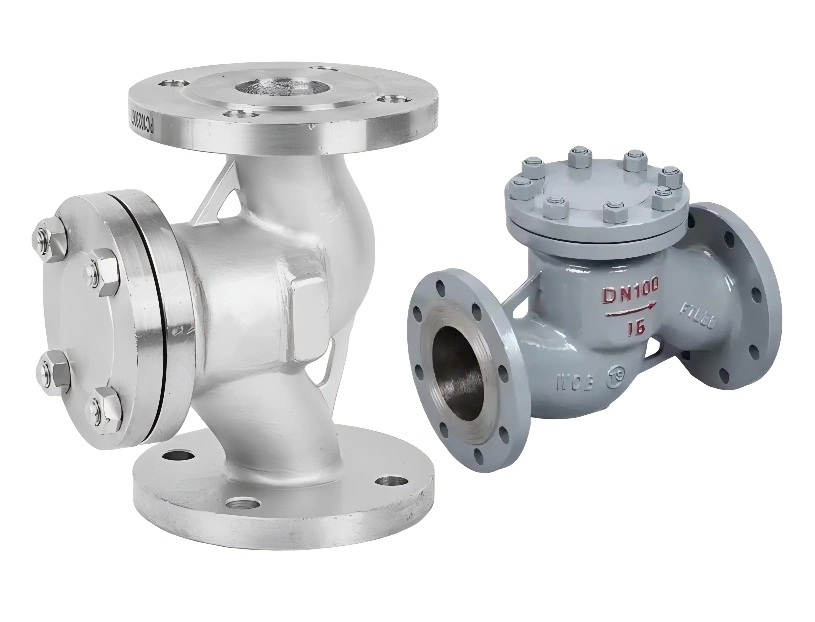
A swing check valve automatically allows flow in one direction only and stops backflow on pump discharge lines, header isolation, steam systems and water treatment plants. Its hinge-pin disc swings open under forward pressure and closes on reverse flow — preventing water hammer and protecting pumps downstream.
Chuanglan manufactures flanged swing check valves in CF8M (316) and CF8 (304) stainless steel as standard range. WCB carbon steel, ductile iron (GGG50) and cast iron (GG25) are available for non-corrosive service. Sizes DN20–DN600 (NPS 3/4″–24″), flanged ends per DIN EN 1092-1 PN16 / ANSI B16.5 Class 150 / JIS 10K. For compact pump discharge, compare our wafer dual plate check valve; for vertical installation, see our lift check valve.
The main advantage of a swing check valve over lift check valves is lower pressure drop and higher flow capacity. Because the disc swings fully out of the flow path, the swing check creates minimal resistance to forward flow — ideal for large-bore water, wastewater and oil pipelines. The swing design also handles slurries and dirty fluids better than lift types, which can jam on particulates. We directly serve EPC contractors and valve distributors in Southeast Asia (Indonesia, Malaysia, Thailand, Vietnam) and the Middle East (Saudi Arabia, UAE, Qatar, Kuwait).
When selecting a swing check valve, consider: size (DN20–DN600), pressure rating (PN16 / PN40 / ANSI 150#–300#), body material (ductile iron for water, WCB for oil/gas, CF8M for corrosive service), installation orientation (horizontal preferred; vertical requires upward flow), disc material (SS316 standard, PTFE/NBR soft seat for bubble-tight shutoff), and options (lever & weight for controlled closure, spring assist for faster closure). Always install a Y-strainer upstream of the pump to protect the check valve seat from debris; pair with a ball valve for isolation on the same line.
Southeast Asia & Middle East Market Notes
Vietnam / Thailand municipal water & wastewater: Ductile iron GGG50 body, PN16 DIN flanges, epoxy coating — standard for pump discharge and trunk mains. Lever & weight option for large DN400+ lines to prevent slam on pump trip.
Indonesia / Malaysia palm oil & chemical: CF8M (316) body, PTFE soft seat — handles CPO and acidic effluent. Y-type body option for low pressure drop on viscous crude palm oil lines.
Saudi Arabia / UAE desalination & oil & gas: CF8M body for coastal chloride environments, ANSI 150# flanges — used on SWRO pre-treatment, brine discharge and pump skids. PTFE soft seat specified for tight shutoff on hydrocarbon service.
Not sure whether you need swing, lift, dual-plate or wafer check valve? Send us your pump flow rate and line size.
Get Free Sizing Report →Swing vs Lift vs Dual-Plate Check Valve
| Feature | Swing Check | Lift Check | Dual-Plate (Wafer) Check |
|---|---|---|---|
| Closure speed | Slow (disc swings) | Fast | Fastest (two plates spring-loaded) |
| Pressure drop | Lowest | High | Medium |
| Water hammer | High risk (slam) | Medium | Lowest |
| Face-to-face | Long (API 6D) | Medium | Very short (wafer) |
| Handles slurries | Yes (disc fully opens) | No (piston jams) | Limited |
| Orientation | Horizontal only | Horizontal / vertical up | Any orientation |
| Best for | Large water, oil, slurry lines | Small high-pressure lines, vertical | Pump discharge, compact installations |
| Our product | Swing Check | Lift Check | Dual-Plate |
Technical Specifications
| Size Range | DN20 – DN600 (NPS 3/4″ – 24″) |
| End Connection | Flanged RF, DIN EN 1092-1 PN16 / ANSI B16.5 Class 150 / JIS 10K |
| Body Material | CF8M (316) / CF8 (304) — premium; WCB / GGG50 / GG25 on request |
| Disc | SS316 / SS420, PTFE or NBR gasket face option |
| Hinge Pin | SS304 / SS316 |
| Pressure Rating | PN16 / ANSI 150# (PN40 / ANSI 300# on request) |
| Temperature Range | -29°C ~ +425°C (WCB) / -196°C ~ +538°C (CF8M) |
| Applicable Media | Water, oil, gas, steam, chemical, pump discharge lines |
| Testing | shell & seat pressure test per API 594 |
| Material Certificates | EN 10204 3.1 MTC (material test reports) included |
| Standard | API 6D, API 594, BS 1868 |
| Options | Lever & weight, spring assist, PTFE soft seat, flanged cap |
Dimension Table — DIN EN 1092-1 PN16 (mm)
L = face-to-face per API 6D / BS 1868 long pattern. D = flange OD, K = bolt circle, d = raised face, n-ΦL = bolt holes. H = body height reference.
| DN | L | D (OD) | K (Bolt Circle) | d (Raised Face) | c (Thickness) | n-ΦL | H |
|---|---|---|---|---|---|---|---|
| 20 | 150 | 105 | 75 | 58 | 14 | 4-Φ14 | 100 |
| 25 | 160 | 115 | 85 | 68 | 14 | 4-Φ14 | 100 |
| 32 | 180 | 140 | 100 | 78 | 14 | 4-Φ18 | 105 |
| 40 | 200 | 150 | 110 | 88 | 15 | 4-Φ18 | 115 |
| 50 | 230 | 165 | 125 | 102 | 16 | 4-Φ18 | 135 |
| 65 | 290 | 185 | 145 | 122 | 16 | 4-Φ18 | 140 |
| 80 | 310 | 200 | 160 | 138 | 18 | 8-Φ18 | 145 |
| 100 | 350 | 220 | 180 | 158 | 19 | 8-Φ18 | 165 |
| 125 | 400 | 250 | 210 | 188 | 20 | 8-Φ18 | 250 |
| 150 | 480 | 285 | 240 | 212 | 22 | 8-Φ22 | 295 |
| 200 | 550 | 340 | 295 | 268 | 24 | 12-Φ22 | 315 |
| 250 | 650 | 400 | 355 | 320 | 28 | 12-Φ26 | 430 |
| 300 | 750 | 455 | 410 | 370 | 28 | 16-Φ26 | 480 |
| 350 | 850 | 520 | 470 | 430 | 30 | 16-Φ26 | 500 |
| 400 | 950 | 580 | 525 | 485 | 32 | 16-Φ30 | 520 |
| 450 | 1050 | 640 | 585 | 545 | 36 | 20-Φ30 | 580 |
| 500 | 1150 | 705 | 650 | 608 | 40 | 20-Φ33 | 630 |
| 600 | 1350 | 840 | 770 | 718 | 44 | 20-Φ36 | 780 |
* ANSI Class 150 / JIS 10K drilled flanges available on request. DN700–DN1200 manufactured to order for large water transmission projects.
Worked Example: Selecting a DN300 Swing Check Valve for a Pump Station
Project: Raw water pump station discharging to a 2 km rising main in Hanoi, Vietnam.
Given: DN300 (12″) discharge line, Q = 1800 m³/h, water at 25°C, PN16 DIN flanges, pump trips can cause severe water hammer.
Step 1 — Confirm velocity:
Pipe area A = π × (0.3/2)² = 0.0707 m². Velocity v = 1800 / (3600 × 0.0707) = 7.07 m/s — high for raw water (recommended 1.5–3.0 m/s). This high velocity will slam the disc on pump trip. A dual-plate check or swing check with lever & weight is essential.
Step 2 — Body material selection:
Raw river water (non-corrosive) — ductile iron GGG50 body with epoxy coating is sufficient and most economical. CF8M not needed unless chlorinated.
Step 3 — Closure mechanism:
Because velocity is high (7 m/s) and line is long (2 km), standard swing check will slam. Specify swing check with lever & weight — the weight slows disc closure, cushioning the reverse flow. Alternatively, specify a dual-plate check valve which closes in 0.1–0.2 seconds.
Step 4 — Flange standard:
End user specified DIN EN 1092-1 PN16: D=455 mm, K=410 mm, 16×Φ26 bolt holes, raised face d=370 mm. Face-to-face L=750 mm per API 6D long pattern.
4 Common Mistakes When Selecting Check Valves
Mistake 1 — Installing swing check vertically: Swing check discs rely on gravity to close. Vertical installation with upward flow causes the disc to hang open and not seal. For vertical lines, use a lift check or dual-plate check.
Mistake 2 — Ignoring water hammer on long rising mains: A standard swing check slams shut on pump trip, generating pressure surges that rupture pipes. For high-velocity (>3 m/s) or long lines, specify lever & weight, spring assist, or a dual-plate check valve.
Mistake 3 — Using metal seat for gas / vacuum service: Metal-to-metal seats leak slightly. For gas, vacuum or hydrocarbon service, specify PTFE or NBR soft seat for bubble-tight shutoff per API 594.
Mistake 4 — Installing check valve backwards (flow arrow): Every check valve has a cast flow arrow on the body. Installing backwards means the disc cannot open and the line is blocked. Always verify the arrow direction before installation.
Need Sizing Help or a Quote?
Send size (DN), pressure (PN/ANSI), material (304/316L), seat (EPDM/Viton) and quantity — we reply within 24 hours.
Get Free Quote »Applications
Water & Wastewater: Pump discharge, trunk mains, water treatment plants.
Oil & Gas: Refineries, gathering stations, pipeline headers.
Power: Cooling water, condensate, boiler feed protection.
Marine & Desalination: Bilge, ballast, SWRO pre-treatment and brine lines.
Commercial Terms & Shipping
Payment: T/T 30% deposit + 70% before shipment; L/C at sight accepted for orders above USD 20,000. PayPal for sample orders.
Warranty: 12 months after shipment for material and manufacturing defects. Covers casting defects, seal leakage and material non-conformance. Damage from misuse, improper installation or corrosion beyond specified limits is not covered.
Packaging: Export plywood case (fumigation-free) or seaworthy pallet. Suitable for FCL container and LCL consolidation. Large DN400+ valves on wooden skids.
Shipping Documents: EN 10204 3.1 MTC, pressure test certificate, packing list, commercial invoice. Certificate of origin and BL available on request.
Shipment Port: FOB Ningbo / Shanghai, China. Can also arrange CIF / DAP to your destination port.
Third-Party Inspection: SGS, Bureau Veritas or Intertek pre-shipment inspection supported at your cost.
FAQ
Swing check valve or dual plate check valve — which one should I choose?
Swing check valves have lower pressure drop and handle slurries/dirty fluids better — best for large-bore water, wastewater and oil pipelines. Dual plate (wafer) check valves are compact (short face-to-face), close faster and reduce water hammer — ideal for pump discharge and tight installations.
Can a swing check valve be installed vertically?
Swing check valves are designed for horizontal installation. On vertical pipe, the disc must lift against gravity — this only works reliably when flow is upward and the line size is large. For vertical service, choose a lift check or dual plate check valve.
What is water hammer and how does a check valve prevent it?
Water hammer is the pressure surge caused by sudden flow reversal when a pump trips. A swing check valve closes automatically on reverse flow, isolating the pump. For severe hammer, add a lever & weight, spring assist, or choose a dual plate check valve which closes much faster.
What is the difference between lift check and swing check valves?
Lift check valves use a piston that moves vertically along guides — they close faster and can be used on vertical lines, but have higher pressure drop and jam easily on dirty fluids. Swing check valves swing on a hinge pin — lower pressure drop, handle slurries, but must be horizontal.
Do you offer PTFE/NBR soft seat for tight shutoff (bubble-tight)?
Yes. Standard metal-to-metal seats are for general service. We can fit a PTFE or NBR gasket face on the disc for bubble-tight shutoff per API 594, commonly used for gas, oil and vacuum service.
What is lever & weight / spring assist closure?
Lever & weight adds a weighted arm on the hinge pin to slow disc closure and prevent slam on high-velocity lines. Spring assist adds a stainless spring to close the disc faster. Both are recommended for pump discharge on long rising mains.
What is the maximum size and delivery time?
Standard production range is DN20–DN600 (up to 24″). We can manufacture DN700–DN1200 (28″–48″) to order for large water transmission projects. Standard sizes ship in 7–15 days; large or special material (CF8M, PN40) takes 15–30 days.
What is the warranty period for your valves?
We provide a 12-month warranty after shipment for material and manufacturing defects. This covers casting defects, seal leakage and material non-conformance. Damage from misuse, improper installation or corrosion beyond specified limits is not covered.
📚 Further reading:
• Wafer Check Valve vs Swing Check Valve (2026 Guide)
• Butterfly Valve Selection Guide (Size, Pressure, Material)
• How to Select a Wafer Butterfly Valve for Seawater Service
You May Also Need
Related Technical Guides
Spring vs Swing Check Valve · Swing Check Valve Guide · Types of Check Valves
Request a Quote for This Swing Check Valve
Tell us the size, pressure and quantity you need. We reply within one working day.