


What Is a Wafer Check Valve? 2026 Guide — Working Principle, Types & Applications
A quick engineering introduction to wafer check valves — how they prevent backflow without power, single-plate vs dual-plate vs PTFE-sealed types, typical applications, and what to specify for water treatment, HVAC and chemical lines in Southeast Asia and the Middle East projects.
* Standard lead time depends on order quantity and destination country. 5–10 days to Southeast Asia, 15–20 days to the Middle East.
⚡ Quick Answer
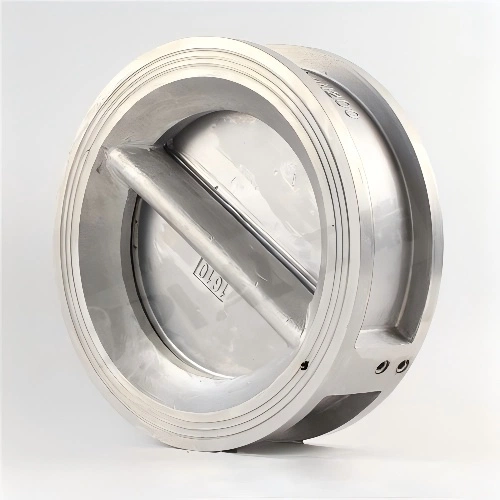
A wafer check valve is a compact automatic backflow prevention valve that fits between two flanges. It opens when inlet pressure exceeds outlet pressure and closes in milliseconds when flow reverses — no external power, no manual operation. Choose single-plate for low-pressure water/oil, dual-plate for high-pressure large-diameter industrial lines, and PTFE/silicone-sealed for food/pharmaceutical sanitary service. Body material: 304 (CF8) for general water/HVAC, 316L (CF8M) for seawater, chemical and coastal service.
🔑 Key Takeaways
- No power, no handwheel: wafer check valves close automatically in milliseconds under spring or swing weight — they protect pumps from reverse flow and water hammer.
- Wafer body = shortest face-to-face: fits between two flanges, ideal for tight spaces where a swing check or lift check will not physically fit.
- Pick the plate style by pressure and size: single-plate for DN25–DN200 low-pressure water/oil; dual-plate for DN150–DN600 high-pressure industrial lines.
- Seawater / coastal service = 316L (CF8M): cast iron and 304 pit within 2–3 years in Jakarta, Surabaya, Jeddah or Dubai salt spray.
On This Page
1. What Is a Wafer Check Valve?
A wafer check valve is a compact, cost-effective automatic valve that prevents backflow in piping systems, allowing fluid to flow in only one direction. Unlike swing check valves, its wafer-style body fits tightly between two pipe flanges, making it ideal for tight-space installations in industrial, water treatment and HVAC systems.
2. How Does a Wafer Check Valve Work?
Wafer check valves operate without external power:
- When inlet pressure exceeds outlet pressure, the internal disc lifts off the seat, opening the flow path.
- When flow stops or reverse pressure occurs, the disc immediately swings/closes back to the seat under spring force or weight, stopping backflow in milliseconds.
- No manual operation is required — protecting pumps and piping from water hammer and reverse flow damage.
3. Common Types of Wafer Check Valves
| Type | Best For | Typical Size Range |
|---|---|---|
| Single-plate (single door) | Low-pressure water and oil systems, light weight, fast closing | DN25–DN200 |
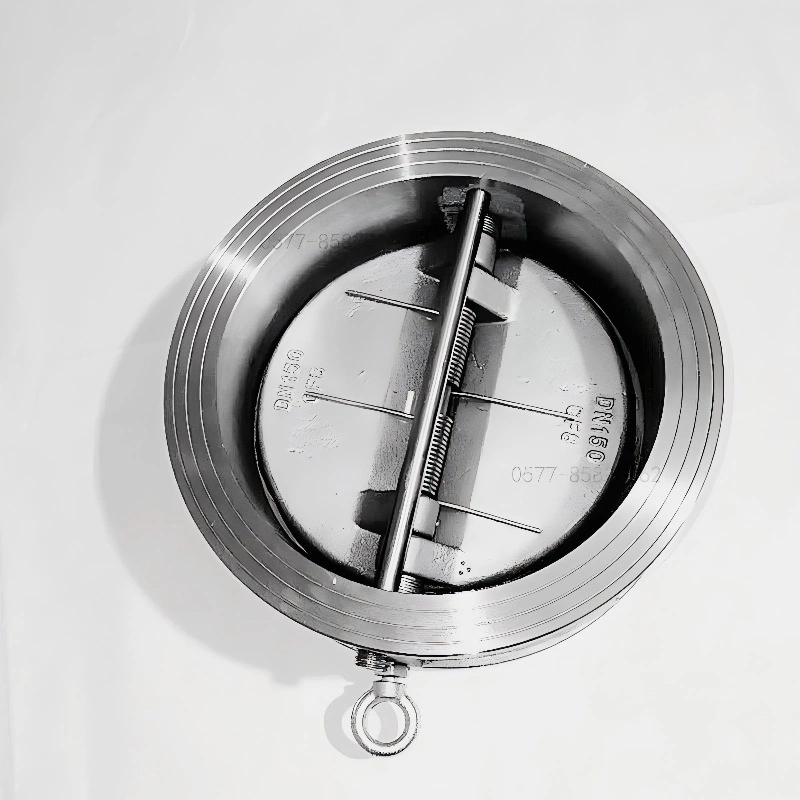
| Dual-plate (double door) | High-pressure, large-diameter industrial pipelines, low pressure drop | DN150–DN600 |
| PTFE / silicone sealed | Food, pharmaceutical and sanitary applications, prevents contamination | DN25–DN300 |
4. Key Applications
Wafer check valves are commonly specified for:
- Water treatment plants and industrial water pipelines
- Chemical processing systems handling corrosive fluids
- HVAC and building heating/cooling loops
- Oil and gas piping networks
- Food and beverage sanitary processing lines
5. Why Choose Chuanglan Wafer Check Valves?
As a Wenzhou-based stainless steel valve manufacturer with 15+ years of export experience, we produce wafer check valves in 304 (CF8) and 316L (CF8M), pressure ratings from PN10 to PN40 and Class 150/300, sizes from DN25 to DN600. Every valve is 100% pressure tested before shipment, with ISO 9001:2015 certification, CE and 3-A available for export.
💡 Why EPC Contractors Specify Wafer Check Valves with Chuanglan
Single-plate, dual-plate and PTFE-sealed wafer check valves in 304 / 316L, DN25–DN600, PN10–PN40 / Class 150–300
Short face-to-face for tight skid installation — ideal for RO, HVAC and pump packages
ISO 9001:2015 certified, 100% factory pressure tested, EN 10204 3.1 MTC, SGS / BV / Intertek inspection available
Need a Quote for Your Wafer Check Valves?
Send us your pipe size, pressure rating, medium and flange standard — our engineers will confirm the correct plate type and material within 24 hours.
Get Free Sizing Report →6. Southeast Asia & Middle East Market Notes
For clients in Southeast Asia (Indonesia, Malaysia, Thailand, Vietnam, Philippines) working on municipal water, HVAC and food processing projects, single-plate and PTFE-sealed 304 wafer check valves are the most common spec. For palm oil mill sterilizers and CIP lines, 316L PTFE-seated units meet FDA 3-A wash-down requirements.
For clients in the Middle East (Saudi Arabia, UAE, Qatar, Kuwait, Oman) working on SWRO desalination, district cooling and refinery pump packages, 316L dual-plate wafer check valves are standard on seawater intake and permeate lines. Carbon steel and cast iron bodies pit within 2–3 years in Gulf salt-laden air — always specify CF8M for coastal service.
Serving EPC Contractors Across Southeast Asia & Middle East · ISO 9001:2015 Certified · 15+ Years Factory Experience
Worked Example: Sizing a Wafer Check Valve for a Pump Discharge
Problem: A vertical pump in a Dubai water treatment plant discharges through DN80 (3″) pipe, flow 50 m³/h, pump starts/stops 20 times per day. What wafer check type and spring tension?
Step 1 — Calculate minimum cracking pressure: At 50 m³/h through DN80, velocity = 50 / 3600 / (π × 0.04²) ≈ 1.1 m/s. A single-plate wafer check cracks open at 0.02–0.05 bar — that’s fine for horizontal mounting.
Step 2 — Water hammer risk: The pump cycles 20×/day, so slam fatigue is real. A dual-plate (double-door) wafer check closes in 0.1–0.2 s vs single-plate 0.3–0.5 s. Dual-plate cuts water hammer roughly 60%.
Step 3 — Select spring: For vertical mounting (flow upward), gravity alone holds the disc closed against backflow, but a standard spring-loaded dual-plate adds reliability. Pick PN16 dual-plate with Viton/FKM seats for treated water.
Answer: Specify DN80 PN16 dual-plate wafer check valve, CF8M (316) body, Viton seat, wafer-style between DIN EN 1092-1 PN16 flanges. Expected service life: 8–10 years with 20×/day cycling.
Common Mistakes to Avoid
- Specifying 304 stainless for coastal or chloride service. If your project is in Southeast Asia (coastal, cooling tower, deicing salts) or the Middle East (desalination, SWRO, humid Gulf climate), 304 will pit within 1–3 years. Specify CF8M (316) or duplex 2205.
- Ignoring pressure-temperature derating. PN16 / Class 150 ratings apply at room temperature only. At 200°C the allowable pressure drops by roughly 40–50%. Always check the manufacturer’s P-T chart before specifying for steam, hot oil, or thermal fluid.
- Buying on price without MTC verification. “Stainless steel” is not enough — ask for EN 10204 3.1 MTC tied to the heat number, and arrange PMI (XRF) witness at the factory if the price is 20% below market. 304 passed off as 316L is the single most common failure in this industry.
- Forgetting face-to-face and flange drilling. A “PN16” wafer valve from one manufacturer may not match the existing flange drilling or face-to-face of another. Always confirm dimensions against EN 558 / API 594 (check valves) / API 609 (butterfly valves) / ASME B16.10 before replacing an installed valve.
FAQ
What is the difference between a wafer check valve and a swing check valve?
Wafer check valves have a compact face-to-face length and fit between two flanges; swing check valves have a longer body with a flanged or threaded end. Wafer style is compact and lighter; swing style provides easier maintenance and better sealing at low pressure.
Can a wafer check valve be installed vertically?
Yes, but only for upward flow. For vertical downward flow, gravity holds the disc open and backflow protection is lost. Always check the manufacturer’s orientation arrow and prefer horizontal installation.
What material should I use for seawater service?
Always specify 316L (CF8M) body and disc for seawater, coastal salt spray or chloride-containing service. Cast iron, carbon steel and standard 304 pit within 2–3 years in marine environments.
How do I choose between single-plate and dual-plate wafer check valves?
Single-plate (single-door) is lighter, cheaper and best for low-pressure water/oil lines up to DN200. Dual-plate (double-door) is better for high-pressure, large-diameter pipelines where low pressure drop and fast closing matter — typical range DN150–DN600.
What pressure rating is typical for wafer check valves?
Most industrial wafer check valves are rated PN16 or Class 150 for water/HVAC service, and PN40 or Class 300 for oil, gas and chemical service. Higher ratings (Class 600+) are usually supplied as swing or lift check rather than wafer style.
Do wafer check valves need regular maintenance?
little. Inspect the disc and seat annually on critical lines, and keep a spare disc kit on site. Typical service life is 10+ years in clean water service.
References & Standards
- ASME B16.34: Valves — Flanged, Threaded, and Welding End
- API 598: Valve Inspection and Testing
- EN 12266-1: Industrial valves — pressure testing
- EN 10204 3.1: Metallic products — inspection documents (MTC)
Related Products
Continue Reading
Get a Quote for Your Wafer Check Valves
MOQ: 1 piece · ISO 9001:2015 certified · 3.1 MTC included · 100% factory pressure tested
Southeast Asia: Indonesia, Malaysia, Thailand, Vietnam, Singapore, Philippines, Myanmar
Middle East: Saudi Arabia, UAE, Qatar, Kuwait, Oman, Bahrain
Other Regions: Europe, North America, South America, Africa, Australia
Delivery: 5–10 days to Southeast Asia · 15–20 days to the Middle East · 25–35 days to Europe / the Americas
Payment: T/T 30% deposit + 70% before shipment · L/C at sight · Warranty: 12 months after shipment for material and manufacturing defects · Packing: export plywood case / fumigation-free pallet · Shipping: FOB Ningbo/Shanghai · Documents: EN 10204 3.1 MTC + packing list + commercial invoice · Third-party inspection welcome: SGS / Bureau Veritas / Intertek
Contact Our Engineers »Need a quote or datasheet? Tell us size, pressure class and material – reply within 24 hours.
Request a Quote