

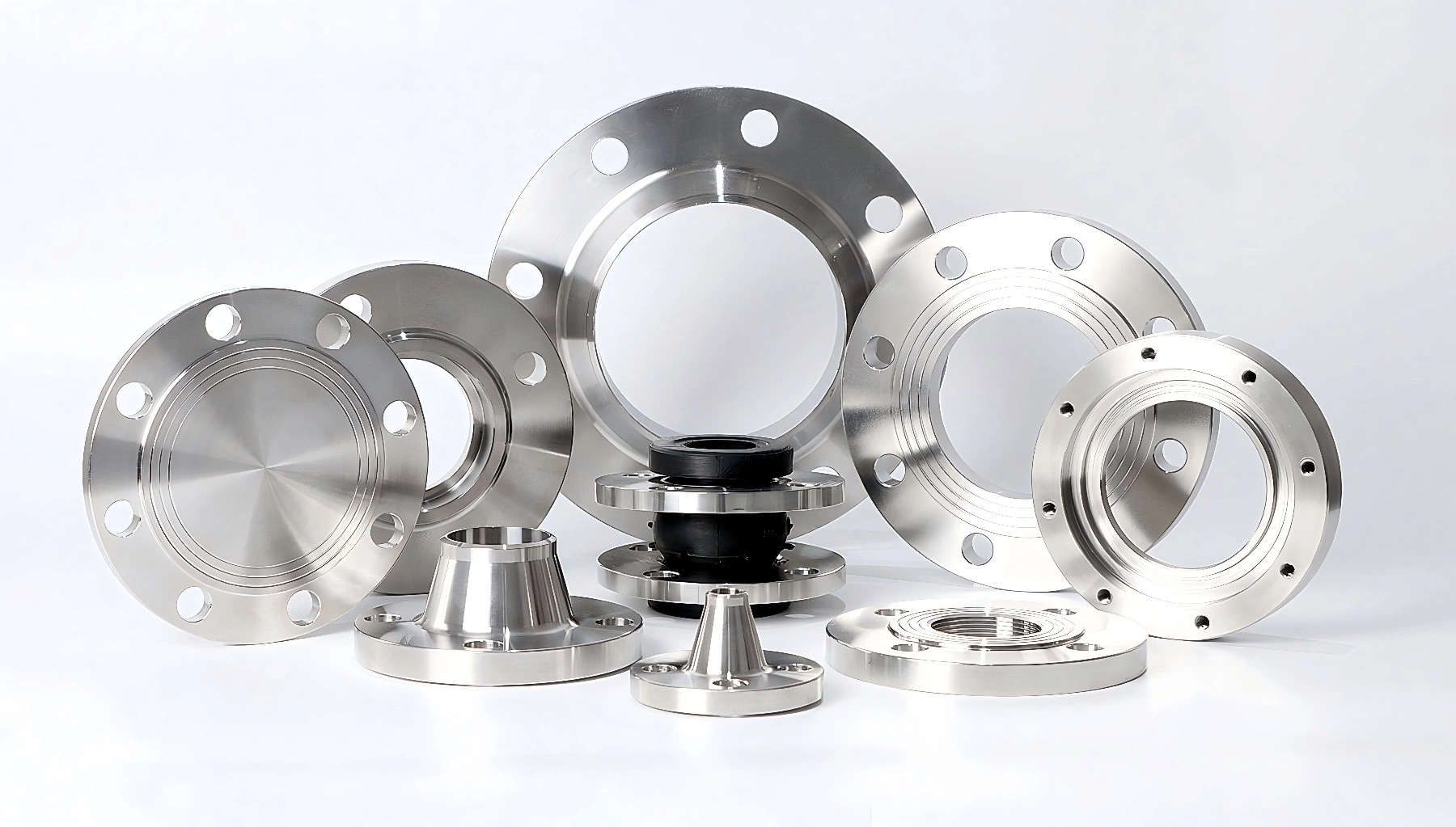
Stainless steel flanges are the connecting interface between valves, pipes and equipment in industrial piping systems. We supply WN (welding neck), SO (slip-on), BL (blind), SW (socket weld) and THD (threaded) flanges in 316L (1.4404) and 304L (1.4306) forged stainless steel, per DIN EN 1092-1 / ANSI B16.5 / JIS 10K standards.
Our flanges are available in sizes DN15–DN600 (NPS ½″–24″), pressure ratings PN6–PN40 / Class 150–300. Raised face (RF 2 mm for PN16, 7 mm for PN40+) or flat face (FF) standard; ring type joint (RTJ) available on request. For complete valve packages, see our flanged ball valve and flanged gate valve; for matching pipe and fittings, see butt-weld pipe fittings and seamless pipe. get a detailed quotation with your standard and pressure rating.
Every flange is PMI (Positive Material Identification) verified with an XRF analyzer to confirm 304 vs 316L chemistry, hydro-tested to 1.5× rated pressure for 60 seconds, and stamped with heat number, material grade, size and pressure rating. We supply EN 10204 3.1 mill certificates with every batch. MOQ 1 piece, 7–15 days delivery. 316L adds 2–2.5% molybdenum and low carbon for chloride resistance — essential for coastal, marine, desalination and pharmaceutical service. Our flanges are forged from solid billet (not cast), ensuring consistent grain structure and radiographic weldability.
🌏 Southeast Asia & Middle East Market Notes
Thailand / Vietnam food & beverage breweries: 316L WN RF flanges, DN25–DN100, Ra 0.8 µm polished face, EPDM gasket — for CIP-cleaned process lines. EN 10204 3.1 MTR required for HACCP audit.
Indonesia / Malaysia palm oil & petrochemical: 316L WN RTJ flanges, ANSI 150#/300, DN50–DN300 — for crude palm oil, cooling water and steam condensate lines. A4-70 stainless bolts recommended to avoid galvanic corrosion with carbon steel piping.
Saudi Arabia / UAE seawater desalination & oil & gas: 316L WN RF flanges, ANSI 150#, DN80–DN500 — for SWRO feed, brine discharge and cooling water. The molybdenum in 316L resists chloride pitting that destroys 304 within 1–2 years in coastal service.
Need WN / SO / BL flanges with matching elbows, pipe and bolts in one shipment? Send us your P&ID or flange data sheet.
Get Free Flange Data Sheet →WN vs SO vs BL vs SW Flange Comparison
| Type | Joint Connection | Best For | Pressure / Temperature | Cost vs WN |
|---|---|---|---|---|
| WN (Welding Neck) | Butt-weld to pipe, full penetration | High pressure, high temperature, cyclic loading, critical service | PN16–PN100 / Class 150–2500, -200 to +600°C | 1.0× (reference) |
| SO (Slip-On) | Slide over pipe, fillet weld both sides | Low pressure, clean fluids, water/HVAC, easy alignment | PN6–PN40 / Class 150–300, -20 to +300°C | ~0.6× |
| BL (Blind) | No pipe, caps pipe end | Piping end closure, future expansion, pressure test blank | Full rated pressure | ~0.8× |
| SW (Socket Weld) | Insert pipe into socket, fillet weld | Small bore DN15–DN50, high pressure, instrumentation | PN40–PN100 / Class 300–2500 | ~0.9× |
| THD (Threaded) | NPT / BSPT threaded to pipe | Small bore, instrument air, gas lines, no-weld zones | PN16–PN40 / Class 150–300 | ~0.7× |
| Lap Joint (LJ) | Stub end + loose flange | Low-frequency assembly, easy rotation, alloy piping | PN6–PN40 / Class 150–300 | ~0.9× |
Technical Specifications
| Type | WN / SO / BL / SW / THD / Lap Joint |
| Size Range | DN15 – DN600 (NPS 1/2″ – 24″) |
| Pressure Rating | PN6 / PN10 / PN16 / PN40 / Class 150 / Class 300 |
| Material | 316L (1.4404) / 304L (1.4306) forged; 304 / 321 on request |
| Standard | DIN EN 1092-1 / ANSI B16.5 / JIS B2220 / BS 4504 |
| Facing | RF (2 mm for PN16 / 7 mm for PN40+) / FF / RTJ |
| Surface Finish | Satin Ra 1.6 µm standard; Ra 0.8 µm polished for food / pharma |
| Bolts | DIN 931 / ASTM A193 B7 / A4-70 stainless (on request) |
| Testing | Hydro 1.5× PN + PMI XRF per batch |
| Material Certificates | EN 10204 3.1 MTC per heat; PED 2014/68/EU, CE on request |
Dimension Table — WN Flange PN16 (mm)
| DN | D (OD) | K (Bolt Circle) | d (Seal Face) | f (RF Ht) | b (Thick) | Hub N (OD) | n-ΦL (Bolts) | H (Hub Ht) |
|---|---|---|---|---|---|---|---|---|
| 15 | 95 | 65 | 45 | 2 | 14 | 30 | 4-M12 | 35 |
| 20 | 105 | 75 | 58 | 2 | 14 | 38 | 4-M12 | 38 |
| 25 | 115 | 85 | 68 | 2 | 16 | 45 | 4-M12 | 40 |
| 32 | 140 | 100 | 78 | 2 | 16 | 55 | 4-M16 | 42 |
| 40 | 150 | 110 | 88 | 2 | 16 | 58 | 4-M16 | 45 |
| 50 | 165 | 125 | 102 | 2 | 18 | 65 | 4-M16 | 48 |
| 65 | 185 | 145 | 122 | 2 | 20 | 80 | 4-M16 | 52 |
| 80 | 200 | 160 | 138 | 2 | 20 | 85 | 8-M16 | 55 |
| 100 | 220 | 180 | 158 | 2 | 22 | 100 | 8-M16 | 62 |
| 125 | 250 | 210 | 188 | 2 | 24 | 125 | 8-M16 | 68 |
| 150 | 285 | 240 | 212 | 2 | 26 | 145 | 8-M20 | 75 |
| 200 | 340 | 295 | 268 | 2 | 30 | 200 | 12-M20 | 88 |
| 250 | 400 | 355 | 320 | 2 | 32 | 240 | 12-M24 | 105 |
| 300 | 455 | 410 | 370 | 2 | 34 | 280 | 16-M24 | 115 |
* SO / BL / SW flange dimensions differ slightly. Contact us for complete dimension drawings. ANSI Class 150 / JIS 10K / PN40 patterns also available.
🧮 Worked Example: Specifying 316L WN Flanges for a Jeddah SWRO Desalination Plant
Project: SWRO desalination plant in Jeddah, Saudi Arabia. High-pressure brine discharge line DN200, seawater at 40°C, chloride 22,000 ppm, ANSI B16.5 Class 150.
Given: Connecting a butterfly valve to the discharge header; 4 flanges per valve joint (2 on valve, 2 on pipe spool).
Step 1 — Material choice: 304 vs 316L?
Seawater contains 22,000 ppm chloride. 304 pits within 1–2 years in this environment (pitting corrosion index PREN 18). 316L has PREN ~25 — molybdenum stabilizes the passive film against chloride attack. Specify 316L (1.4404), forged F316L per ASTM A182.
Step 2 — Flange type & facing:
High-pressure cyclic service (pump trip, pressure spikes). Specify WN (welding neck) for full-penetration butt weld and radiographic inspection. RF facing (2 mm raised face for Class 150) with spiral-wound gasket (316L winding + graphite filler). RTJ would be overkill at Class 150.
Step 3 — Bolts & gasket:
Use A4-70 stainless bolts (not carbon steel B7) — dissimilar metal with 316L flange would cause galvanic corrosion. 8 × 3/4″ bolts per ANSI B16.5 Class 150 DN200 (8″). Gasket: 316L spiral-wound with graphite filler, suitable for -20 to +500°C.
Step 4 — Documentation:
Every flange must ship with EN 10204 3.1 MTR certifying heat number, chemistry (C≤0.030% for L-grade, Mo 2.0–2.5%), mechanical properties, PMI traceability. Our QA team runs XRF on every batch and hydro-tests to 24 bar for PN16 / 300 psi for Class 150 before shipment.
⚠️ 4 Common Mistakes When Ordering Stainless Steel Flanges
Mistake 1 — Mixing DIN PN16 and ANSI 150# on the same joint: They look similar but bolt circles don’t match (DN100 PN16: 8×M16 on 180 mm; ANSI 150# 4″: 8×5/8″ on 152 mm). The flanges won’t bolt up. Always match standard across the joint; if you need a hybrid, ask for a “spacer flange” adapter.
Mistake 2 — Buying 304 for coastal / seawater service: 304 pits within 1–2 years in chloride environments. Always specify 316L (PREN ≥25) for seawater, cooling tower water with chlorine, or coastal atmosphere. The 20% price premium is trivial vs replacing a failed joint.
Mistake 3 — Forgetting the mill certificate (MTR): Without EN 10204 3.1, you cannot defend the material grade in an audit, insurance claim or piping failure investigation. We supply 3.1 with every batch; ask for it explicitly on your PO.
Mistake 4 — Using carbon steel B7 bolts with 316L flanges: Galvanic corrosion eats the carbon steel bolt in months when coupled to 316L in wet service. Specify A4-70 (316 stainless) bolts for all stainless-stainless joints, or use a dielectric gasket if mixing materials.
📋 Commercial Terms
Payment: T/T 30% deposit + 70% before shipment; L/C at sight accepted for EPC piping package orders. PayPal for sample orders.
Warranty: 12 months after shipment for material and manufacturing defects — covers bolt circle / bore / raised-face dimensional non-conformance, material chemistry and PMI mismatch vs the MTR, hydro test failure, and facing surface defects (scratches, pits, rust). Damage from over-torque bolt tightening, field weld defects on the hub or neck, gasket-set mistakes beyond the flange itself, or mismatched DIN vs ANSI standard selection by the customer is not covered. Always provide the heat number from the EN 10204 3.1 MTC when raising a claim.
Packaging: Export plywood case; fumigation-free pallet; flange faces protected with plastic / wooden covers to avoid transit damage; bolt holes plugged.
Shipping Documents: EN 10204 3.1 MTC per heat, hydro test report, PMI XRF result, packing list, commercial invoice, PED / CE declaration on request.
Shipment Port: FOB Ningbo / Shanghai, China; CIF / DAP available on request.
Third-Party Inspection: SGS / Bureau Veritas / Intertek pre-shipment dimensional, hydro and PMI inspection supported at buyer cost.
Need Sizing Help or a Quote?
Send size (DN), pressure (PN/ANSI), material (304/316L), seat (EPDM/Viton) and quantity — we reply within 24 hours.
Get Free Quote »FAQ
Which flange type should I choose — WN, SO, BL or SW?
WN (welding neck) is the default for high-pressure / high-temperature / cyclic service — the long hub distributes stress and can be radiographically inspected. SO (slip-on) is cheaper, easier to align and used for low-pressure clean fluids (water, HVAC). BL (blind) caps pipe ends. SW / THD are only for small bore DN≤50. When in doubt, specify WN — it costs more but eliminates the most common leakage point.
304 or 316L — what is the real difference?
Both are austenitic stainless. 304 (18% Cr, 8% Ni) handles water, mild chemicals and food. 316L adds 2–2.5% molybdenum and low carbon — it resists chloride (seawater, coastal, desalination) and is required for pharmaceutical, marine and bleach service. If your site is near the sea or fluid contains salt, always choose 316L. The “L” means low carbon (C≤0.030%) to avoid carbide precipitation during welding.
RF, FF or RTJ facing — which gasket do I need?
RF (raised face) is the industry default and works with spiral-wound or ring gaskets. FF (flat face) is used only with cast iron flanges or Class 125. RTJ (ring type joint) is for Class 600+ high-pressure oil & gas — a steel ring (RX, BX, octagonal) sits in a machined groove. Never mix RF and FF flanges across a joint.
How many bolts are on a PN16 DN100 flange?
Per EN 1092-1, PN16 DN100 has 8 holes M16 on a 180 mm bolt circle. ANSI 150# 4″ also has 8 bolts (5/8″ UNC on 152 mm) — look similar but the bolt circles don’t match, so they cannot be mated. If you need a hybrid, ask us for a spacer flange adapter.
How do you pressure test a flange?
Every flange body is hydro-tested to 1.5× rated pressure (PN16 → 24 bar) for 60 seconds minimum, no visible leakage. We also PMI (XRF) each batch to verify 304 vs 316L chemistry, and supply EN 10204 3.1 mill certificates. Radiographic, ultrasonic and dye-penetrant tests available for nuclear / offshore projects.
Can you supply flanges with matching elbows, pipe and bolts in one shipment?
Yes — we manufacture butt-weld elbows and pipe fittings, seamless pipe and A4-70 bolts in the same heat. This avoids material mismatch (one batch PMI covers the whole joint) and reduces logistics cost for EPC contractors.
MOQ, stock and lead time?
MOQ is 1 piece. Standard PN16 / Class 150 DN15–DN100 in 304 are usually in stock (7 days). DN125 and above, 316L, RTJ facing or special standards take 15–25 days.
What is your warranty period?
We provide a 12-month warranty after shipment for material and manufacturing defects. This covers bolt circle / bore / raised-face dimensional non-conformance, material chemistry and PMI mismatch against the MTR, hydro test failure, and facing surface defects. Damage from over-torque bolt tightening, field weld defects on the hub, gasket-set mistakes, or mismatched standard selection by the customer is not covered. Always quote the heat number from the EN 10204 3.1 MTC when raising a warranty claim.
📚 Further reading:
• Butterfly Valve Selection Guide (Size, Pressure, Material)
• How to Select a Wafer Butterfly Valve for Seawater Service
• Y-Strainer Sizing Guide for Power Plants
You May Also Need
Related Technical Guides
Stainless Steel Flanges Selection · ANSI vs DIN vs JIS Valve Standards
Request a Quote for This Stainless Steel Flanges
Tell us the size, pressure and quantity you need. We reply within one working day.
Need a Custom Valve or Fitting?
Send us your specs: pressure, size, material and quantity — our engineers will reply within 24 hours with a detailed quotation. MOQ 1 piece.
FOB Ningbo / Shanghai · 5–10 days to Southeast Asia · 15–20 days to the Middle East · We reply within 24 hours (usually same business day)
Commercial terms: T/T 30% deposit + 70% before shipment, L/C at sight · export plywood case / fumigation-free pallet · 12 months warranty after shipment for material and manufacturing defects · EN 10204 3.1 MTC + API 598 test report + packing list + commercial invoice with every order · SGS / Bureau Veritas / Intertek pre-shipment inspection available
Get Free Quote »