

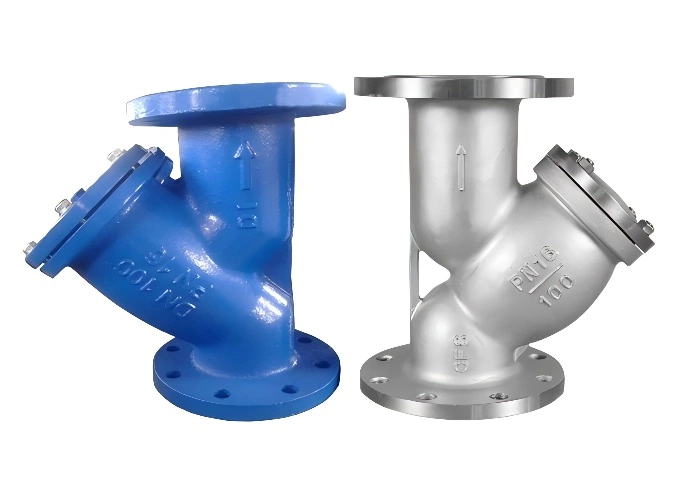
A Y strainer is a pipeline protection device that removes solids (welding slag, scale, sand, pipe debris) from flowing fluid using a perforated or wire-mesh screen. Its Y-shaped body design lets you remove and clean the screen in minutes without disturbing the main pipe — making it the most widely used strainer type in industrial piping.
Chuanglan manufactures flanged Y-strainers in CF8M (316) and CF8 (304) stainless steel as premium range. Cast iron (GG25), ductile iron (GGG50) and WCB carbon steel are standard for water / oil & gas service. We supply DN15–DN350 (NPS ½″14″) for DIN EN 1092-1 PN10/PN16/PN40 / ANSI B16.5 Class 150 / JIS 10K flanges. Always install a Y-strainer upstream of every butterfly valve, ball valve, check valve and pump — seat damage from debris is the #1 premature failure cause. get a detailed quotation.
The main advantage of a Y strainer over basket-type or T-type strainers is its compact size and low pressure drop. The Y-shaped body creates a smooth flow path, reducing head loss by up to 50% compared to basket strainers. The screen pulls out of the Y branch for cleaning without disconnecting the main pipe — ideal for continuous operation. We directly serve EPC contractors and valve distributors across Southeast Asia (Indonesia, Malaysia, Thailand, Vietnam) and the Middle East (Saudi Arabia, UAE, Qatar, Kuwait).
When selecting a Y strainer, consider: size (DN15–DN350), pressure rating (PN10/PN16/PN40 / ANSI 150#), body material (cast iron for water/HVAC, ductile iron for general, WCB for oil/gas, CF8M for corrosive service), mesh size (20 mesh ≈ 850 µm for coarse, 40 mesh ≈ 425 µm for general, 100 mesh ≈ 150 µm for fine, 200 mesh ≈ 75 µm for precision), and installation orientation (horizontal with Y branch pointing down). As a rule of thumb, mesh hole size should be 50% smaller than the smallest orifice you are protecting — never finer, or the strainer clogs too fast.
🌏 Southeast Asia & Middle East Market Notes
Thailand / Vietnam commercial HVAC & data centers: Ductile iron body, SS304 20-mesh screen, PN16 — standard upstream of chillers, AHU control valves and condenser water pumps. EPDM gasket for chilled water service.
Indonesia / Malaysia palm oil & petrochemical: WCB body, SS316 40-mesh screen, ANSI 150# — used on cooling water, steam condensate and fuel oil lines. Blow-off connection for periodic flush.
Saudi Arabia / UAE desalination & oil & gas: CF8M body, SS316 60-mesh screen, ANSI 150# — used on SWRO feed water, chemical dosing and hydrocarbon circuits. 316L for coastal chloride corrosion resistance; Monel screen option for seawater.
Not sure which mesh size or body material fits your fluid? Send us your medium, pump or valve model and particle size spec.
Get Free Sizing Report →Y Strainer vs Basket Strainer vs Duplex Strainer
| Feature | Y Strainer (This) | Basket Strainer | Duplex Strainer |
|---|---|---|---|
| Size range | DN15–DN350 | DN50–DN600+ | DN25–DN200 |
| Debris holding | Small (needs frequent clean) | 3–5× larger | Medium (twin baskets) |
| Pressure drop | Lowest | Medium | Medium |
| Cleaning online? | No (must shutdown) | No (must shutdown) | Yes (diverter valve) |
| Cost | Lowest | Medium | Highest |
| Best for | Pump protection, boiler feed, HVAC, steam | Dirty water, wastewater, large particles | Critical continuous service (refineries, power) |
| Installation orientation | Horizontal, Y branch down | Vertical top access | Horizontal with diverter |
| Best fluid | Clean-to-moderate water, oil, gas, steam | Dirty water, slurry, pulp | Critical continuous process |
Key Features
| Body Type | Flanged Y-type |
| Pressure Rating | PN10 / PN16 / PN40 / ANSI Class 150 |
| Sizes Available | DN15 – DN350 (NPS 1/2″ – 14″) |
| Body Material | CF8M (316) / CF8 (304) — premium; WCB / GGG50 / GG25 on request |
| Screen Material | SS304 / SS316 / Monel / Hastelloy |
| Mesh Size | 20 mesh (850 µm) to 200 mesh (75 µm) |
| Temperature Range | -29°C to +230°C (depending on body material) |
| Testing | Shell & seat test per API 598 |
| Material Certificates | EN 10204 3.1 MTC included per heat |
| Standards | ANSI B16.34 / DIN EN 1092 / API 598 |
| Options | Blow-off connection, differential pressure gauge, insulation jacket, Monel / Hastelloy screen |
Material Standards
| Part | Cast Iron GG25 | Carbon Steel WCB | Stainless 304 (CF8) | Stainless 316 (CF8M) |
|---|---|---|---|---|
| Body / Cap | GG25 | ASTM A216 WCB | ASTM A351 CF8 | ASTM A351 CF8M |
| Screen | SS304 | SS304 / SS316 | SS304 | SS316 |
| Gasket | PTFE / Graphite | Graphite | PTFE | PTFE |
| Typical Service | Cold water, HVAC | Oil, gas, steam | Chemical, food, water | Seawater, chloride, acid |
Dimension Table — Flanged Y-Strainer (DIN PN16, mm)
| NPS | DN | L (Length) | H (Height) | D (Flange OD) | K (Bolt Circle) | d (Seal Face) | n-ΦL (Bolts) |
|---|---|---|---|---|---|---|---|
| 1/2″ | 15 | 140 | 70 | 95 | 65 | 45 | 4-Φ14 |
| 3/4″ | 20 | 145 | 80 | 105 | 75 | 58 | 4-Φ14 |
| 1″ | 25 | 150 | 90 | 115 | 85 | 68 | 4-Φ14 |
| 1 1/4″ | 32 | 180 | 110 | 140 | 100 | 78 | 4-Φ18 |
| 1 1/2″ | 40 | 200 | 115 | 150 | 110 | 88 | 4-Φ18 |
| 2″ | 50 | 230 | 125 | 165 | 125 | 102 | 4-Φ18 |
| 2 1/2″ | 65 | 250 | 140 | 185 | 145 | 122 | 4-Φ18 |
| 3″ | 80 | 280 | 170 | 200 | 160 | 138 | 8-Φ18 |
| 4″ | 100 | 320 | 200 | 220 | 180 | 158 | 8-Φ18 |
| 5″ | 125 | 350 | 220 | 250 | 210 | 188 | 8-Φ18 |
| 6″ | 150 | 380 | 250 | 285 | 240 | 212 | 8-Φ22 |
| 8″ | 200 | 480 | 310 | 340 | 295 | 268 | 12-Φ22 |
| 10″ | 250 | 550 | 370 | 400 | 355 | 320 | 12-Φ26 |
| 12″ | 300 | 600 | 450 | 455 | 410 | 370 | 16-Φ26 |
| 14″ | 350 | 660 | 500 | 520 | 470 | 430 | 16-Φ26 |
* ANSI Class 150 / JIS 10K drilled flanges available on request. PN40 pattern for high-pressure service.
🧮 Worked Example: Selecting a DN100 Y-Strainer for a Bangkok Chilled Water Pump
Project: 40-story office tower in Bangkok, Thailand. Primary chilled water pump DN100 discharge to AHU header.
Given: Q = 100 m³/h, chilled water at 7°C, PN16, pump impeller clearance 3 mm. Protect the pump impeller and downstream 2-way control valve (orifice 6 mm).
Step 1 — Choose mesh size:
The control valve orifice is 6 mm (6000 µm). Rule of thumb: mesh hole ≤ 50% of orifice = 3 mm = 3000 µm. Standard 20-mesh screen (850 µm holes) is well below 3000 µm — safe for both pump impeller and control valve. Specify 20 mesh (850 µm) SS304 with perforated plate backup (standard on DN50+).
Step 2 — Body material & flange:
Chilled water at 7°C, non-corrosive. Specify ductile iron GGG50 body, EPDM gasket, DIN EN 1092-1 PN16 flanges. No need for CF8M on budget commercial building project.
Step 3 — Orientation & location:
Install horizontally on pump suction, Y branch pointing down (so debris collects in pocket, not on screen face). Place 5 pipe diameters after any elbow. Add isolation gate valve before and butterfly valve after the strainer so you can clean without draining the system.
Step 4 — Maintenance plan:
Fit a differential pressure gauge across inlet/outlet. Clean screen when ΔP reaches 0.5 bar (7 psi). On clean chilled water, expect to clean every 6–12 months; on startup lines, check monthly until debris load drops.
⚠️ 4 Common Mistakes When Selecting Y-Strainers
Mistake 1 — Installing Y branch upward: Solids fall back into the flow path and the strainer collects nothing. On horizontal pipe, the Y branch (with the drain cap) must point downward. If pipe orientation is fixed, install vertical-up flow with Y branch horizontal.
Mistake 2 — Mesh too fine (clogs fast): 200-mesh on a raw water line will clog in days. Match mesh to the protected orifice: 20 mesh for pump protection, 40–60 for control valves/meters, 100+ only for chemical / food-grade precision.
Mistake 3 — Skipping the perforated plate backup: Fine mesh alone bursts under water hammer or high ΔP. Always specify perforated plate backup behind the mesh on DN50+ and high-pressure applications.
Mistake 4 — Using Y-strainer for dirty wastewater: Y-strainer pocket holds little debris. For wastewater, palm oil effluent or fluids with >5 mm particles, switch to a basket strainer (3–5× capacity) or duplex strainer for continuous duty.
📋 Commercial Terms
Payment: T/T 30% deposit + 70% before shipment; L/C at sight accepted for large orders. PayPal for sample orders.
Warranty: 12 months after shipment for material and manufacturing defects — covers casting defects, flange dimension non-conformance, screen perforation non-conformance and gasket non-conformance. Damage from water hammer beyond rated ΔP, screen corrosion beyond specified media, or field welding is not covered.
Packaging: Export plywood case; fumigation-free wooden pallet; flange faces protected with plastic caps to prevent transit damage.
Shipping Documents: EN 10204 3.1 MTC per heat, API 598 pressure test report, packing list, commercial invoice; certificate of origin on request.
Shipment Port: FOB Ningbo / Shanghai, China; CIF / DAP available on request.
Third-Party Inspection: SGS / Bureau Veritas / Intertek pre-shipment inspection supported at buyer cost.
Need Sizing Help or a Quote?
Send size (DN), pressure (PN/ANSI), material (304/316L), seat (EPDM/Viton) and quantity — we reply within 24 hours.
Get Free Quote »Applications
Water Treatment
Potable water, wastewater, desalination
Power Plants
Cooling water, steam, fuel systems
Oil & Gas
Refineries, pipelines, storage terminals
Chemical
Corrosive fluids, acid & alkali service
Quality Control Process
Raw Material
EN 10204 3.1 MTC (material test reports)
Casting / Forging
Self-owned foundry, in-house control
Machining
CNC precision machining, in-process inspection
Pressure Test
Shell & seat test per API 598
Final Inspection
Visual, dimensional, performance testing
FAQ
What mesh size should I choose for my Y strainer?
General pump protection uses 20 mesh (850 µm) or 30 mesh (600 µm). For meters, thermostatic valves and small-bore equipment, use 40–60 mesh (250–425 µm). For fine chemical or food-grade service, 100–200 mesh (75–150 µm). Rule of thumb: mesh holes should be ≤50% of the smallest orifice you are protecting.
Which way should a Y strainer be installed — screen up or down?
On horizontal pipe, the Y branch (with the screen cap) must point downward so solids collect in the pocket. On vertical pipe (flow upward), the Y branch can point horizontally. Never mount the Y branch upward — debris falls back into the flow.
How often should I clean the screen?
Industry rule: clean when differential pressure across the strainer reaches 0.5–1.0 bar (7–15 psi), or every 3–6 months on clean water. On dirty water or startup lines, check monthly. For critical systems, fit a ΔP gauge across inlet and outlet.
Y strainer or basket strainer — which do I need?
Y-strainers are compact, low cost and handle clean-to-moderately dirty fluids — best for pump protection, boiler feed, HVAC, steam. Basket strainers hold 3–5× more debris, required for highly dirty fluids, wastewater, large particles (>5 mm) and positive-displacement pump suction.
Can the screen break and let debris through?
Yes — this is the #1 failure mode. Causes: water hammer, excessive ΔP on a clogged screen, corrosion. We offer perforated plate backup behind the mesh (standard on DN50+), SS316 / Monel screens for chemical duty, and ΔP switch alarm. Always replace a damaged screen immediately.
Should I install a Y strainer on pump suction or discharge?
Best practice is on the pump suction (low-pressure side), because the suction impeller is the most sensitive component. If suction is already crowded, install on discharge near the pump — but never skip it entirely. Always pair with isolation valves so you can clean without draining the system.
MOQ, stock and delivery time?
MOQ is 1 piece. DN15–DN100 in cast iron / ductile iron are usually in stock (7 days). DN125 and above, WCB or CF8M takes 15–25 days. ANSI 150# / JIS 10K / PN40 flanges, blow-off connection and ΔP gauge all available on request.
What is your warranty period?
We provide a 12-month warranty after shipment for material and manufacturing defects. This covers casting defects, flange dimension non-conformance, screen perforation non-conformance and gasket non-conformance. Damage from water hammer beyond rated ΔP, screen corrosion beyond specified media, or field modifications is not covered. Always provide the heat number from the EN 10204 3.1 MTC when raising a warranty claim.
📚 Further reading:
• Y-Strainer Sizing Guide for Power Plants
• How to Select a Wafer Butterfly Valve for Seawater Service
• Wafer Check Valve vs Swing Check Valve (2026 Guide)
Related Products
You May Also Need
Related Technical Guides
Y-Strainer Sizing Guide · Y-Strainer vs Basket Strainer · How to Clean a Y-Strainer · Y-Strainer Orientation · Steam Strainer Orientation · Y-Strainers for Pumps & Valves
Request a Quote for This Y Strainer
Tell us the size, pressure and quantity you need. We reply within one working day.
Need a Custom Valve or Fitting?
Send us your specs: pressure, size, material and quantity — our engineers will reply within 24 hours with a detailed quotation. MOQ 1 piece.
FOB Ningbo / Shanghai · 5–10 days to Southeast Asia · 15–20 days to the Middle East · We reply within 24 hours (usually same business day)
Commercial terms: T/T 30% deposit + 70% before shipment, L/C at sight · export plywood case / fumigation-free pallet · 12 months warranty after shipment for material and manufacturing defects · EN 10204 3.1 MTC + API 598 test report + packing list + commercial invoice with every order · SGS / Bureau Veritas / Intertek pre-shipment inspection available
Get Free Quote »