


Butterfly Valve Selection Guide (2026): Wafer vs Flanged
How to choose the right butterfly valve — wafer vs flanged, liner materials, pressure ratings, Cv sizing and common mistakes for HVAC, water treatment and industrial applications.
* Standard lead time depends on order quantity and destination country. 5-10 days to Southeast Asia, 15-20 days to Middle East.
⚡ Quick Answer
For HVAC, cooling tower and water treatment service up to PN16 (ANSI Class 150), choose a wafer butterfly valve with ductile iron GGG40 body, 304 stainless disc and EPDM liner — it is shorter, lighter and 20-30% cheaper than flanged. Switch to flanged only when pressure exceeds PN16 or the line requires easy isolation for maintenance.
Size by Cv (not pipe size): required Cv = GPM ÷ √ΔP(psi), and pick a valve that delivers that Cv at 60-70% opening. Never use EPDM liner for oil service — it swells and fails within months.
🔑 Key Takeaways
- Wafer vs flanged: Wafer for DN50+ low-pressure HVAC / water / cooling tower (≤ PN16) · flanged for PN25+ critical oil & gas or when you need easy in-line isolation.
- Liner by fluid: EPDM for water/steam/HVAC (-30°C to 120°C) · NBR for oil & petroleum · PTFE for strong acids/bases — never EPDM in oil service.
- Body by environment: Ductile iron GGG40 for standard water · epoxy-coated or 316 stainless for coastal / salt-spray projects in SEA & Gulf.
- Sizing rule: Calculate Cv = GPM ÷ √ΔP(psi) — for a 120 m³/h (528 GPM) cooling tower with 0.3 bar ΔP, required Cv ≈ 253; pick DN150 wafer valve (Cv ≈ 350 at 60% open).
On This Page
A butterfly valve is the most cost-effective choice for large-diameter piping systems — and also the most mis-specified. Most engineers just match the pipe size and pick the cheapest option, but choosing between wafer and flanged body, the right liner material, and the correct pressure rating can mean the difference between 10 years of reliable service or constant leaking.
In this guide, we break down the two main butterfly valve body types, when to use EPDM vs PTFE liners, and how to pick the right pressure class — based on our experience supplying wafer butterfly valves to HVAC, water treatment and industrial plants across Southeast Asia and the Middle East.
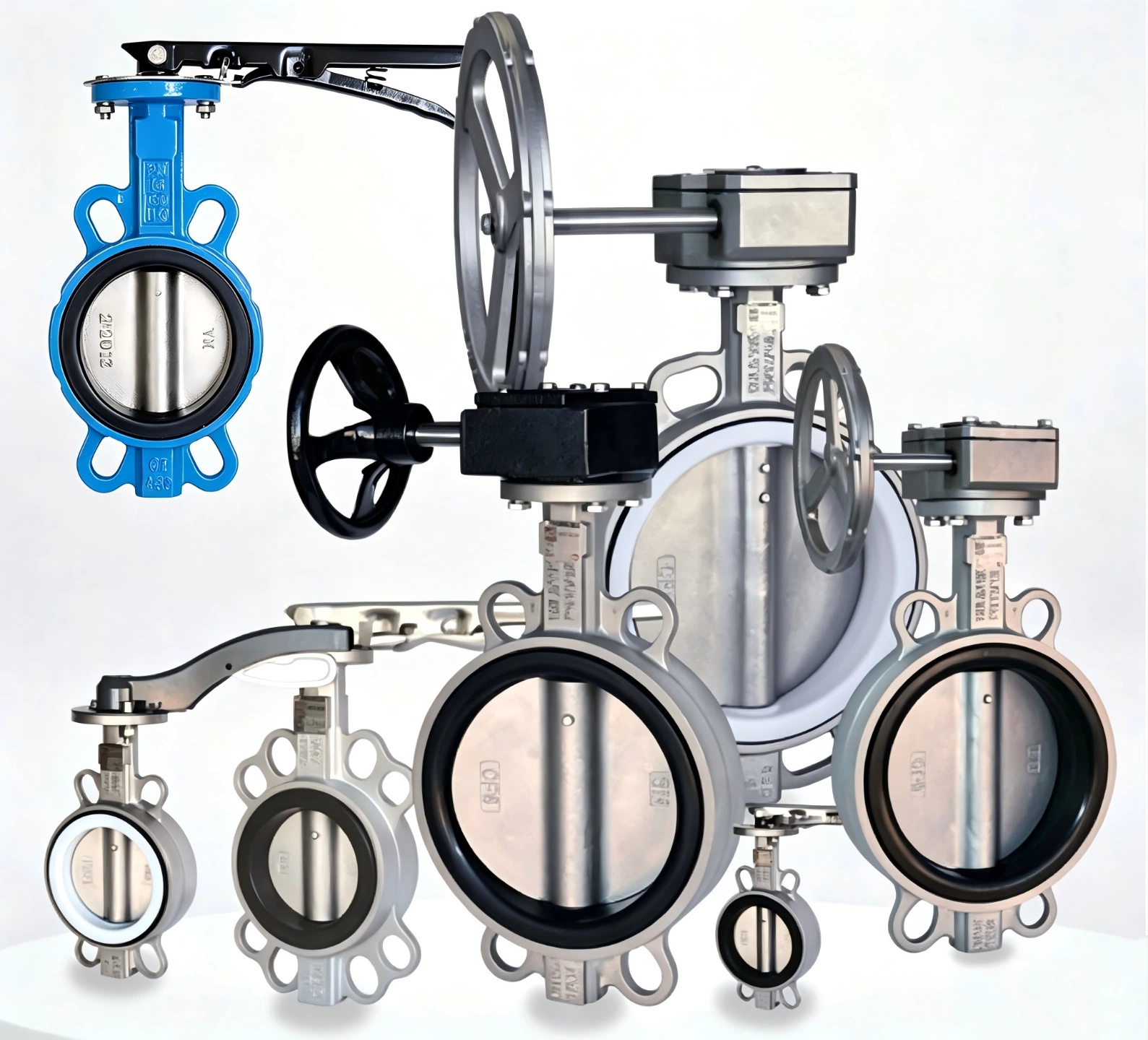
1. Wafer vs Flanged: What’s the Difference?
The butterfly valve body type determines how it connects to your piping. This is the first and most important decision you make.
| Wafer Butterfly Valve | Flanged Butterfly Valve | |
|---|---|---|
| How it connects | Sandwiched between two pipe flanges, held by through bolts | Bolted directly to matching pipe flanges |
| Face-to-face length | Short (API 609 short pattern) | Longer (API 609 standard pattern) |
| Weight | Lightweight (50% less than flanged) | Heavier |
| Cost | Lower | Higher (20-30% more) |
| Leak risk | Slightly higher (depends on flange alignment) | Lower (better sealing) |
| Best for | Large diameter, low pressure, HVAC, water treatment | High pressure, critical service, oil & gas |
2. When to Choose Wafer Type
Choose a wafer butterfly valve if:
- Your line size is DN50 (2″) or larger
- Pressure rating is PN16 (ANSI 150#) or lower
- The fluid is water, HVAC systems, or general industry
- You want the lowest cost for large diameters (DN300+)
- Space is tight (wafer is much shorter than flanged)
Most of our customers in HVAC and water treatment use the wafer type — it’s the most cost-effective option for large piping systems.
3. When to Choose Flanged Type
Choose a flanged butterfly valve if:
- Pressure rating exceeds PN16 (ANSI 150#)
- The application is critical (oil & gas, chemical processing)
- You need better sealing performance
- The piping system requires standard face-to-face dimensions
- You plan to isolate the valve later (flanged is easier to remove)
For high-pressure chemical and oil applications, we recommend the flanged type — it’s more reliable and easier to maintain.
4. Liner Material Selection
The valve liner (seat) is the soft material that seals against the disc. Choosing the right liner is critical for chemical compatibility and temperature range.
| Liner Material | Temperature Range | Best For |
|---|---|---|
| EPDM | -30°C to +120°C | Water, steam, HVAC, most chemicals |
| PTFE (Teflon) | -20°C to +180°C | Strong acids, bases, corrosive chemicals |
| NBR (Buna-N) | -10°C to +90°C | Oil, petroleum, diesel |
| Silicone | -60°C to +200°C | High temperature, food grade |
Mistake we see often: using EPDM for oil or petroleum service. EPDM will swell and fail within months in oil. Always use NBR for oil and petroleum applications.
5. Body Material Selection
| Body Material | Best For | Common Applications |
|---|---|---|
| Ductile Iron (GGG40) | Water, HVAC, low pressure | Buildings, water treatment, irrigation |
| Cast Steel (WCB) | Oil, gas, high temperature | Oil & gas pipelines, steam systems |
| Stainless 304 (CF8) | Corrosive chemicals, food | Chemical plants, food processing |
| Stainless 316 (CF8M) | Sea water, chlorides, harsh chemicals | Marine, desalination, pharmaceutical |
For most HVAC and water treatment applications, ductile iron body with EPDM liner is the standard choice — reliable and cost-effective. For coastal projects in Southeast Asia and the Middle East, we recommend 316 stainless body to resist salt spray corrosion.
International Standards Reference
| Standard Category | US / ANSI | European / EN | Japanese / JIS |
|---|---|---|---|
| Design | API 609 / MSS SP-67 | EN 593 (ISO 10931) | JIS B2002 |
| Face-to-Face | API 609 short / long pattern | EN 558 / ISO 5752 | JIS B2002 |
| Flange | ASME B16.5 (Class 150/300) | EN 1092-1 (PN10/16/25/40) | JIS B2220 (10K/20K) |
| Pressure Rating | ANSI Class 150–300 | PN10–PN25 | 10K–20K |
| Testing | API 598 / MSS SP-67 | EN 12266-1 | JIS B2003 |
| Actuator Mounting | ISO 5211 | ISO 5211 | ISO 5211 |
| Fire Safe | API 607 / API 6FA | ISO 10497 | — |
Note: API 609 covers double-flanged, lug and wafer-type butterfly valves — the primary US spec for HVAC and water service.
Worked Example: Sizing a Butterfly Valve for a Cooling Tower
Let’s size a balancing butterfly valve for a cooling tower circulation loop serving a commercial building in Dubai.
Step 1 — Design flow rate
Cooling tower loop flow: 120 m³/h (528 GPM). Water at 30°C (90°F), density ≈ 995 kg/m³.
Step 2 — Select pipe size
Target velocity: 2.0 m/s in the main line. Required pipe area A = Q ÷ v = 0.0333 m³/s ÷ 2.0 m/s = 0.0167 m².
Pipe diameter d = √(4A ÷ π) = √(4 × 0.0167 ÷ 3.1416) ≈ 0.146 m → choose DN150 (6″) pipe.
Step 3 — Check valve Cv requirement
Allowable pressure drop across balancing valve: ΔP = 0.3 bar ≈ 4.35 psi (typical for balancing duty).
Required Cv = Q(GPM) ÷ √ΔP(psi) = 528 ÷ √4.35 ≈ 253.
A DN150 (6″) wafer butterfly valve at 60% open has Cv ≈ 350 — comfortably above requirement, confirming DN150 is correct. At 60% opening, the valve provides good balancing authority without excessive throttling.
Step 4 — Select valve configuration
• Body: Ductile iron GGG40 (standard for cooling tower water)
• Disc: 304 stainless (resists water treatment chemicals)
• Liner: EPDM (water service, up to 120°C)
• Pressure: PN16 (system design 8 bar, 2× margin)
• Actuation: Manual gear operator for balancing; optional electric actuator for BMS control
💡 Why HVAC MEP Contractors Choose Chuanglan
✅ Wafer & flanged butterfly valves from DN50 to DN600, 304/316/ductile iron bodies in stock
✅ ISO 9001:2015 certified factory, 100% factory pressure tested, EN 10204 3.1 MTC included
✅ MOQ: 1 piece — sample for your project before bulk EPC order
Need Help Sizing Your Butterfly Valve?
Send us your pipe size, pressure rating, fluid type and connection standard — our engineers will recommend the right model and quote within 24 hours.
Get Free Sizing Report →6. Common Sizing Mistakes
Mistake 1: Just matching the pipe size. Butterfly valves come in different pressure ratings (PN10, PN16, PN25, ANSI 150#, ANSI 300#). A PN16 valve will not work on a PN25 system. Always match the pressure class to your system design.
Mistake 2: Forgetting about torque. Large butterfly valves (DN300+) require significant torque to operate. If you plan to automate the valve, buy a valve with an ISO mounting pad and calculate the required actuator size first.
For automated applications, we supply pneumatic wafer butterfly valves pre-assembled and tested.
Mistake 3: Ignoring the disc material. The disc (the round part that rotates) is in contact with the fluid. For corrosive applications, always use 316 stainless disc, not standard ductile iron disc.
Mistake 4: Using EPDM for oil service. EPDM swells and degrades rapidly in oil, petroleum or diesel. Always specify NBR (Buna-N) or Viton (FKM) liner for hydrocarbon service.
Southeast Asia & Middle East Market
Butterfly valves are the workhorse of HVAC and water treatment projects across Southeast Asia — Indonesia, Malaysia, Thailand, Vietnam and Singapore — and the Middle East: Saudi Arabia, UAE, Qatar and Oman. Two regional considerations drive valve selection:
- High ambient temperatures (Gulf region): Cooling towers and HVAC systems in Riyadh, Dubai and Abu Dhabi run at 45-50°C ambient. Specify EPDM liners rated for continuous 120°C service, not just 80°C, to avoid liner hardening within 2-3 years.
- Corrosive coastal environments: Projects in Jakarta, Kuala Lumpur, Bangkok, Jeddah and Dubai are exposed to salt spray. Ductile iron bodies need epoxy coating (minimum 250μm), and critical applications should use 316 stainless bodies and discs.
Chuanglan Valve directly supplies wafer and flanged butterfly valves to EPC contractors, MEP consultants and HVAC distributors across Southeast Asia and the Middle East, with factory-direct pricing and 7-15 day delivery.
Serving EPC Contractors Across SEA & Middle East · ISO 9001:2015 Certified · 15+ Years Factory Experience
FAQ
What is the difference between wafer and flanged butterfly valves?
Wafer valves are sandwiched between pipe flanges with through bolts — they are shorter, lighter and cheaper. Flanged valves bolt directly to matching pipe flanges — they are longer, heavier, provide better sealing and are easier to isolate for maintenance.
What pressure rating is standard for a butterfly valve?
PN16 (ANSI 150#) is the industry standard for HVAC, water treatment and general industrial butterfly valves. Higher pressure applications (PN25 / ANSI 300#) require flanged body construction.
Can butterfly valves be used for throttling flow?
Yes, but only between 30° and 70° opening. Below 30°, the disc causes excessive turbulence and cavitation; above 70°, the valve provides little additional flow reduction. For precise control, use a dedicated control valve.
What liner material should I use for cooling tower water?
EPDM is the standard choice for cooling tower water. It handles temperatures from -30°C to 120°C, resists chlorine treatment chemicals and has excellent compression set properties.
How do I know what size butterfly valve I need?
Calculate the required Cv from your flow rate and allowable pressure drop, then match to the valve’s Cv curve at 60-70% opening. Do not just match the pipe size — an oversized valve will chatter and fail prematurely.
Can butterfly valves be automated with pneumatic or electric actuators?
Yes. We supply manual, gear-operated, pneumatic and electric actuated butterfly valves with ISO 5211 mounting pads. Actuator sizing is based on valve size, pressure and required torque.
What is your MOQ and lead time for butterfly valves?
MOQ is 1 piece for standard wafer and flanged butterfly valves. Lead time is 7-15 days for standard sizes; custom materials and actuated configurations take 20-30 days.
References & Standards
- API 609: Butterfly Valves: Double Flanged, Lug, and Wafer Type
- EN 593: Industrial valves — Metallic butterfly valves
- ASME B16.34: Valves — Flanged, Threaded, and Welding End
- MSS SP-67: Butterfly Valves for Flanged Ends
- ISO 5211: Industrial valves — Part-turn actuator attachments
Related Products
Continue Reading
Get a Quote for Your Butterfly Valve Project
MOQ: 1 piece · ISO 9001:2015 certified · 3.1 MTC included · 100% factory pressure tested
Southeast Asia: Indonesia, Malaysia, Thailand, Vietnam, Singapore, Philippines, Myanmar
Middle East: Saudi Arabia, UAE, Qatar, Kuwait, Oman, Bahrain
Other Regions: Europe, North America, South America, Africa, Australia
🚢 Delivery: 5-10 days to Southeast Asia · 15-20 days to Middle East · 25-35 days to Europe / Americas
Request Quotation →Need a quote or datasheet? Tell us size, pressure class and material – reply within 24 hours.
Request a Quote