


Types of Check Valves: Which One Fits Your Piping System?
The 2026 engineer’s guide to the four main check valve types — swing, wafer single-plate, wafer dual-plate, and lift — how each opens and closes, which installation orientation they accept, closing speed and water-hammer behavior, pressure drop, and typical size range. Includes a Bangkok HVAC worked example where swing check valves on pump discharge caused water-hammer pipe bursts, solved by switching to wafer dual-plate check valves.
* Standard lead time depends on order size and destination. 5–10 days to Southeast Asia, 15–20 days to the Middle East.
⚡ Quick Answer
The four main industrial check valve types are: (1) Swing check valve — a hinged disc that swings open on forward flow and slams shut on reverse flow; best for large-diameter, low-velocity horizontal piping. (2) Wafer single-plate check — a single tilting disc in a thin wafer body; compact, general industrial use. (3) Wafer dual-plate check — two spring-loaded half-discs that close in milliseconds; best for fast closure and water-hammer reduction on pump discharge. (4) Lift check valve — a piston that lifts off its seat on forward flow and drops on reverse; best for high-pressure vertical flow lines. The single most common selection mistake is using a swing check valve on a fast-cycling pump discharge — the slow slam closure causes water hammer, bursts joints, and damages the pump. Switch to wafer dual-plate check (spring-assisted, closes in <0.1 seconds) for any pump discharge with frequent on-off cycles.
🔑 Key Takeaways
- Swing check = large diameter, low velocity, horizontal piping, slow closure (water-hammer risk on pump discharge)
- Wafer single-plate = compact general industrial, medium closure speed, low cost
- Wafer dual-plate = fast closure (<0.1 s), water-hammer reduction, pump discharge ideal
- Lift check = high pressure, vertical flow lines, piston-style
On This Page
What Is a Check Valve?
A check valve (also called a non-return valve or one-way valve) allows fluid to flow in only one direction. When forward flow stops or reverses, the valve closes automatically — no actuator, no operator needed. Check valves protect pumps, compressors, boilers, and equipment from reverse-flow damage, water hammer, and back-syphoning. Choosing the right type of check valve is critical for dependable operation and long service life.
The most common industrial check valves are swing, wafer single-plate, wafer dual-plate, and lift. Each type is designed for specific flow rates, installation orientations, and pressure conditions.
1. Swing Check Valve
A swing check valve uses a hinged disc that swings open on forward flow (like a door) and slams shut when reverse flow hits. It’s the oldest and most traditional check valve design.
| Attribute | Specification |
|---|---|
| Best For | Large diameter (DN100+), low velocity, horizontal piping, steady flow |
| Installation Orientation | Horizontal preferred; vertical with upward flow possible but not ideal (hinge works against gravity) |
| Closure Speed | Slow (0.5-2 seconds) — water-hammer risk on fast-cycling pumps |
| Pressure Drop | Low (disc hangs fully out of the flow path when open) |
| Size Range | DN50–DN600+ (2″–24″+) |
| Body Options | Cast iron / ductile iron / WCB / CF8 / CF8M flanged ends |
See our swing check valve guide for the full specification.
2. Wafer Single-Plate Check Valve
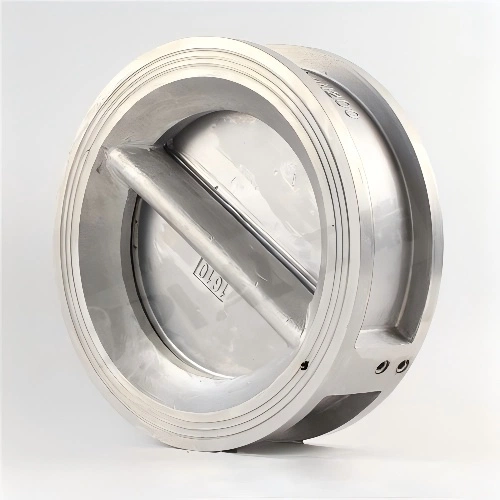
A wafer single-plate check valve uses a single tilting disc in a thin wafer body. It clamps between two flanges (no own flanges), similar to a wafer butterfly valve.
| Attribute | Specification |
|---|---|
| Best For | Compact installation, general industrial use, medium flow rates |
| Installation Orientation | Horizontal or vertical (tilting disc works both ways) |
| Closure Speed | Medium (0.2-0.5 seconds) |
| Pressure Drop | Medium (disc sits in the flow path when open) |
| Size Range | DN50–DN300 (2″–12″) |
| Body Options | CF8 / CF8M wafer body, NBR / EPDM / Viton seat |
See our wafer single-plate check valve guide for the full specification.
3. Wafer Dual-Plate Check Valve
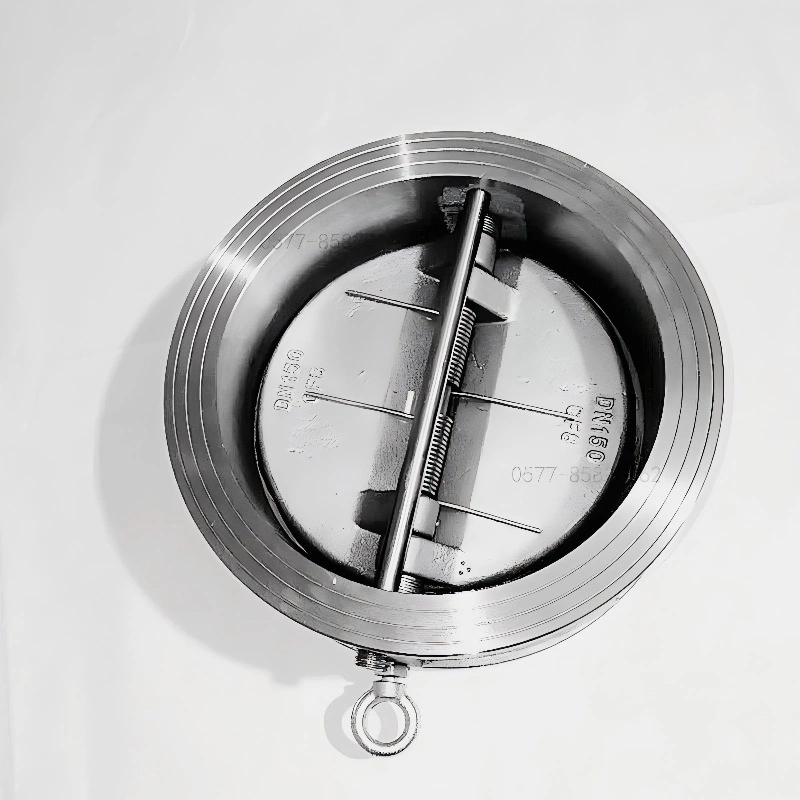
A wafer dual-plate check valve (also called a dual-disc check or duo-check) uses two spring-loaded half-discs that split open on forward flow and snap shut in milliseconds on reverse flow. This is the preferred check valve for pump discharge and fast-cycling systems.
| Attribute | Specification |
|---|---|
| Best For | Pump discharge, compressor bypass, fast-cycling systems, water-hammer reduction |
| Installation Orientation | Horizontal or vertical (spring-assisted closure works both ways) |
| Closure Speed | Fast (<0.1 seconds) — minimum water-hammer risk |
| Pressure Drop | Low-medium (discs fold flat against the body when open) |
| Size Range | DN50–DN600 (2″–24″) |
| Body Options | CF8 / CF8M / 2205 duplex wafer body, EPDM / NBR / Viton seat, spring options (standard / high-pressure) |
See our wafer dual-plate check valve guide for the full specification.
4. Lift Check Valve
A lift check valve uses a piston (or ball) that lifts vertically off its seat on forward flow and drops back onto the seat by gravity when flow stops. It’s the traditional high-pressure check valve design, often built into a globe valve-shaped body.
| Attribute | Specification |
|---|---|
| Best For | High-pressure service, vertical upward-flow lines, steam / oil & gas |
| Installation Orientation | Vertical upward flow preferred (gravity assists closure); horizontal possible but requires spring-assisted seat |
| Closure Speed | Medium (0.1-0.3 seconds, gravity-assisted) |
| Pressure Drop | High (piston in the flow path, globe-style body) |
| Size Range | DN15–DN200 (1/2″–8″) — smaller sizes dominate |
| Body Options | WCB / CF8 / CF8M flanged or threaded, metal-to-metal seat for high pressure |
See our flanged lift check valve guide for the full specification.
Head-to-Head Comparison
Here’s the quick-reference comparison table for choosing the right check valve type:
| Check Valve Type | Closure Speed | Water-Hammer Risk | Pressure Drop | Orientation | Best Use |
|---|---|---|---|---|---|
| Swing | Slow (0.5-2 s) | High | Low | Horizontal | Large diameter, low velocity, steady flow |
| Wafer Single-Plate | Medium (0.2-0.5 s) | Medium | Medium | Horizontal or vertical | Compact general industrial |
| Wafer Dual-Plate | Fast (<0.1 s) | Low | Low-medium | Horizontal or vertical | Pump discharge, fast cycling |
| Lift | Medium (0.1-0.3 s) | Medium | High | Vertical upward | High pressure, steam, oil & gas |
See spring vs swing check valve for the deeper dive on closure-speed tradeoff.
Worked Example: Bangkok HVAC Water Hammer
Step 1 — Problem
A Bangkok shopping-mall HVAC system had 12 primary chilled-water pumps (DN200 discharge, 1200 m³/h each). Each pump discharge was fitted with a flanged swing check valve — the standard specification the mechanical contractor used on every project. The pumps cycled on and off frequently as the mall loaded and unloaded through the day. Within 6 months of commissioning, two welded joints on the DN200 discharge line had cracked and started leaking chilled water onto the floor below. Plant maintenance documented the leaks: each joint cracked within 2 seconds of a pump stopping. The ops team called in a hydraulic consultant, who diagnosed water hammer from slow swing-check closure.
Step 2 — Root cause analysis
A swing check valve on a DN200 line takes roughly 1-2 seconds for the hinged disc to swing shut after pump stop. In that 1-2 seconds, the forward flow decelerates rapidly (because the pump is off), but the reverse flow starts rushing back toward the pump — the disc hasn’t closed yet. When the disc finally slams shut, the reverse-flow momentum is stopped instantly, creating a pressure spike of 2-3× the operating pressure (water hammer). On a 1200 m³/h DN200 line, that spike is enough to crack welded joints and damage pump mechanical seals. The consultant calculated the spike at ~18 bar (operating pressure was 6 bar) — well above the pipe design pressure.
Step 3 — Correct retrofit
Chuanglan Valve supplied 12× DN200 wafer dual-plate check valves in CF8M (316 stainless) with EPDM seats and spring-assisted closure. The dual-plate design closes in <0.1 seconds — fast enough that the reverse-flow momentum never builds, eliminating the water-hammer spike. The dual-plate valves were wafer-style (clamped between the existing pipeline flanges), so the retrofit took 4 hours per pump during a scheduled mall maintenance window, with no pipe modification needed. The mall switched all 12 pumps in one 2-day shutdown.
Step 4 — Outcome
• No further joint cracks or mechanical-seal failures in the 18 months since the retrofit.
• The mall’s mechanical consultant added a permanent line to every future HVAC pump spec: “Pump discharge check valve: wafer dual-plate (spring-assisted), NOT swing. Closure time <0.1 seconds.”
• Lesson: swing check valves are fine for large, slow, steady-flow lines — but on pump discharge with frequent cycling, they cause water hammer. Spend the small premium for dual-plate and save 100× that in joint repairs and downtime.
💡 How Chuanglan Specs Every Check Valve Quote
Four types in stock: swing, wafer single-plate, wafer dual-plate, lift — all in CF8M / CF3M / 2205 duplex options
Closure-speed datasheet on every quote (so you can match the valve to your pump cycling frequency)
Spring-loaded dual-plate with horizontal AND vertical mounting — gravity not required
MTC EN 10204 3.1 heat-number-tied certificate on every order; optional SGS / BV / Intertek / Lloyd’s PMI XRF witness
MOQ starts at 1 piece for stock items, 7–15 day standard delivery, OEM / ODM from 200+ pcs
Not Sure Which Check Valve Your Pump Discharge Needs?
Send us your line size, flow rate, operating pressure, pump cycling frequency, and installation orientation — our engineers will recommend the right check valve type and reply within 24 hours.
Get Free Sizing Report →Southeast Asia & Middle East Market Notes
For clients in Southeast Asia, check valve selection is dominated by HVAC and water-treatment projects. Bangkok, Jakarta, Ho Chi Minh, and Manila shopping malls and office buildings use chilled-water pump discharge — and the #1 spec error we see is swing check on pump discharge, exactly the water-hammer failure in the Bangkok worked example above. We now review every HVAC pump spec before quoting and recommend dual-plate as default for pump discharge. Water-treatment plants (raw-water intake, filter backwash) typically use swing check on large-diameter steady-flow lines (DN300+), which is fine — but the backwash pump discharge should always be dual-plate. Palm-oil mill condensate and steam systems use lift check on vertical lines, because gravity-assisted closure is dependable for saturated steam.
For clients in the Middle East (Saudi Arabia, UAE, Qatar, Kuwait, Oman, Bahrain), check valve selection is dominated by district cooling (Tabreed, QCool, Marafiq) and oil & gas. District cooling primary pump discharge uses wafer dual-plate check in 2205 duplex for seawater side and CF8M for closed fresh-water side — water-hammer on a district-cooling pump loop is a one-way ticket to pipe-burst and lost cooling load. Oil & gas EPCs (Saudi Aramco SAES, ADNOC ICV, KNPC, QatarEnergy) require API 6D check valves with ISO 15156 for sour service — typically swing check for large-diameter transmission, lift check for high-pressure small sizes, with metal-to-metal seats. Always verify the owner’s engineering standard before choosing check valve type.
Chuanglan Valve ships swing check valves, wafer single-plate check valves, wafer dual-plate check valves, and flanged lift check valves in CF8 / CF8M / CF3M / 2205 duplex, full EN 10204 3.1 MTC, and optional third-party inspection. Serving EPC Contractors Across Southeast Asia & Middle East · ISO 9001:2015 Certified · 15+ Years Factory Experience · MOQ starts at 1 piece, 7–15 day standard delivery.
Common Mistakes to Avoid
- Specifying 304 stainless for coastal or chloride service. If your project is in Southeast Asia (coastal, cooling tower, deicing salts) or the Middle East (desalination, SWRO, humid Gulf climate), 304 will pit within 1–3 years. Specify CF8M (316) or duplex 2205.
- Ignoring pressure-temperature derating. PN16 / Class 150 ratings apply at room temperature only. At 200°C the allowable pressure drops by roughly 40–50%. Always check the manufacturer’s P-T chart before specifying for steam, hot oil, or thermal fluid.
- Buying on price without MTC verification. “Stainless steel” is not enough — ask for EN 10204 3.1 MTC tied to the heat number, and arrange PMI (XRF) witness at the factory if the price is 20% below market. 304 passed off as 316L is the single most common failure in this industry.
- Forgetting face-to-face and flange drilling. A “PN16” wafer valve from one manufacturer may not match the existing flange drilling or face-to-face of another. Always confirm dimensions against EN 558 / API 609 / ASME B16.10 before replacing an installed valve.
FAQ
What is the difference between swing and dual-plate check valves?
Swing check uses a hinged disc that swings open and slams shut (closure time 0.5-2 seconds). Dual-plate check uses two spring-loaded half-discs that close in <0.1 seconds. Swing is better for large-diameter steady-flow lines; dual-plate is better for pump discharge and fast-cycling systems where slow closure causes water hammer.
Which check valve type is best for pump discharge?
Wafer dual-plate (spring-assisted) is the default choice for pump discharge. It closes in <0.1 seconds, preventing reverse-flow momentum from building and eliminating water-hammer spikes. Swing check valves on pump discharge are the most common cause of pipe-burst and mechanical-seal failures.
Can a swing check valve be installed vertically?
Technically yes, but the hinged disc works against gravity on vertical upward-flow lines, causing delayed closure and leakage. For vertical upward flow, use a wafer single-plate, wafer dual-plate, or lift check valve instead.
What size range do check valves come in?
Swing and dual-plate: DN50–DN600 (2″–24″), larger on request. Wafer single-plate: DN50–DN300. Lift check: DN15–DN200 (smaller sizes dominate because lift style has high pressure drop).
What body material should I use for seawater check valves?
2205 duplex body for direct seawater (desalination, cooling-tower open loop). CF8M (316) is acceptable for brackish water and coastal air but not direct seawater. Ductile iron and WCB should not be used on coastal or seawater service.
Do check valves require maintenance?
Check valves are normally maintenance-free, but we recommend inspecting seats and discs every 3-5 years on critical service (pump discharge, boiler feed). Seats (EPDM / NBR / Viton) are consumable on high-cycling systems and may need replacement every 5-8 years.
What is the lead time for check valves from Chuanglan?
Standard stock items (DN50–DN200, CF8M, PN16, EPDM seat) ship in 5–10 days to Southeast Asia and 15–20 days to the Middle East. Custom configurations (2205 duplex, API 6D, ISO 15156 sour service, large DN400+) take 25–35 days. MOQ starts at 1 piece for stock items.
References & Standards
Related Products
Continue Reading
Get a Check Valve Quote for Your Pump Discharge
MOQ: 1 piece · ISO 9001:2015 certified · EN 10204 3.1 MTC included · 100% factory pressure tested
Southeast Asia: Indonesia, Malaysia, Thailand, Vietnam, Myanmar, Singapore, Philippines
Middle East: Saudi Arabia, UAE, Qatar, Kuwait, Oman, Bahrain
Other Regions: Europe, North America, South America, Africa, Australia
Delivery: 5–10 days to Southeast Asia · 15–20 days to the Middle East · 25–35 days to Europe / the Americas
Payment: T/T 30% deposit + 70% before shipment · L/C at sight · Warranty: 12 months after shipment for material and manufacturing defects · Packing: export plywood case / fumigation-free pallet · Shipping: FOB Ningbo/Shanghai · Documents: EN 10204 3.1 MTC + packing list + commercial invoice · Third-party inspection welcome: SGS / Bureau Veritas / Intertek
Get Free Quote »Need a quote or datasheet? Tell us size, pressure class and material – reply within 24 hours.
Request a Quote