


How to Clean a Y Strainer: Step-by-Step Maintenance Guide
Isolate → vent → remove the screen → back-flush inside-out → replace the gasket → restart. A 6-step procedure that prevents pump shutdowns, water hammer and gasket leaks on industrial water, steam, oil and food lines.
* Standard lead time depends on order quantity and destination country. 5–10 days to Southeast Asia, 15–20 days to the Middle East.
⚡ Quick Answer
To clean a Y strainer: (1) close upstream + downstream isolation valves and vent the body, (2) unscrew the drain plug at the Y branch, (3) pull the screen out along the Y angle, (4) back-flush from inside out with low-pressure water (soak in mild degreaser for oil/scale), (5) replace the body gasket every time, (6) hand-tighten, reopen downstream first, then upstream slowly.
The most dependable trigger is pressure drop: when inlet-to-outlet ΔP rises 10–15% above the clean baseline, it is time to clean — do not rely on a fixed calendar alone.
🔑 Key Takeaways
- Signal to clean: Inlet-to-outlet pressure drop rises by 10–15% over the clean baseline. Fit one pressure gauge on each side — this is the single best maintenance upgrade.
- Cleaning direction: Always back-flush inside → outside. Flushing from the outside pushes debris deeper into the mesh and blows it through.
- Gasket rule: Replace the body gasket on every opening. Reused gaskets are the #1 cause of leaks after reassembly.
- Southeast Asia / coastal projects: 304 (CF8) pits within 12–24 months in humid, chlorinated or coastal air — specify CF8M (316) body and screen for Indonesia, Malaysia, Thailand, Vietnam and Gulf refineries.
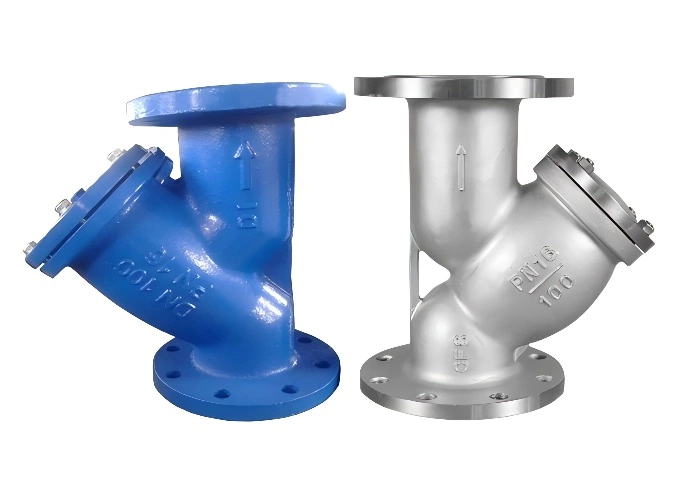
On This Page
1. Why Y Strainer Cleaning Matters
A clogged Y strainer is one of the most common causes of unexpected pump shutdowns, pressure drops and product contamination in industrial piping. Whether you run a water treatment plant, a food processing line or an oil & gas pipeline, regular Y strainer maintenance prevents expensive downtime. This guide walks you through exactly how to clean a Y strainer step by step, how often to do it, and the mistakes that damage the screen.
2. How Often Should You Clean a Y Strainer?
Cleaning frequency depends on your media and pressure drop. As a rule of thumb:
- Clean water loops: every 3-6 months
- Cooling water: every 1-2 months
- Steam systems: every 4-8 weeks
- Oil & gas / slurry: every 2-4 weeks
- Food & beverage: every week or after each batch
The most dependable signal is pressure drop. If inlet pressure minus outlet pressure rises by more than 10-15% above the clean value, it’s time to clean. Install a pressure gauge on both sides of the strainer — this is the single best maintenance investment you can make.
3. Step-by-Step Cleaning Procedure
Step 1 — Isolate the line. Close the upstream and downstream isolation valves. If the system is under pressure, vent it slowly through the drain/cock at the bottom of the strainer body. Never open a pressurized strainer.
Step 2 — Remove the plug or cap. Unscrew the drain plug (blow-off cock) at the bottom of the Y branch. For larger strainers, this may be a flanged cover. Have a bucket ready — trapped water will drain out.
Step 3 — Take out the screen. Pull the perforated/screen element straight out along the Y branch angle. Inspect it: most damage (holes, blown mesh) happens near the inlet side where debris hits hardest.
Step 4 — Clean the screen. Rinse with low-pressure water from the inside out (back-flush direction) to push debris out through the perforations. For stubborn oil or scale, soak in a mild degreaser or citric acid solution. If the mesh is torn, holes >10% of the open area, or corroded, replace it — do not reuse a damaged screen.
Step 5 — Inspect the gasket. Replace the body gasket every time you open the strainer. A reused gasket is the #1 cause of leaks after reassembly. EPDM, NBR or PTFE — match your media.
Step 6 — Reassemble and restart. Insert the screen fully, replace the gasket, hand-tighten the plug (don’t over-torque). Open the downstream valve first, then the upstream valve slowly to avoid water hammer. Check for leaks for 5-10 minutes.
4. Common Mistakes to Avoid
| Mistake | Consequence | Correct Action |
|---|---|---|
| Cleaning from outside in | Pushes debris deeper into mesh | Back-flush inside → out |
| Reusing old gasket | Leak after reassembly | Replace gasket every time |
| Opening under pressure | Water jet, injury, lost product | Isolate + vent first |
| Installing screen backwards | Screen collapses, blows out | Perforated side faces flow inlet |
| Ignoring pressure drop | Pump damage, low flow | Fit pressure gauges both sides |
International Standards Reference
| Standard Category | US / ANSI | European / EN | Japanese / JIS |
|---|---|---|---|
| Design | ASME B16.34 / MSS SP-80 | EN 12516 | JIS B2003 |
| Pressure Rating | ANSI Class 150-2500 | PN10-PN40 | 10K-20K |
| Flange | ASME B16.5 | EN 1092-1 | JIS B2220 |
| End Connection | NPT thread / socket weld / flanged | BSP thread / flanged | Rc thread / flanged |
| Screen Mesh | Perforated 3/6/10/20 mesh or wedge wire | Perforated 0.5-3 mm holes | Perforated 0.5-3 mm holes |
| Shell Material | CF8M (316) / CF8 (304) / WCB carbon | 1.4408 (316L) / 1.4308 (304) | SCS14A (316L) / SCS13A (304) |
| Testing | API 598 / ISO 5208 | EN 12266-1 | JIS B2003 |
5. When to Replace vs Clean the Screen
Not every screen should be cleaned and reused. Replace it when you see:
- Torn mesh or holes larger than 10% of open area
- Corrosion on 304/316 screen (especially in chlorinated water or seawater)
- Permanent deformation (screen collapsed inward)
- Food/pharma applications — always replace for hygiene, don’t reuse
For sizing the right mesh rating for your media, see our Y strainer sizing guide. And if you’re unsure about pipe orientation during reinstall, review the correct Y strainer orientation guide.
💡 Why EPC Contractors Buy Y Strainers from Chuanglan
304 / 316L Y strainers threaded, socket-weld and flanged from DN15 to DN300
Replaceable mesh screens in stock (3/6/10/20 mesh) — one-day dispatch for spares
ISO 9001:2015 certified factory, 100% pressure tested, EN 10204 3.1 MTC included
Need a Replacement Y Strainer or Mesh Screen?
Send us your pipe size, pressure rating and media — we’ll quote the correct body and mesh spec within 24 hours.
Get Free Sizing Report →6. Southeast Asia & Middle East Market Notes
If you operate in Thailand, Malaysia, Indonesia or Vietnam — where palm oil, natural gas and water treatment plants run year-round in high humidity — 304 stainless steel is often not enough. Opt for CF8M (316) strainer bodies and screens in coastal or chemical-exposed environments. The small price difference avoids premature corrosion and strainer failure in 12-24 months.
Middle East note: Gulf water treatment, seawater cooling and desalination plants (Jeddah, Dammam, Jubail, Abu Dhabi, Dubai) run chlorinated water year-round — even 316L pits above 50°C in high-chloride service. Specify 316L with wedge-wire screens, or consult our engineers for 2205 duplex / Hastelloy options on critical cooling loops.
For project-specific material selection, contact our engineers.
Worked Example: Sizing Mesh for a Cooling Water Line
Problem: A plant in Jakarta runs a cooling water line at DN100 (4″), flow 80 m³/h, velocity 1.5 m/s. The pump impeller is 60 mm. What mesh should the Y strainer use?
Step 1 — Determine pump protection gap: A 60 mm impeller needs inlet protection of particles smaller than 3 mm (API 614 practice: 0.5% of impeller diameter). That means 20 mesh = 840 μm openings is too fine; 20 mesh catches particles up to 0.84 mm — that’s over-spec.
Step 2 — Pick standard mesh: For general cooling water with filter, use 20 mesh (840 μm) if downstream has spray nozzles; use 1/8″ perforated screen (3.2 mm holes) if only protecting the pump. The 1/8″ screen gives 80% open area and much lower pressure drop.
Step 3 — Calculate pressure drop: At 80 m³/h through DN100 Y strainer with 1/8″ perforated screen: ΔP ≈ 0.05 bar clean, rising to 0.2 bar when dirty. Set the differential alarm at 0.15 bar — clean when it hits that level.
Answer: Use 1/8″ (3.2 mm) perforated SS316 screen for pump protection. Clean at ΔP 0.15 bar, typically every 3–4 months in cooling tower service.
FAQ
How often should I clean a Y strainer?
Clean water loops: every 3-6 months. Cooling water: every 1-2 months. Steam systems: every 4-8 weeks. Oil/gas slurry: every 2-4 weeks. Food & beverage: weekly or after each batch. The real trigger is pressure drop — when ΔP rises 10-15% above clean baseline, clean immediately.
What causes a Y strainer to clog?
Common sources: sand and sediment in raw water, rust/scale from carbon steel pipes, welding spatter left after commissioning, biofilm and marine growth in cooling water, polymer and fibre in food lines, and process catalyst fines in oil & gas. A suction-side strainer catches debris before it reaches the pump impeller.
Can I clean the screen with high-pressure water?
Use low-pressure water only — typically below 5 bar. High-pressure jetting distorts thin mesh and can blow holes in the screen. For oil or scale, soak in mild degreaser or dilute citric acid, then back-flush inside-out. Replace the screen if mesh is torn or corroded.
Which direction should the mesh / perforated screen face?
The perforated (solid) side faces the flow inlet; the mesh backing sits on the outlet side. If the screen is reversed, it collapses inward and can blow out under pressure surges. See our Y strainer orientation guide for the correct installation angle.
304 or 316L strainer body for coastal / Southeast Asia / Gulf projects?
Use 316L (CF8M) for coastal Indonesia, Malaysia, Thailand, Vietnam, chlorinated cooling water, desalination feed, and any Gulf seawater application. 304 (CF8) is acceptable for clean water and dry utility loops but will pit within 12-24 months in humid, chlorinated or coastal air.
How do I know when to replace vs clean the screen?
Clean and reuse when the mesh is intact and pressure drop recovers after back-flushing. Replace when: mesh is torn, holes exceed 10% of open area, mesh is visibly corroded, screen is permanently deformed, or the service is food/pharma hygiene.
References & Standards
- ASME B16.34: Valves — Flanged, Threaded, and Welding End
- MSS SP-80: Guidelines for the Selection and Installation of Strainers
- EN 12516: Industrial valves — shell design strength
- API 598: Valve Inspection and Testing
- ISO 5208: Industrial valves — pressure testing of metallic valves
Related Products
Continue Reading
Get a Quote for Y Strainers or Replacement Mesh
MOQ: 1 piece · ISO 9001:2015 certified · 3.1 MTC included · 100% factory pressure tested
Southeast Asia: Indonesia, Malaysia, Thailand, Vietnam, Singapore, Philippines, Myanmar
Middle East: Saudi Arabia, UAE, Qatar, Kuwait, Oman, Bahrain
Other Regions: Europe, North America, South America, Africa, Australia
Delivery: 5–10 days to Southeast Asia · 15–20 days to the Middle East · 25–35 days to Europe / the Americas
Payment: T/T 30% deposit + 70% before shipment · L/C at sight · Warranty: 12 months after shipment for material and manufacturing defects · Packing: export plywood case / fumigation-free pallet · Shipping: FOB Ningbo/Shanghai · Documents: EN 10204 3.1 MTC + packing list + commercial invoice · Third-party inspection welcome: SGS / Bureau Veritas / Intertek
Contact Our Engineers »Need a quote or datasheet? Tell us size, pressure class and material – reply within 24 hours.
Request a Quote