


Y Strainer vs Basket Strainer: Which One to Choose in 2026?
Complete comparison, sizing example and FAQ for piping engineers — flow capacity, pressure drop, viscosity correction and Southeast Asia/ME market notes.
* Standard lead time depends on order quantity and destination country. 5–10 days to Southeast Asia, 15–20 days to the Middle East.
⚡ Quick Answer
Choose a Y strainer for small-to-medium lines (DN15–DN300) carrying low-viscosity fluids such as water, steam or gas. Choose a basket strainer for large lines (DN50+), high-viscosity fluids (oil, palm oil), or when you need to hold 3–5× more debris before cleaning.
For a typical DN100 cooling water pump with moderate sand debris, a 20-mesh Y strainer is sufficient. Switch to a basket strainer only when flow exceeds ~300 m³/h, viscosity exceeds ~20 cSt, or debris load is high (seawater intake, heavy oil).
🔑 Key Takeaways
- Pick by line size & viscosity: Y strainer for DN15–DN300 water/steam/gas · basket strainer for DN50+ high-viscosity oil, palm oil or seawater intake.
- Mesh default: 20 mesh (850 μm) for general water · 30–40 mesh for steam · 10–20 mesh to protect pump seal faces.
- Cleaning trigger: When ΔP rises by 0.2–0.3 bar above baseline — for a DN100 Y strainer at 120 m³/h, clean when ΔP reaches ~0.25 bar (50% screen blockage).
- Orientation rule: Vertical Y strainers must have flow going upward so debris falls into the screen; downward flow lets sediment bypass the screen entirely.
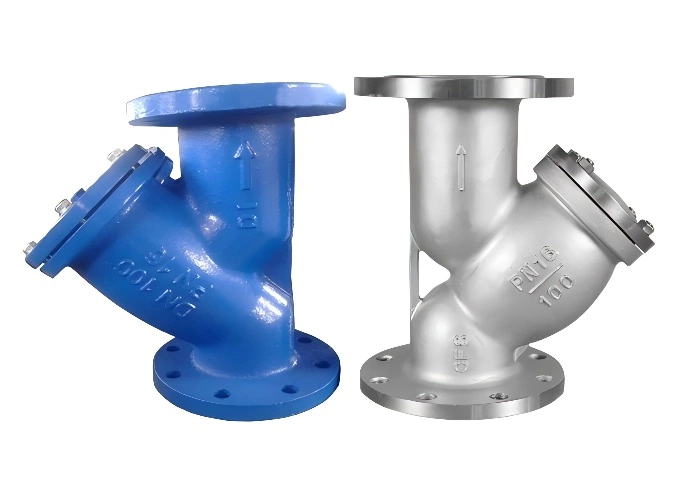
When engineers design piping systems, one of the most common questions is: should I use a Y strainer or a basket strainer? Both remove solids from flowing media, but they work differently in terms of pressure drop, flow capacity, maintenance, and installation orientation. In this guide, we compare both types side by side with real sizing examples and help you pick the right one for your project.
On This Page
What is a Y Strainer?
A Y strainer (also called a wye strainer) gets its name from its Y-shaped body. The screening element sits at a 45° angle to the pipeline, allowing it to be installed in horizontal or vertical lines where flow is upward. It is compact, lightweight, and ideal for moderate filtration of low-viscosity fluids such as water, steam, gas, and oil.
Y strainers are commonly used upstream of pumps, meters, control valves, butterfly valves and check valves to protect expensive equipment from pipe scale, welding spatter, and other debris. At Chuanglan Valve, we manufacture CF8/CF8M stainless steel Y strainers from DN15 to DN300, with perforated or wire-wound screens available.
What is a Basket Strainer?
A basket strainer (also called a pot strainer or bucket strainer) uses a cylindrical “basket” that drops vertically into a larger chamber. The larger internal volume means it can hold significantly more debris before needing cleaning. Basket strainers are designed for high flow rates, high viscosity fluids, and applications where frequent cleaning is not practical.
They are typically installed in horizontal lines with the basket accessible from above (via a bolted cover). Common applications include cooling water systems, chemical processing, fuel oil, and any line where the strainer must capture a large volume of solids without causing pressure buildup — for example, upstream of ball valves in large cooling circuits.
Side-by-Side Comparison Table
| Parameter | Y Strainer | Basket Strainer |
|---|---|---|
| Body Shape | Y-shaped, 45° angle | Vertical pot/bucket |
| Size Range | DN15 – DN300 (½” – 12″) | DN50 – DN600 (2″ – 24″) |
| Flow Capacity | Good for small-to-medium lines | Excellent for large lines / high flow |
| Debris Holding | Small screen area → clean more often | Large basket → holds 3–5× more debris |
| Pressure Drop (clean) | Low (≈0.05–0.1 bar at design flow) | Slightly higher (≈0.1–0.2 bar) |
| Installation | Horizontal or vertical (upward flow) | Horizontal only (basket from top) |
| Best For | Water, steam, gas, oil; small lines | High viscosity, cooling water, large flow |
| Weight / Cost | Lightweight, lower upfront cost | Heavier, higher upfront cost |
International Standards Reference
| Standard Category | US / ANSI | European / EN | Japanese / JIS |
|---|---|---|---|
| Design | MSS SP-80 / ASME B16.5 | EN 1092-1 | JIS B2003 |
| Face-to-Face | ASME B16.10 | EN 558 / ISO 5752 | JIS B2002 |
| Flange | ASME B16.5 (Class 150/300) | EN 1092-1 (PN10/16/25/40) | JIS B2220 (10K/20K) |
| Pressure Rating | ANSI Class 150–300 | PN10–PN40 | 10K–20K |
| Testing | API 598 / API 6D | EN 12266-1 | JIS B2003 |
| Materials | ASTM A351 CF8/CF8M | EN 10213 | JIS G5121 |
| Waterworks | AWWA C509 | EN 12334 | — |
Note: ANSI Class and PN ratings are not directly interchangeable — always verify pressure-temperature rating tables. Our strainers are manufactured to meet all three standards above.
Worked Example: Sizing for a Water Pipeline
Scenario: A palm oil mill in Indonesia needs to protect a centrifugal cooling-water pump. Design flow = 120 m³/h, pipe size = DN100 (4″), water at 30°C, expected debris = sand and pipe scale.
Step 1 — Calculate velocity:
Pipe area = π × (0.1/2)² = 0.00785 m²
Velocity = 120 m³/h ÷ 3600 s ÷ 0.00785 m² = 4.24 m/s
Step 2 — Choose strainer type:
For 4″ cooling water with moderate sand debris, a DN100 Y strainer with 20 mesh perforated screen is sufficient. If the line were DN200+ or carrying high-viscosity oil, we would recommend a basket strainer instead.
Step 3 — Check pressure drop (clean screen):
Approximate ΔP for a DN100 Y strainer at 120 m³/h = 0.08 bar. This is well within the pump’s allowable NPSH margin. When the screen reaches 50% blockage, ΔP rises to ~0.25 bar — at that point, clean the screen.
💡 Why Engineers Choose Chuanglan
15+ years OEM/ODM for European & Southeast Asian distributors
CF8/CF8M body material, ISO 9001:2015 certified factory, 100% factory pressure tested
MOQ: 1 piece — small trial orders welcome
Not Sure Which Strainer Size You Need?
Send us your flow rate, pipe size and fluid type — we’ll size it for you, free.
Get Free Sizing Report →Advanced: Pressure Drop & Viscosity Correction
The pressure drop numbers above assume clean water at room temperature. When working with viscous fluids (e.g., heavy oil, molasses, palm oil), the pressure drop increases significantly. Use this correction rule of thumb:
Corrected ΔP = Clean ΔP × (Viscosity / 1 cSt)^0.5
For example, if fluid viscosity = 100 cSt (≈heavy fuel oil), the pressure drop becomes roughly 10× higher. In that case, a basket strainer with a larger open area is strongly recommended, because the smaller screen of a Y strainer will clog rapidly.
Other advanced notes:
- Steam service: Y strainers are standard; basket strainers are rare for steam due to orientation constraints.
- Vacuum service: Use a basket strainer — the larger body prevents air binding.
- Duplex strainers: For critical lines where shutdown is not allowed, choose a duplex (twin) basket strainer that can be cleaned online without stopping flow.
Southeast Asia & Middle East Applications
In Southeast Asia (Indonesia, Malaysia, Thailand, Vietnam), the majority of strainer demand comes from palm oil mills, water treatment plants, and HVAC cooling systems. For palm oil mills specifically, we recommend 304/316 stainless steel basket strainers in DN100–DN300, because palm oil is viscous and leaves heavy residue that clogs Y strainers quickly.
In the Middle East (Saudi Arabia, UAE), demand is driven by seawater desalination, district cooling, and oil & gas upstream facilities. These applications often require super duplex (2205) or 316L stainless steel with epoxy-coated carbon steel bodies to resist chloride corrosion. Basket strainers dominate in desalination intake lines due to the high debris load from seawater.
Serving EPC Contractors Across Southeast Asia & Middle East · ISO 9001:2015 Certified · 15+ Years Factory Experience
Common Mistakes to Avoid
- Specifying 304 stainless for coastal or chloride service. If your project is in Southeast Asia (coastal, cooling tower, deicing salts) or the Middle East (desalination, SWRO, humid Gulf climate), 304 will pit within 1–3 years. Specify CF8M (316) or duplex 2205.
- Ignoring pressure-temperature derating. PN16 / Class 150 ratings apply at room temperature only. At 200°C the allowable pressure drops by roughly 40–50%. Always check the manufacturer’s P-T chart before specifying for steam, hot oil, or thermal fluid.
- Buying on price without MTC verification. “Stainless steel” is not enough — ask for EN 10204 3.1 MTC tied to the heat number, and arrange PMI (XRF) witness at the factory if the price is 20% below market. 304 passed off as 316L is the single most common failure in this industry.
- Forgetting face-to-face and flange drilling. A “PN16” wafer valve from one manufacturer may not match the existing flange drilling or face-to-face of another. Always confirm dimensions against EN 558 / API 609 / ASME B16.10 before replacing an installed valve.
FAQ
Can I install a Y strainer vertically?
Yes, but only when flow is upward (so debris falls into the screen). If flow is downward, the debris will settle in the pipeline below the strainer instead of being captured.
How often should I clean the strainer screen?
Monitor the pressure drop across the strainer. Start with a baseline clean reading, and clean when ΔP increases by 0.2–0.3 bar above the baseline. For new piping systems, clean more frequently for the first 3 months.
What mesh size should I use?
General water service: 20 mesh (850 micron). Steam: 30–40 mesh. Chemicals: consult the pump/valve manufacturer’s recommendation (often 10–20 mesh to protect seal faces).
Are basket strainers always better than Y strainers?
No. For small lines (DN50 and below) and clean fluids, Y strainers are cheaper, lighter, and easier to install. Basket strainers only make sense when flow rate, debris volume, or viscosity is high.
What materials does Chuanglan offer?
We offer CF8 (304), CF8M (316), CF3M (316L), WCB carbon steel, and duplex 2205 Y strainers and basket strainers, with threaded, wafer, and flanged ends. All units are 100% pressure tested before shipment.
What is the lead time for custom sizes?
Standard DN15–DN300 Y strainers ship within 7–15 days. Large custom basket strainers (DN350+) typically take 25–30 days. MOQ is 1 piece.
References & Standards
- ASME PTC 19.3: Applications for Strainers in Piping Systems
- ASME B16.5: Pipe Flanges and Flanged Fittings (NPS 1/2 through NPS 24)
- MSS SP-80: Specification for Thermoplastic Industrial Valves (flanged end dimensions)
- API 6D: Specification for Pipeline and Piping Valves
- AWWA C509: Standard for Resilient-Seated Iron Gate Valves (waterworks)
Related Products
Continue Reading
Request a Free Strainer Quote within 24 Hours
Tell us your pipe size, flow rate, fluid type and required mesh — we’ll reply with factory-direct pricing.
Southeast Asia: Indonesia, Malaysia, Thailand, Vietnam, Philippines, Myanmar
Middle East: Saudi Arabia, UAE, Qatar, Kuwait, Oman, Bahrain
Other Regions: Europe, North America, South America, Africa, Australia — 20+ countries total
Delivery: 5–10 days to Southeast Asia · 15–20 days to the Middle East · 25–35 days to Europe / the Americas
Payment: T/T 30% deposit + 70% before shipment · L/C at sight · Warranty: 12 months after shipment for material and manufacturing defects · Packing: export plywood case / fumigation-free pallet · Shipping: FOB Ningbo/Shanghai · Documents: EN 10204 3.1 MTC + packing list + commercial invoice · Third-party inspection welcome: SGS / Bureau Veritas / Intertek
Contact Our Engineers »Need a quote or datasheet? Tell us size, pressure class and material – reply within 24 hours.
Request a Quote