

How to Select a Wafer Butterfly Valve for Seawater Service (2026 Guide)
Material, seat, pressure rating and sizing guide for cooling water, desalination and offshore applications. Complete 2026 guide with worked example for a Red Sea SWRO intake.
* Standard lead time depends on order quantity and destination country. 5-10 days to Southeast Asia, 15-20 days to Middle East.
⚡ Quick Answer
For seawater service, always specify a 316L (CF8M) wafer butterfly valve with an EPDM seat, PN16 rating and EN 1092-1 or ASME B16.5 flange pattern.
304 stainless steel will pit within months in chloride-rich water (above 200 ppm). For a DN200 Red Sea cooling water circuit at 320 m³/h, a 316L wafer butterfly valve with EPDM seat is the standard pick. Specify 2205 duplex only for brine, splash-zone or high-velocity sand-laden service.
🔑 Key Takeaways
- Default spec for seawater: 316L (CF8M) body + disc + stem, EPDM seat, PN16, EN 1092-1 or ASME B16.5 flanged ends.
- Never use 304 in chloride water: Above 200 ppm chloride (seawater ~22,000 ppm), 304 pitts within months — 316L is the minimum grade.
- Velocity check: For DN200 at 320 m³/h, calculated velocity is 2.83 m/s — within the seawater-safe 1.5–3.0 m/s range (above 3 m/s causes erosion).
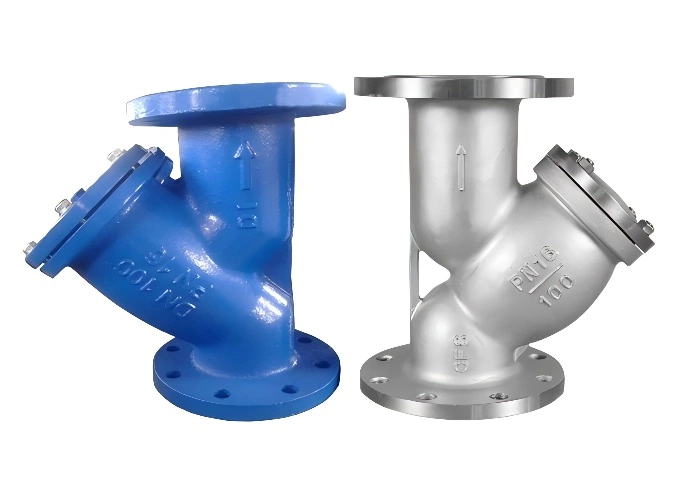
- Protect the seat: Add a 20-mesh Y-strainer upstream for untreated intakes; specify 2205 duplex only for brine, splash-zone or sand-laden service.
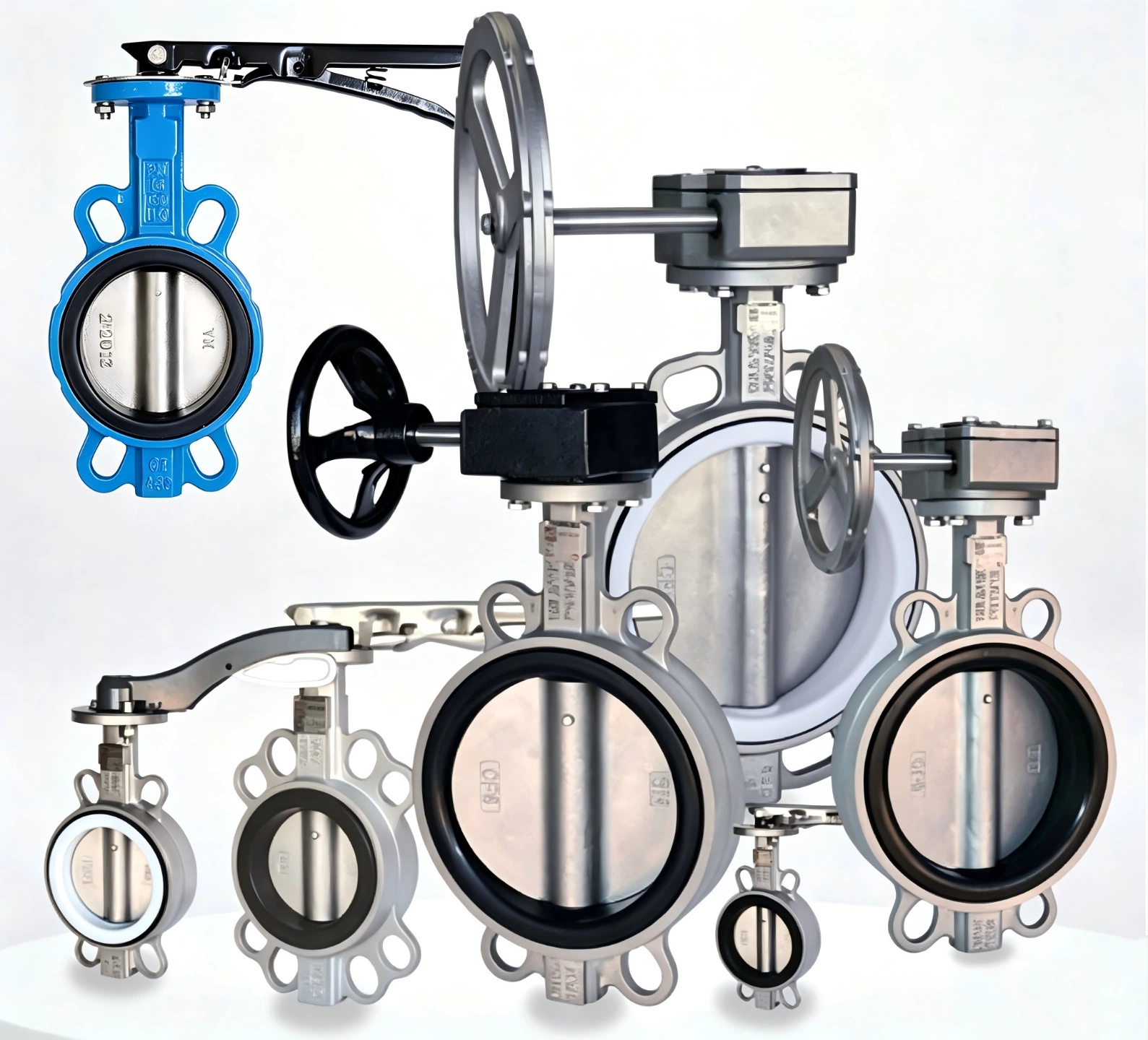
This guide explains how to choose the right wafer butterfly valve for seawater service. Seawater applications require careful valve selection because chloride-rich water accelerates pitting and crevice corrosion in standard 304 stainless steel. A wafer butterfly valve with 316L (CF8M) body and EPDM or PTFE lined seat is the most common choice for cooling water systems, desalination plants, shipboard seawater circuits and offshore platforms. We manufacture stainless steel wafer butterfly valves in sizes DN50–DN300 (2″–12″), pressure ratings PN10–PN16, with 304/316L body materials. For backflow protection, we also supply wafer check valves and y-strainers for upstream protection.
On This Page
Why 316L Body Is Mandatory for Seawater
304 stainless steel contains approximately 18% chromium and 8% nickel but no molybdenum. In chloride environments above 200 ppm, 304 suffers pitting corrosion within months — often visible as pinholes on the disc edge and stem area. 316L adds 2.0–2.5% molybdenum, which raises the pitting resistance equivalent number (PREN) from roughly 19 to 24–26.
For continuous immersion in seawater, we always specify 316L (CF8M) for the body, disc and stem. Duplex stainless steel (2205) is available for more aggressive applications such as brine systems or splash zones, but it costs 30–40% more than 316L and is usually unnecessary for standard cooling water. Also verify that the stem is not plated carbon steel — a zinc-plated stem will corrode within one season in seawater.
Seat Material: EPDM vs PTFE vs Viton
The seat material determines both chemical resistance and temperature range. For seawater cooling service, the choice is usually straightforward, but there are important edge cases.
| Seat Material | Temp Range | Seawater | Oil/Chemicals | Best For |
|---|---|---|---|---|
| EPDM | -40°C to 120°C | ✅ Excellent | ❌ Poor (swells in oil) | Standard seawater cooling water |
| PTFE (lined) | -50°C to 180°C | ✅ Excellent | ✅ Excellent | Chemical service, high temp |
| Viton (FKM) | -20°C to 200°C | ⚠️ Good but expensive | ✅ Excellent | Oil, hydrocarbon, steam |
| NBR (Buna-N) | -20°C to 80°C | ⚠️ Not recommended | ✅ Good | Fresh water, oil only |
| HNBR | -30°C to 150°C | ✅ Good | ✅ Good | Compressor, gas service |
| Silicone | -60°C to 200°C | ⚠️ Poor abrasion | ⚠️ Limited | Food/pharma high temp |
International Standards Reference
| Standard Category | US / ANSI | European / EN | Japanese / JIS |
|---|---|---|---|
| Design | API 609 | EN 593 | JIS B2002 |
| Face-to-Face | ASME B16.10 | EN 558 / ISO 5752 | JIS B2002 |
| Flange | ASME B16.5 (Class 150/300) | EN 1092-1 (PN10/16/25/40) | JIS B2220 (10K/20K) |
| Pressure Rating | ANSI Class 150–300 | PN10–PN16 | 10K |
| Testing | API 598 / API 6D | EN 12266-1 | JIS B2003 |
| Fire Safe | API 607 / API 6FA | ISO 10497 | — |
| Waterworks | AWWA C504 | EN 12334 | — |
Note: ANSI Class and PN ratings are not directly interchangeable — always verify pressure-temperature rating tables. Our butterfly valves are manufactured to meet all three standards above.
Pressure Rating and Flange Standards
PN16 is the standard rating for most seawater cooling circuits. PN10 is acceptable for low-pressure condenser water below 100 kPa. Verify your pipeline design pressure — do not upgrade to PN25 unless the system actually requires it, because PN25 flanges have different bolt hole patterns and are 20–30% more expensive.
For flanged wafer body, confirm the flange standard matches your installation: EN 1092-1 (Europe / Middle East), ASME B16.5 Class 150 (USA / Southeast Asia), or JIS 10K (Japan). Mixing EN and ASME flanges will result in a mounting mismatch even if the pressure rating appears similar. If backflow prevention is required between the pump and the heat exchanger, install a wafer check valve on the discharge side, not a second butterfly valve.
Worked Example: Red Sea Cooling Water Circuit
Problem: A desalination plant in Saudi Arabia needs an isolation valve on the seawater intake line. Design flow is 320 m³/h, pipe size DN200, design pressure 10 bar, temperature 35°C, media is untreated Red Sea seawater (chloride ~22,000 ppm).
Step 1: Calculate velocity
Pipe cross-section area = π × (0.2/2)² = 0.0314 m²
Velocity = 320 m³/h ÷ 3600 s/h ÷ 0.0314 m² = 2.83 m/s
✅ Acceptable. Seawater line optimum velocity is 1.5–3.0 m/s to avoid erosion.
Step 2: Select size and pressure class
DN200 wafer butterfly valve matches the pipe. At 2.83 m/s, pressure drop across an open butterfly valve is approximately 0.05 bar — negligible. Design pressure 10 bar → PN16 rating covers the requirement.
Step 3: Select material and seat
Chloride 22,000 ppm → 316L CF8M body, disc and 316 stem. 35°C pure seawater, no oil → EPDM seat. No need for PTFE premium.
Result: Select DN200 PN16 wafer butterfly valve, 316L body/disc, 316 stem, EPDM seat, EN 1092-1 flanged ends, gear operator. Add a y-strainer upstream to protect the seat from shellfish and debris.
💡 Why Engineers Choose Chuanglan
✅ 15+ years OEM/ODM for European & Southeast Asian distributors
✅ 304/316L body material, ISO 9001:2015 certified factory, 100% factory pressure tested
✅ MOQ: 1 piece — small trial orders welcome
Not Sure Which Seawater Valve Size You Need?
Send us your flow rate, pipe size and fluid type — we’ll size it for you, free.
Get Free Sizing Report →Advanced: Velocity, Cavitation and Corrosion Allowance
Two failure modes are often overlooked in seawater butterfly valve selection:
1. Erosion at high velocity. If velocity exceeds 3.5 m/s in untreated seawater with sand or silt, the disc edge will wear within 18–24 months. If your calculated velocity is above 3 m/s, either increase pipe size or specify a hardened disc (Stellite 6 overlay on seating edge).
2. Cavitation under throttling. A wafer butterfly valve is an isolation valve, not a control valve. If you need to continuously modulate flow between 20–70% open, the disc edge experiences pressure drops that can cause cavitation damage. For control duty, use a dedicated control valve with anti-cavitation trim.
3. Corrosion allowance. 316L cast body in seawater has a general corrosion rate of about 0.02–0.05 mm/year. Over a 10-year design life, body wall thickness loss is 0.2–0.5 mm. Standard cast wall thickness (8–10 mm) has ample margin, but verify wall thickness on smaller sizes below DN50.
Southeast Asia & Middle East Applications
We export wafer butterfly valves to Southeast Asia and Middle East markets, where coastal industrialization drives demand for seawater-rated valves:
- Indonesia & Malaysia: Palm oil mills, coastal power plants and LNG regasification terminals require 316L wafer butterfly valves with EPDM seats on cooling water systems in Sumatra and Johor.
- Saudi Arabia & UAE: Desalination plants and district cooling systems use 2205 duplex body for high-salinity Red Sea and Arabian Gulf service, supplied with SGS/BV inspection and 3.1 MTC.
- Thailand & Vietnam: Food processing and shipyard cooling circuits prefer 316L wafer butterfly valves with gear operators, paired with y-strainers for pump protection.
- Philippines: Power plants and water distribution systems use PN16 316L wafer butterfly valves for budget-friendly, reliable performance, often paired with wafer check valves for backflow prevention.
Serving EPC Contractors Across SEA & Middle East · ISO 9001:2015 Certified · 15+ Years Factory Experience
FAQ
Can I use a 304 wafer butterfly valve for seawater?
No. 304 stainless steel will suffer pitting corrosion within months in chloride-rich seawater. Always choose 316L (CF8M) body and disc.
What seat material is best for seawater?
EPDM is standard for water service. Use PTFE if the media contains oil or chemicals, or if temperature exceeds 80°C.
Do I need a pneumatic actuator or is a manual handle enough?
Manual handle is fine for isolation valves. Use a pneumatic actuator if you need automatic control, fail-safe closure or remote operation from the control room.
Should I install a y-strainer before the butterfly valve?
Yes for untreated seawater intakes. Shellfish, sand and debris can damage the seat and prevent tight shutoff. A 20 mesh y-strainer upstream is standard practice.
What pressure rating do I need?
PN16 is standard for most cooling water circuits. PN10 works for low-pressure condenser water below 100 kPa. Do not over-specify PN25 unless your system requires it.
Can you supply 2205 duplex for aggressive seawater?
Yes. 2205 duplex and 2507 super duplex are available for critical Middle East desalination projects. Lead time is 25–35 days. We also supply 3.1 MTC and SGS/BV inspection.
What is the typical lead time for wafer butterfly valves?
7–15 working days for standard sizes (DN50–DN150) in 316L/EPDM. 20–30 days for special materials (2205 duplex), PTFE seats or pneumatic actuators.
References & Standards
- API 609: Butterfly Valves — Double-Offset, Triple-Offset, and Double-Eccentric
- ASTM A351/A351M: Standard Specification for Castings, Austenitic, for Pressure-Containing Parts (CF8M / 316L)
- EN 1092-1: Flanges and their joints — Circular flanges for pipes, valves, and fittings
- AWWA C504: Standard for Rubber-Seated Butterfly Valves
- NACE MR0175 / ISO 15156: Petroleum and natural gas industries — Materials for use in H2S-containing environments
Related Products
Continue Reading
Request a Free Seawater Valve Quote within 24 Hours
Send us your pipe size, flow rate, fluid type and required seat material — we will reply with factory direct pricing.
Southeast Asia: Indonesia, Malaysia, Thailand, Vietnam, Philippines, Myanmar
Middle East: Saudi Arabia, UAE, Qatar, Kuwait, Oman, Bahrain
Other Regions: Europe, North America, South America, Africa, Australia — 20+ countries total
🚢 Delivery: 5-10 days to Southeast Asia · 15-20 days to Middle East · 25-35 days to Europe / Americas
Contact Our Engineers →Need a quote or datasheet? Tell us size, pressure class and material – reply within 24 hours.
Request a Quote