


Ball Valve vs Gate Valve 2026: Which One to Choose for Your Piping System?
The complete 2026 comparison — operation, sealing, pressure drop, throttling, size range, cost, maintenance, and the regional selection rules for Southeast Asia and the Middle East EPC projects.
* Standard lead time depends on order quantity and destination country. 5–10 days to Southeast Asia, 15–20 days to the Middle East.
⚡ Quick Answer
Choose a ball valve for DN8–DN300 tight shutoff, fast quarter-turn, compact footprint and easy automation. Choose a gate valve for DN350+ large-diameter lines, minimal pressure drop in full-open position, steam/utility service, and when ball valves become uneconomic. Neither is designed for throttling — use a globe valve or control valve for flow regulation. For SWRO / desalination plants, the standard practice is a mixed approach: ball valves on RO skids, gate valves on large intake and outfall lines.
🔑 Key Takeaways
- Ball valve = quarter-turn, bubble-tight shutoff, compact, automatable — best for DN8–DN300 water, gas, oil and chemical lines.
- Gate valve = multi-turn rising stem, near-zero ΔP when fully open — cost-effective at DN350+; preferred for steam, condensate and large utility lines.
- Cost crossover around DN300–DN350: below DN150 ball and gate are similar in price; above DN400 a ball valve can cost 2–3× the equivalent gate valve.
- Never throttle either valve mid-position. Partially opening a ball valve erodes the soft seat; partially opening a gate valve vibrates the wedge and wears seat rings. Use a globe or control valve instead.
On This Page
1. What Is a Ball Valve?
Choosing the right valve for your piping system is one of the most common questions our clients ask us, especially when selecting between ball valves and gate valves for industrial, water treatment and oil & gas projects. Both are commonly used stainless steel valves, but they work differently and are suited for noticeably different applications.
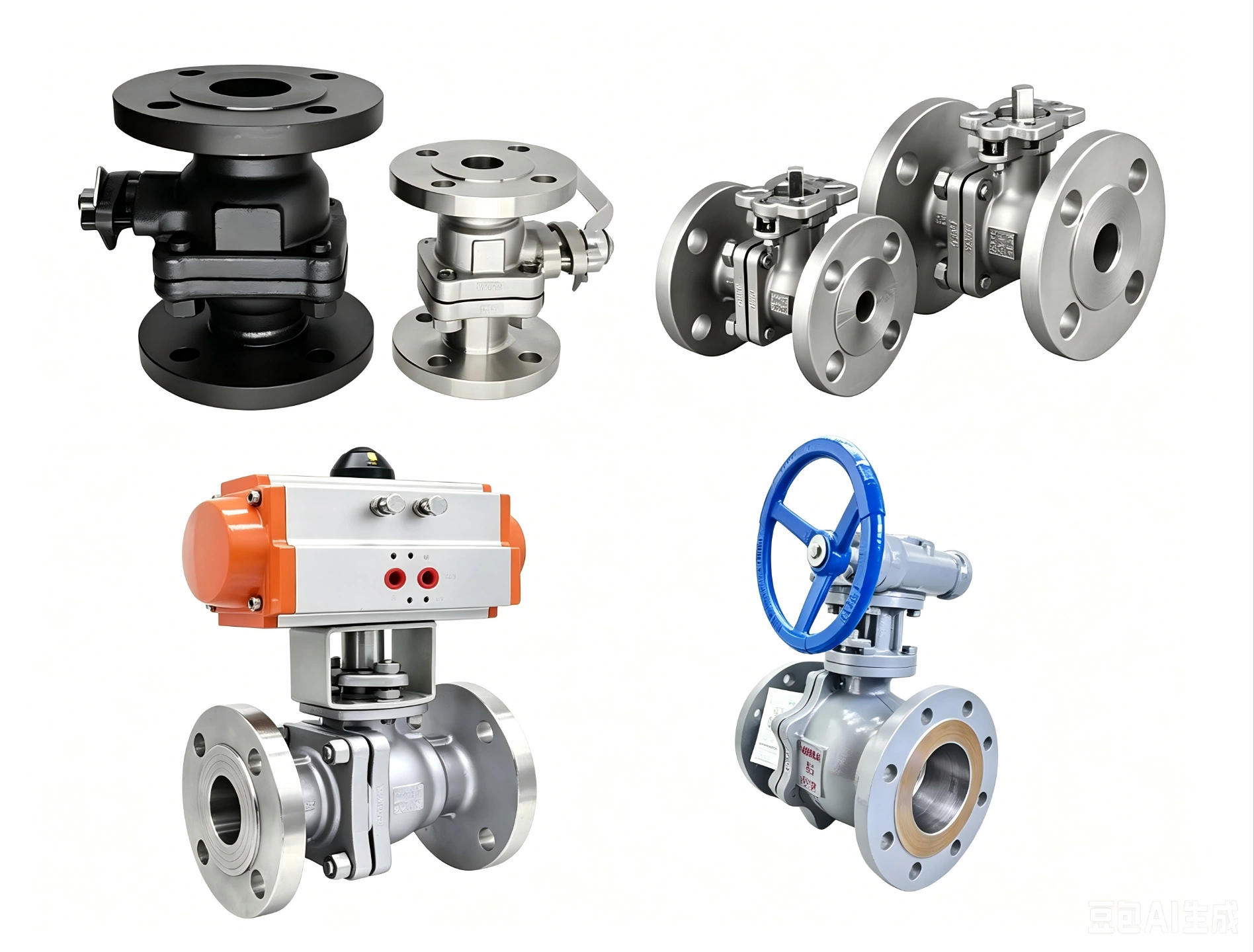
A ball valve uses a hollow, perforated rotating ball to control flow. Turn the handle 90 degrees, and the ball aligns to open or close the flow path completely. It provides tight shutoff, low pressure drop when fully open (full-bore design), and requires little maintenance.
2. What Is a Gate Valve?
A gate valve uses a rising, wedge-shaped gate that lifts up or drops down to block flow. It is designed for fully open or fully closed operation, with minimal flow resistance when fully open, and is commonly used for large diameter pipelines. The stem rises visibly as the valve opens, giving a clear visual indicator of position.
3. Ball Valve vs Gate Valve: Head-to-Head Comparison
| Feature | Ball Valve | Gate Valve |
|---|---|---|
| Operation | 90° quarter turn, fast open/close | Multi-turn rising stem, slow operation |
| Sealing Performance | Excellent bubble-tight shutoff | Good shutoff, can leak slightly over time |
| Pressure Drop (fully open) | Moderate (full bore ≈ low; reduced bore higher) | low, full unobstructed flow |
| Throttling Capability | Poor — seats get damaged in mid-position | Acceptable for light throttling at low velocity |
| Size Range | DN8 to DN300 (larger = expensive) | DN15 to DN600+ (cost-effective at large sizes) |
| Weight (DN100 Class 150) | ≈ 12–18 kg | ≈ 25–35 kg |
| Relative Cost (DN100 304) | Slightly higher | Lower at DN100–DN150; significantly cheaper at DN400+ (2–3× less) |
| Maintenance | low, simple design | Higher — packing and stem maintenance required |
| Actuation | Easy — small pneumatic/electric actuator | Heavier multi-turn actuator needed (3–5× larger) |
International Standards Reference
| Standard Category | US / ANSI | European / EN | Japanese / JIS |
|---|---|---|---|
| Ball Valve Design | API 6D / ASME B16.34 | EN 12516 / EN ISO 17292 | JIS B2003 |
| Gate Valve Design | API 600 / ASME B16.34 | EN 12516 / EN 1984 | JIS B2003 |
| Pressure Rating | ANSI Class 150-2500 | PN10-PN100 | 10K-40K |
| Flange | ASME B16.5 / B16.47 | EN 1092-1 | JIS B2220 |
| Body Material | CF8M (316) / CF8 (304) / WCB / WCC | 1.4408 (316) / 1.4308 (304) | SCS14A (316) / SCS13A (304) |
| Seat / Trim | PTFE / RPTFE / Graphite / 316 trim | PTFE / RPTFE / Graphite | PTFE / RPTFE |
| Testing | API 598 / ISO 5208 | EN 12266-1 | JIS B2003 |
4. Worked Example: SWRO Desalination Plant (Ras Al Khaimah, UAE)
Let’s walk through a real EPC project at a SWRO desalination plant in Ras Al Khaimah, UAE.
Step 1 — Project scope
A 100,000 m³/day SWRO plant needs 80 isolation valves across the seawater intake, pre-treatment and permeate piping. Sizes range from DN50 to DN500. Operating pressure: 6 bar on the low-pressure side and 64 bar on the RO membrane side. Medium: seawater, 316L (CF8M) required throughout.
Step 2 — Option A: All ball valves
• DN50–DN300 (60 valves): 316L flanged ball valves, Class 150 — standard pricing, in stock.
• DN400–DN500 (20 valves): 316L flanged ball valves — large ball valves are disproportionately expensive (roughly 2–3× the equivalent gate valve at this size), plus lead time 25–35 days.
• Total budget impact: significantly higher on the large-diameter intake lines for no engineering benefit.
Step 3 — Option B: Mixed selection (recommended)
• DN50–DN300 (60 valves): 316L flanged ball valves for tight shutoff on RO skids, chemical dosing and permeate piping.
• DN400–DN500 (20 valves): 316L rising-stem flanged gate valves for seawater intake and outfall isolation — near-zero pressure drop in full-open position, much more economic at this size, shorter lead time.
• Result: roughly 40% of the valve budget saved compared to Option A.
Step 4 — Final selection
Mixed approach confirmed. Tight, bubble-tight shutoff preserved on the high-value RO membrane skids (ball valves, 316L, Class 150, PTFE seats). Large low-pressure intake and outfall lines use cost-effective 316L rising-stem gate valves (Class 150, EN 1092 flanges). Every unit ships with EN 10204 3.1 MTC and a 100% shell and seat pressure test.
💡 Why EPC Contractors Source Ball & Gate Valves from Chuanglan
304 / 316L / WCB flanged ball valves DN8–DN300 and flanged gate valves DN15–DN600, Class 150/300/600, PN16–PN40
Full-size range in stock for Southeast Asia water treatment and ME desalination intake lines
ISO 9001:2015 certified, 100% factory pressure tested, EN 10204 3.1 MTC, SGS / BV / Intertek inspection available
Need Help Selecting Ball vs Gate for Your Project?
Send us your pipe sizes, pressures and media — our engineers will recommend the right valve type per line within 24 hours.
Get Free Sizing Report →5. Which One to Choose?
Choose a ball valve when:
- You need tight, bubble-tight shutoff (water, gas, oil, chemical)
- The valve size is DN300 or smaller
- Fast operation is required (quarter turn)
- You plan to automate with a small pneumatic or electric actuator
- Space is limited — ball valves are more compact
Choose a gate valve when:
- Large diameter pipelines (DN350+) where ball valves become expensive
- Low pressure drop is critical (fully open, unobstructed flow)
- The valve stays either fully open or fully closed for long periods
- Steam, condensate or general utility service at high temperature
6. Throttling: Why Not Use Either?
Neither ball valves nor gate valves are designed for throttling (regulating flow at partial opening). Partially opening a ball valve erodes the soft seat quickly. Partially opening a gate valve causes the wedge to vibrate and wear the seat rings.
For throttling and flow control applications, use a globe valve or a control valve with a characterized trim. If you see a ball or gate valve being throttled in the field, it is a design error — plan to replace it.
7. Southeast Asia & Middle East Market Notes
For clients in Southeast Asia (Vietnam, Thailand, Indonesia, Malaysia, Philippines) working on water treatment, HVAC and small-scale industrial piping, ball valves are almost always the better choice — they are compact, fast acting, and provide dependable shutoff for general industrial use. Most municipal water projects in Indonesia and Thailand specify DN50–DN200 flanged ball valves in 304 or 316.
For clients in the Middle East (Saudi Arabia, UAE, Qatar, Kuwait, Oman) working on large oil & gas pipeline networks, refineries, desalination and utility systems, gate valves are preferred for large diameters (DN300+) due to their low flow resistance and lower cost at large sizes. SWRO desalination plants in the UAE typically use a mixed approach — ball valves on RO skids, gate valves on intake and outfall lines.
Chuanglan Valve supplies both stainless steel flanged ball valves and rising-stem flanged gate valves in 304 / 316L, Class 150/300, to EPC contractors across Southeast Asia and the Middle East, with MOQ 1 piece and 7–15 day delivery. Every unit ships with EN 10204 3.1 MTC and a 100% factory pressure test.
Serving EPC Contractors Across Southeast Asia & Middle East · ISO 9001:2015 Certified · 15+ Years Factory Experience
Common Mistakes to Avoid
- Specifying 304 stainless for coastal or chloride service. If your project is in Southeast Asia (coastal, cooling tower, deicing salts) or the Middle East (desalination, SWRO, humid Gulf climate), 304 will pit within 1–3 years. Specify CF8M (316) or duplex 2205.
- Ignoring pressure-temperature derating. PN16 / Class 150 ratings apply at room temperature only. At 200°C the allowable pressure drops by roughly 40–50%. Always check the manufacturer’s P-T chart before specifying for steam, hot oil, or thermal fluid.
- Buying on price without MTC verification. “Stainless steel” is not enough — ask for EN 10204 3.1 MTC tied to the heat number, and arrange PMI (XRF) witness at the factory if the price is 20% below market. 304 passed off as 316L is the single most common failure in this industry.
- Forgetting face-to-face and flange drilling. A “PN16” wafer valve from one manufacturer may not match the existing flange drilling or face-to-face of another. Always confirm dimensions against EN 558 / API 609 / ASME B16.10 before replacing an installed valve.
FAQ
Can I use a ball valve for throttling flow?
No. Ball valves are designed for fully open or fully closed service. Partially opening a ball valve will damage the soft seat and cause premature failure. Use a globe valve for throttling applications.
Which valve is better for steam service?
Gate valves are traditionally used for high-temperature steam piping because they handle thermal expansion better. Ball valves with PTFE seats are limited to about 180°C; for steam above that, use RPTFE seats or metal-seated ball valves, or switch to gate valves.
What is the lead time for both valves from Chuanglan?
Standard 304/316L ball and gate valves (DN15–DN200, Class 150) are in stock, ready to ship in 7 days. Larger sizes (DN250+) and higher pressure ratings (Class 300/600) take 25–30 days.
Are ball valves more expensive than gate valves?
For small sizes (DN≤80), ball valves and gate valves are similar in price. Above DN150, ball valves become progressively more expensive than gate valves — by DN400 a ball valve can cost 2–3× the equivalent gate valve.
Which valve lasts longer — ball or gate?
With proper service (full open / full close, no throttling), both last 10+ years. Ball valves have fewer moving parts and lower maintenance. Gate valves need periodic repacking of the stem, but the wedge itself is hard-wearing.
Can I automate a gate valve the same way as a ball valve?
Not as easily. Ball valves take a quarter-turn actuator (small and cheaper). Gate valves need a multi-turn actuator that is 3–5× larger and more expensive. If automation is required, prefer ball valves.
Which is better for seawater service — ball or gate?
Both can work in 316L or duplex stainless. For seawater intake lines at DN300+, gate valves are more common. For RO skids and chemical dosing, ball valves with tight shutoff are preferred.
References & Standards
- API 6D: Pipeline Valves / ASME B16.34: Valves — Flanged, Threaded, and Welding End
- API 600: Steel Gate Valves — Flanged and Butt-Welding Ends
- API 598: Valve Inspection and Testing
- EN 10204 3.1: Metallic products — inspection documents (MTC)
- EN 1092-1: Steel flanges for general piping
Related Products
Continue Reading
Get a Quote for Your Ball or Gate Valve Project
MOQ: 1 piece · ISO 9001:2015 certified · 3.1 MTC included · 100% factory pressure tested
Southeast Asia: Indonesia, Malaysia, Thailand, Vietnam, Singapore, Philippines, Myanmar
Middle East: Saudi Arabia, UAE, Qatar, Kuwait, Oman, Bahrain
Other Regions: Europe, North America, South America, Africa, Australia
Delivery: 5–10 days to Southeast Asia · 15–20 days to the Middle East · 25–35 days to Europe / the Americas
Payment: T/T 30% deposit + 70% before shipment · L/C at sight · Warranty: 12 months after shipment for material and manufacturing defects · Packing: export plywood case / fumigation-free pallet · Shipping: FOB Ningbo/Shanghai · Documents: EN 10204 3.1 MTC + packing list + commercial invoice · Third-party inspection welcome: SGS / Bureau Veritas / Intertek
Contact Our Engineers »Need a quote or datasheet? Tell us size, pressure class and material - reply within 24 hours.
Request a Quote