


Wafer vs Flanged Butterfly Valve: Which One Should You Buy in 2026?
A clear comparison of wafer and flanged butterfly valves — face-to-face, weight, pressure rating, cost, maintenance and real-world selection rules for water, HVAC, oil, gas and steam.
* Standard lead time depends on order quantity and destination country. 5–10 days to Southeast Asia, 15–20 days to the Middle East.
⚡ Quick Answer
Choose a wafer butterfly valve for large water / HVAC / cooling water lines at DN200 and above — it is 30-65% lighter, 20-40% cheaper, and its short face-to-face saves pipe rack and mechanical-room space.
Choose a flanged butterfly valve for high-pressure oil, gas, steam, chemical or safety-critical lines, or anywhere the valve must be removed and serviced while the surrounding pipe stays in place. For seawater or PN25+ steam, move up to a flanged high-performance / triple-offset valve in 2205 duplex or 316L — a standard ductile-iron wafer is not suitable.
🔑 Key Takeaways
- Connection drives everything: a wafer body is sandwiched between two pipe flanges with through-bolts; a flanged valve has its own bolted flanges. That single difference sets weight, cost, maintenance and pressure rating.
- Wafer wins on size: at DN600+, a wafer valve is roughly 200 kg lighter than its flanged equivalent — on an 8-valve cooling loop that removes ~1,600 kg of pipe-rack load.
- Flanged wins on serviceability: you can unbolt and remove it without shifting adjacent pipe. Use it on isolation points you will actually inspect during operation.
- Hard limits: standard wafer ductile-iron bodies are typically PN10/PN16 only and not suitable for seawater (use 2205/316L flanged triple-offset). EPDM-lined wafer tops out around 120°C saturated steam.
On This Page
Choosing between a wafer butterfly valve and a flanged butterfly valve is one of the most common decisions engineers face when specifying piping systems. Both use the same quarter-turn disc design, but their connection types, face-to-face dimensions, weight and best-use scenarios are noticeably different. Pick the wrong one and you’ll end up with costly rework, leakage or a valve that’s impossible to maintain.
1. The Core Difference: How They Connect
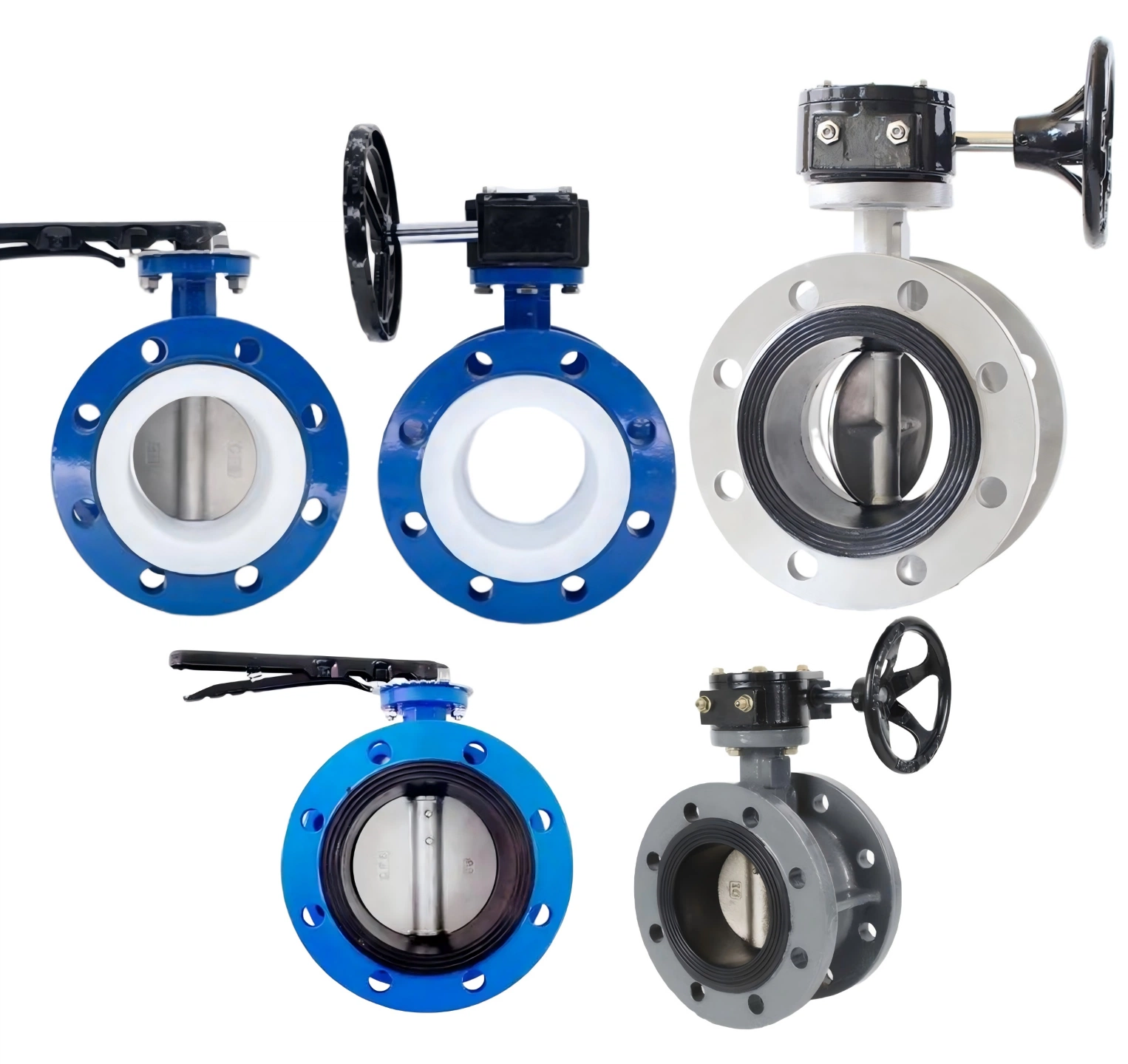
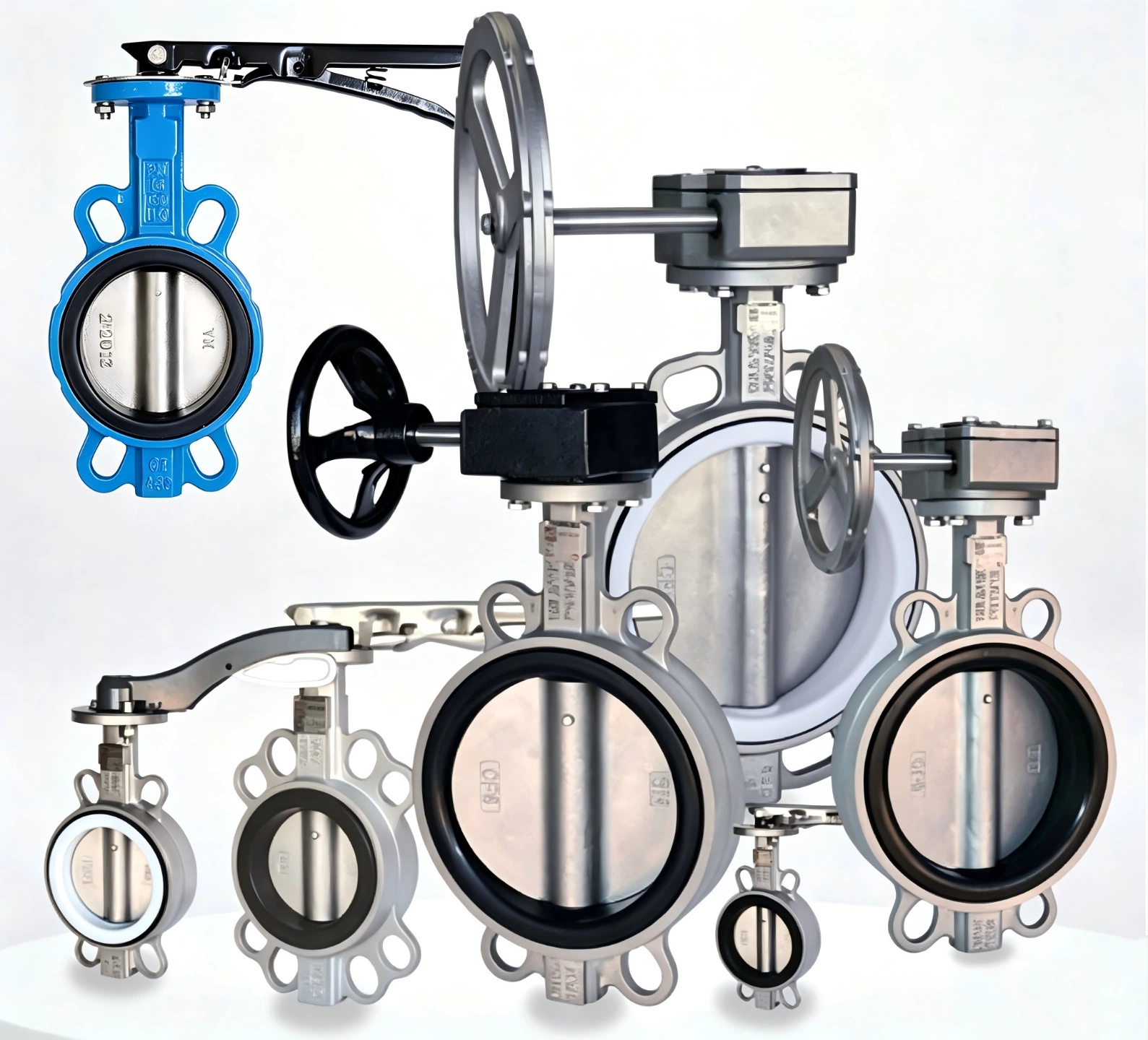
A wafer butterfly valve is a thin, disc-shaped body that is sandwiched between two pipe flanges. Long bolts pass through both pipe flanges and the wafer valve body — there are no external flanges on the valve itself. A flanged butterfly valve has its own pair of flanges bolted directly to the pipe flanges, with gaskets in between.
This single design difference drives everything else: weight, cost, installation, maintenance and pressure rating.
2. Side-by-Side Comparison
| Feature | Wafer Butterfly Valve | Flanged Butterfly Valve |
|---|---|---|
| Face-to-Face | compact (EN 558 Series 20, ~10-15% of pipe OD) | Longer (EN 558 Series 14, ~15-25% of pipe OD) |
| Weight | Light (30-65% lighter than flanged at large sizes) | Heavier, more robust |
| Installation | Sandwiched between two flanges; through-bolts | Bolted to pipe flanges with gaskets on each side |
| Pressure Rating | Typically PN10 / PN16 / Class 150 | PN16–PN40 / Class 150–300 available |
| Relative Cost | 20-40% lower per unit | Higher upfront cost |
| Maintenance | Harder to remove — must shift pipe flanges | Easy to unbolt and remove for servicing |
| Bi-directional sealing | Limited (one direction bubble-tight) | Full (double-offset / triple-offset available) |
| Best For | Space-limited rooms, large DN200+ lines, water/HVAC | High pressure, corrosive media, frequent maintenance, isolation duties |
3. When to Choose Wafer
Go with a wafer butterfly valve when:
- Space is tight — the short face-to-face means you save critical room in mechanical rooms, skids and compact piping layouts.
- You’re buying large sizes (DN200 and above) — the weight saving is dramatic (a DN600 wafer valve can be roughly 200 kg lighter than a flanged equivalent).
- The line carries water, HVAC chilled water, cooling water or general low-pressure media.
- Budget is tight and the valve is not a critical isolation point that will need frequent servicing.
4. When to Choose Flanged
Go with a flanged butterfly valve when:
- The line carries oil, gas, chemical or steam at higher pressures (PN16 and above).
- The valve is a critical isolation point that will need inspection, repair or replacement during operation.
- You need positive isolation for safety reasons — the bolted flange connection is more dependable under thermal cycling.
- Local codes or project specifications explicitly require flanged end connection.
- The piping system already uses flanged connections throughout and you want a consistent joint design.
5. Worked Example: Power Plant Cooling Water (Surabaya, Indonesia)
Let’s walk through a real engineering selection from a 2×660 MW coal-fired power plant in Surabaya, Indonesia.
Step 1 — Project data
Cooling water inlet line: DN600, flow rate 4500 m³/h, pressure PN10, fluid is brackish cooling water, ambient 35°C. Valve is used for isolation only, not throttling.
Step 2 — Weight comparison at DN600
• Wafer butterfly valve (GGG40 body, EPDM seat): ≈ 115 kg
• Flanged butterfly valve (GGG40 body, EPDM seat): ≈ 320 kg
• Difference: roughly 205 kg saved per valve.
With 8 isolation valves on the cooling water loop, that’s roughly 1,640 kg less weight to support on the pipe rack and install. The structural steel savings alone often justify choosing wafer at this size.
Step 3 — Relative cost comparison (factory-direct, 2026)
• Wafer DN600: baseline unit cost
• Flanged DN600: roughly 30-40% higher per unit
• Across 8 valves on the same loop, the wafer package is materially cheaper on equipment alone — before adding the structural steel saving.
Step 4 — Selection decision
Because the fluid is brackish cooling water at PN10 (well below wafer rating), and the valves are on a dedicated cooling loop that can be drained during overhaul, wafer is the correct choice. The ~205 kg weight saving per valve and the ~30-40% lower equipment cost dominate.
Step 5 — Material upgrade for brackish water
Brackish water is mildly corrosive. Specify: body GGG40 with epoxy coating, ductile iron disc with 316SS edge, EPDM seat, stem 410SS. This avoids the pitting that plain cast iron bodies suffer within 3-5 years in coastal Java.
International Standards Reference
| Standard Category | US / ANSI | European / EN | Japanese / JIS |
|---|---|---|---|
| Design | API 609 / MSS SP-67 | EN 593 | JIS B2002 |
| Face-to-Face (Wafer) | API 609 / MSS SP-67 | EN 558-1 Series 20 | JIS B2002 |
| Face-to-Face (Flanged) | ASME B16.10 | EN 558-1 Series 14 | JIS B2002 |
| Flange | ASME B16.5 Class 150/300 | EN 1092-1 PN16-PN40 | JIS B2220 10K-20K |
| Pressure Rating | ANSI Class 150-300 | PN10-PN40 | 10K-20K |
| Testing | API 598 / ISO 5208 | EN 12266-1 | JIS B2003 |
| Liner / Seat | EPDM / NBR / Viton FKM / PTFE | EPDM / NBR / FKM / PTFE | EPDM / NBR / FKM / PTFE |
| Actuator Mounting | ISO 5211 | ISO 5211 | ISO 5211 |
💡 Why EPC Contractors Buy Butterfly Valves from Chuanglan
Wafer, lug and flanged butterfly valves DN50–DN1200 from a single Wenzhou factory
Pre-assembled with pneumatic / electric actuators, limit switches and positioners — tested before shipment
ISO 9001:2015 certified, 100% factory pressure tested, EN 10204 3.1 MTC included
Not Sure Whether to Specify Wafer or Flanged?
Send us your media, size, pressure, temperature and maintenance requirements — our engineers will recommend the right connection type and quote within 24 hours.
Get Free Sizing Report →6. Common Buying Mistakes
Mistake 1: Specifying wafer for high-pressure steam. Wafer valves are rated for PN10–PN16 in most standard bodies. For PN25 or PN40 service, you usually need a flanged body with reinforced stem and disc.
Mistake 2: Forgetting that wafer valves need through-bolts. When you buy a wafer valve, the buyer often forgets to order the longer through-bolts and nuts. Always confirm bolt length with the manufacturer.
Mistake 3: Installing a wafer valve where it will need servicing. If the valve is buried in a tight piping layout with no room to shift flanges, maintenance becomes a nightmare. In those locations, spend the extra money on flanged.
Mistake 4: Ignoring the liner material. Both wafer and flanged butterfly valves rely on an elastomer liner (EPDM, NBR, Viton, PTFE) for sealing. Wrong liner = leakage and product contamination. Match the liner to your media and temperature.
Mistake 5: Forgetting the actuator mounting pad. If you plan to automate the valve later, confirm the body has an ISO 5211 mounting pad. We supply pre-assembled pneumatic wafer butterfly valves for automated service.
7. Southeast Asia & Middle East Market Notes
Butterfly valves dominate large water, cooling and HVAC projects across Southeast Asia and the Middle East. Two regional selection rules drive nearly every spec we see:
- Indonesia power & water projects: PLN (state utility) and independent power producers in Java, Sumatra and Kalimantan overwhelmingly spec wafer butterfly valves for cooling water and fire-fighting loops at DN300+. The weight saving on elevated pipe racks is the deciding factor. Spec epoxy-coated bodies because coastal Java brackish water attacks plain cast iron within 3-5 years.
- Gulf seawater desalination (Ras Al Khair, Jebel Ali, Umm Al Nar): Desalination intake and outfall lines use DN1200–DN2400 flanged triple-offset butterfly valves rated PN10/PN16 in 2205 duplex or 316L. Wafer types are not acceptable here — seawater service requires positive bi-directional shutoff and flanged joints for buried and submerged service.
- Vietnam & Thailand district cooling (Hanoi, Bangkok): District cooling networks in newly built CBDs use a mix: lug wafer for plant room isolation, flanged for street vault isolation. EPDM seats rated to 120°C handle the Gulf and tropical heat.
Chuanglan Valve supplies wafer, lug and flanged butterfly valves to EPC contractors, power utilities and MEP consultants across Southeast Asia and the Middle East. Serving EPC Contractors Across Southeast Asia & Middle East with factory-direct supply chain, MOQ 1 piece and 7–15 day delivery.
8. Bottom Line
For most water, HVAC and low-pressure general industrial service at large sizes, the wafer butterfly valve is the smart choice — compact, light and cost-effective. For high-pressure, corrosive, safety-critical or frequently serviced lines, the flanged butterfly valve is worth the extra cost and weight.
Not sure which one fits your project? Send us your media, size, pressure and temperature — we’ll recommend the right connection type and quote within 24 hours.
FAQ
Can I replace a wafer butterfly valve with a flanged one in the same piping?
Usually no — the face-to-face dimensions differ (EN 558 Series 20 wafer vs Series 14 flanged). The pipe spacing was designed for one or the other. Changing type requires pipe rework. Always match the face-to-face dimension shown on your drawing.
What size should I choose between wafer and flanged?
Both types come in the same nominal sizes (DN50 to DN1200+). The choice is about connection style, not bore size. The pressure rating and liner material determine the actual size for your application.
Are wafer butterfly valves suitable for steam service?
Standard wafer butterfly valves with EPDM liners are limited to about 120°C saturated steam. For higher temperature steam, specify a flanged high-performance or triple-offset butterfly valve with graphite metal seats.
How much more expensive is a flanged butterfly valve vs wafer?
As of 2026, at the same size, pressure rating and material, a flanged butterfly is typically 20-40% more expensive per unit than the equivalent wafer type — driven by the cast flanges, extra gaskets and through-bolts. Larger sizes scale proportionally.
Which is better for seawater service?
Always use a flanged high-performance or triple-offset butterfly valve in 2205 duplex or 316L for seawater. Standard wafer types in ductile iron are not designed for salt-water service and will pit within 2-3 years.
Do wafer butterfly valves need special gaskets?
No — standard flange gaskets (rubber, PTFE or spiral-wound) work between the wafer body and pipe flanges. The important thing is to use the correct through-bolt length and tighten in a crisscross pattern.
Can I get both wafer and flanged types with pneumatic or electric actuators?
Yes. We supply both types pre-assembled with rack-and-pinion pneumatic actuators, electric actuators, limit switch boxes, solenoid valves and positioners, fully tested before shipment. MOQ is 1 unit.
References & Standards
- API 609: Butterfly Valves — Double Flanged, Lug Wafer, and Wafer Type
- EN 558: Industrial valves — face-to-face and centre-to-face dimensions
- ASME B16.34: Valves — Flanged, Threaded, and Welding End
- EN 1092-1: Flanges and their joints — circular flanges for pipes
- ISO 5211: Industrial valves — part-turn valve actuator attachment
Related Products
Continue Reading
Get a Quote for Your Butterfly Valve Project
MOQ: 1 piece · ISO 9001:2015 certified · 3.1 MTC included · 100% factory pressure tested
Southeast Asia: Indonesia, Malaysia, Thailand, Vietnam, Singapore, Philippines, Myanmar
Middle East: Saudi Arabia, UAE, Qatar, Kuwait, Oman, Bahrain
Other Regions: Europe, North America, South America, Africa, Australia
Delivery: 5–10 days to Southeast Asia · 15–20 days to the Middle East · 25–35 days to Europe / the Americas
Payment: T/T 30% deposit + 70% before shipment · L/C at sight · Warranty: 12 months after shipment for material and manufacturing defects · Packing: export plywood case / fumigation-free pallet · Shipping: FOB Ningbo/Shanghai · Documents: EN 10204 3.1 MTC + packing list + commercial invoice · Third-party inspection welcome: SGS / Bureau Veritas / Intertek
Get Free Quote »Need a quote or datasheet? Tell us size, pressure class and material – reply within 24 hours.
Request a Quote