
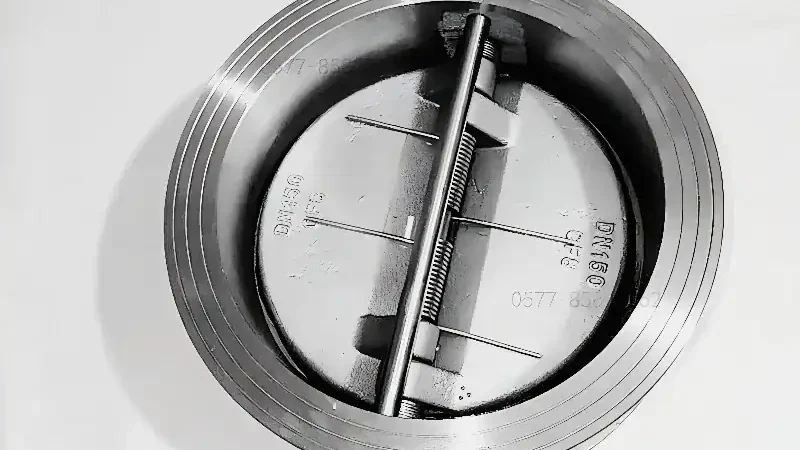
Can a Check Valve Be Installed Vertically? Installation Orientation & Flow Direction
Which check valve families survive a vertical line, which fail outright, and how flow direction and valve type decide it — with the cracking-pressure penalty of vertical installation worked through on a DN100 rising main.
* Standard lead time depends on order quantity and destination country. 5–10 days to Southeast Asia, 15–20 days to the Middle East.

Quick Answer
Whether a check valve can be installed vertically depends on what closes the disc, not on the pipe. Swing check valves close by gravity: horizontal flow is fine, vertical upward flow works but chatters, and vertical downward flow does not work at all because the disc hangs open. Dual-plate and single-plate wafer check valves close by spring torsion and can be installed in any orientation — but vertical upward flow adds the disc weight to the cracking pressure, so the spring you need is not the spring you would fit on a horizontal line. Lift and piston check valves are the opposite case: they must be mounted vertically with flow upward.
Three things decide the answer every time: the closing mechanism, the flow direction relative to gravity, and the flange face the valve seats against. Get the first wrong on a vertical line and the valve never closes; get the second wrong and it closes but never opens freely.
Key Takeaways
- Swing check on a vertical line: only with flow upward, and only above roughly 0.5 m/s — below that the disc hunts and hammers.
- Vertical downward flow is the one arrangement no gravity-closed valve can protect. The disc stays open and the line has no backflow protection at all.
- Dual-plate wafer check is the practical choice for vertical lines: spring-closed, compact, and orientation-independent within the spring’s design range.
- Vertical upward flow raises cracking pressure by the disc weight divided by disc area — on a DN100 dual plate that is about 0.008 bar, on a DN300 about the same percentage but a much heavier disc to accelerate.
- Mount close to the pump, one to two pipe diameters downstream, so the returning volume that has to be stopped is as small as possible.
- The arrow is not a suggestion. A reversed check valve does not seal, does not protect, and on a vertical line it turns the pump discharge into a dead-end.
On This Page
- 1. The One Rule That Decides Everything: What Closes the Disc
- 2. Swing Check Valves: Horizontal by Default, Vertical Only Upward
- 3. Wafer Check Valves: The Practical Answer for Vertical Lines
- 4. Lift, Piston and Tilting-Disc Check Valves
- 5. Flow Direction: The Arrow, the Flange and Three Ways It Goes Wrong
- 6. Installation Orientation Side by Side
- 7. Worked Example: DN100 Dual Plate, Vertical vs Horizontal
- 8. What Vertical Installation Actually Costs
- 9. Southeast Asia & Middle East Market Notes
- 10. FAQ
1. The One Rule That Decides Everything: What Closes the Disc
Every check valve on the market falls into one of two families, and the family tells you the installation rule before you look at the drawing.
Gravity-closed valves rely on the disc falling back onto the seat. Gravity only works in one direction, so the valve only works in the orientations where that direction lines up with closing. Swing, tilting-disc, lift and piston checks are all in this family.
Spring-closed valves rely on a torsion spring, a compression spring or a diaphragm to push the disc back. Spring force has no preferred direction, so the valve can be mounted any way the flanges allow. Dual-plate and single-plate wafer checks, and wafer butterfly checks, are in this family.
That is the whole logic. Everything else — the noise, the cracking pressure, the water hammer — is a consequence of how much work gravity or the spring is doing in the orientation you chose.
One practical warning before the details: orientation rules assume the valve is mounted with its axis in the plane the manufacturer tested. A check valve installed at a 45° angle is neither horizontal nor vertical, and neither set of rules applies cleanly. If the pipe really does run at an angle, specify it to the supplier and take the recommendation in writing.
2. Swing Check Valves: Horizontal by Default, Vertical Only Upward
A swing check valve hangs a disc from a hinge pin above the seat. Flow pushes it open, and when flow stops the disc falls back. The hinge pin is the detail that decides the installation.
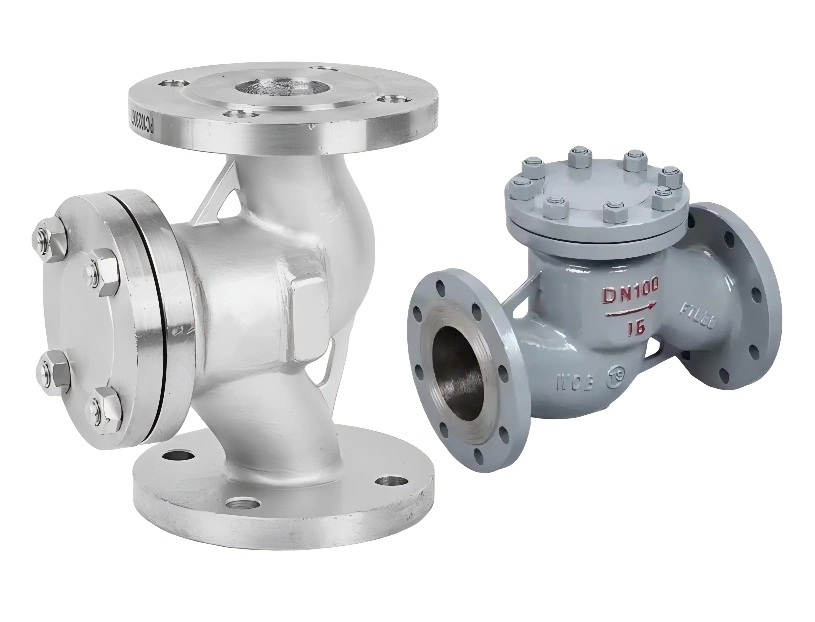
Horizontal pipe, horizontal flow. The standard case. The hinge pin is horizontal, the disc swings in a vertical arc, and gravity plus the returning flow both push it shut. Closing is reliable from a very low reverse velocity, and the valve is quiet. This is what almost every pump discharge line in a water treatment plant looks like.
Vertical pipe, flow upward. Workable, with conditions. The hinge pin is now horizontal in the other plane, and the disc still falls onto the seat — but it is falling against the flow, so the flow has to be fast enough to hold it fully open. Below roughly 0.5 m/s the disc sits part-open, hunts, and the valve chatters audibly. Above that it holds, closes on reverse flow, and is acceptable on clean water. The cost is wear on the hinge and seat, and noise.
Vertical pipe, flow downward. This does not work. The disc hangs open by its own weight and the flow keeps it there. Reverse flow passes straight through because the disc is already in the open position and gravity cannot bring it down against the stream. The valve becomes a restriction, not a protection device.
If your line is vertical with downward flow, a swing check is the wrong product regardless of brand, pressure class or price. The fix is a spring-closed type, covered in the next section.
3. Wafer Check Valves: The Practical Answer for Vertical Lines
A wafer check valve fits between two flanges and holds two spring-loaded half-discs (dual plate) or a single spring-loaded disc (single plate). Because the spring does the closing, none of the three orientation rules above applies.
Horizontal flow. The preferred arrangement, and the one most catalogues are rated in. Both half-discs open symmetrically, the spring closes them together, and the flow profile through the body is the cleanest. Pressure drop data published by manufacturers is measured here, so if you compare two suppliers on ΔP, compare them in this orientation.
Vertical flow, upward. Fully acceptable, and the standard fix for a vertical rising main. Two things change: the spring now has to lift the disc weight as well as crack open against the flow, so the effective cracking pressure rises; and the disc has further to travel before it is fully open, so the first fraction of a second after pump start is slightly dirtier than on a horizontal line.
Vertical flow, downward. Also acceptable — gravity now helps close, so the valve shuts marginally earlier and harder. Earlier and harder is not automatically better: a faster closing disc produces a larger surge. On a long vertical drop with a high static head, that surge is the thing that splits flanges, so specify a damped or slow-closing option rather than assuming the standard spring is fine.
For line-by-line selection see how to choose a wafer check valve, and for the difference between the two wafer types see dual plate against single plate.
4. Lift, Piston and Tilting-Disc Check Valves
These three are the mirror image of the wafer family, and they are where most installation mistakes in steam and gas systems come from.
Lift check. A disc or cone rises off a seat inside a vertical guide. It only works with the axis vertical and flow upward — the disc has to fall back down the guide to close. Installed horizontally, the disc binds against the guide wall and either sticks open or never seats. A flanged lift check valve on a horizontal steam header is a design error, not a preference.
Piston check. Same logic as lift, with a piston instead of a disc, and used where the flow is dirty enough that a swing disc would erode. Vertical, flow upward, always.
Tilting disc. A disc on an offset hinge, closer to balanced than a swing disc, so it closes faster and suits large diameters. It is gravity-assisted with a slight spring bias: horizontal is standard, vertical upward is acceptable on large clean-water lines, vertical downward is not.
The practical rule for anyone specifying on site: if the valve has a guide, a piston or a bare hinge with no spring, it is gravity-closed and the pipe has to be horizontal or flowing upward.
5. Flow Direction: The Arrow, the Flange and Three Ways It Goes Wrong
The cast arrow on the body points from inlet to outlet. It is the only authoritative mark on the valve, and it is ignored often enough that it deserves its own section.
Mistake one: reversed valve. With the arrow against the flow, the disc is held shut by the flow it is supposed to pass. The pump dead-heads, the line goes to shutoff head, and on a vertical rising main the result is a pressure spike rather than a flow. Reversed installation also destroys the seat within hours on any line with solids.
Mistake two: the wrong flange face. A wafer valve seats on both flange faces at once. If one flange is a raised-face and the other a flat-face, or if the gaskets are different thicknesses, the body is loaded asymmetrically and the disc can bind. On vertical lines this shows up as a valve that closes slowly on one side and leaks on the other, which reads as a seat problem and gets diagnosed as one.
Mistake three: no room to open. A swing check needs clear space downstream for the disc to swing through. Bolted directly against an elbow, the disc hits the elbow wall, sits half-open and chatters. One to two pipe diameters of straight run downstream is the practical minimum, and the same applies to the upstream side if the valve sits close to a pump discharge flange.
On vertical lines all three mistakes are harder to see, because there is no horizontal reference to compare against. A quick field check: confirm the arrow against the pump rotation direction, not against the pipe route. The route bends; the pump does not.
6. Installation Orientation Side by Side
| Valve type | Horizontal flow | Vertical, flow up | Vertical, flow down | Closes by | Typical service |
|---|---|---|---|---|---|
| Swing check | ✓ standard | ✓ above ~0.5 m/s, noisy | ✗ disc hangs open | Gravity + reverse flow | Water, wastewater, pump discharge |
| Tilting disc | ✓ standard | ✓ large clean-water lines | ✗ | Gravity + light spring bias | Large diameter water, cooling |
| Dual plate wafer | ✓ preferred | ✓ cracking pressure rises | ✓ closes harder, check surge | Spring torsion | HVAC, general process, POME |
| Single plate wafer | ✓ standard | ✓ | ✓ | Spring | Compact lines, tight spaces |
| Wafer butterfly check | ✓ | ✓ | ✓ | Spring | Slurry, viscous media, palm oil |
| Lift check | ✗ disc binds in guide | ✓ required | ✗ | Gravity | Steam, gas, small water lines |
| Piston check | ✗ | ✓ required | ✗ | Gravity | Dirty steam, condensate |
The table is a starting point, not a substitute for the supplier’s installation drawing. Two cases need that drawing: valves above DN300, where the disc mass makes the vertical cracking pressure penalty large, and any valve with an elastomer seat above 100°C, where the seat softens and the closing behaviour changes with orientation.
7. Worked Example: DN100 Dual Plate, Vertical vs Horizontal
Scenario. A palm oil mill in North Sumatra lifts cooling water from a sump pit to a header tank 14 m above. Rising main: DN100 (4″) schedule 40, flow 60 m³/h, water at 32°C. The engineer has specified a dual plate wafer check valve with a 0.05 bar spring, the same valve already used on the horizontal distribution lines inside the plant.
Step 1 — Velocity in the rising main.
60 m³/h = 0.01667 m³/s. Internal area of DN100 sch40 (ID ≈ 102.3 mm) = π × 0.05115² = 0.00822 m².
v = 0.01667 / 0.00822 = 2.03 m/s. Comfortably above the 0.5 m/s floor, so the disc will hold open and this is not a chatter case.
Step 2 — What the orientation adds to cracking pressure.
Projected area of one half-disc at DN100 ≈ π × 0.1023² / 8 = 0.00411 m². Half-disc plus spring arm mass, from the supplier’s drawing, 0.28 kg.
Gravity term = m g / A = 0.28 × 9.81 / 0.00411 = 669 Pa = 0.0067 bar.
Effective cracking on the rising main = 0.050 + 0.007 = 0.057 bar, about 14% higher than the horizontal bench figure.
Step 3 — Is 14% the problem? Not for cracking. It becomes the problem at the other end: with a 14 m static head the reverse velocity at closing is set by the whole column, not by the spring. Pump trip at 60 m³/h gives a reverse velocity approaching 2.0 m/s before the valve seats.
Joukowsky estimate with an effective wave speed of 1,350 m/s for steel pipe with some free air: ΔP = ρ a Δv = 1000 × 1350 × 2.0 = 2.7 MPa = 27 bar surge on a line rated 16 bar.
Step 4 — What the orientation decision actually is. Fit the dual plate, but not with the standard spring and not alone. Use the same valve with a heavier spring option where the supplier offers one, mount it within two pipe diameters of the pump discharge so the returning volume is small, and add a surge allowance upstream. The 0.007 bar the vertical position added is irrelevant next to the 27 bar the column can deliver.
Conclusion. On a vertical line the spring choice and the mounting distance decide the surge; the orientation only decides whether the valve closes at all. Both matter, but they are not the same question — which is why a cracking-pressure calculation alone will pass a design that fails on surge.
8. What Vertical Installation Actually Costs
Three costs come with a vertical line, and they are routinely left out of the quotation comparison.
Cracking pressure. The gravity term above scales with disc mass over disc area, so it grows roughly with diameter. It is small in bar terms — single-digit percent — but it is not zero, and a pump sized tight to the head will notice it. Ask for the cracking figure in the orientation you will install, not the catalogue figure.
Spring life. A vertical upward line keeps the spring loaded against the disc weight at rest as well as in service. In a plant cycling the pump several times an hour, the spring is doing more work per cycle than on a horizontal line, and the failure shows up as a valve that starts to leak past the seat after 18 to 24 months rather than at the end of its rated life.
Surge. The static head that made the line vertical is also the head that drives the reverse flow when the pump stops. A vertical line is therefore a surge line by construction. Closing faster than the column can be stopped converts that head into a pressure spike, so on vertical lines the valve specification and the surge calculation belong in the same document.
For the horizontal case the same physics applies but the driving head is usually smaller, which is why vertical installations are where surge damage is found first. If the line carries a viscous or dirty medium — palm oil, POME, slurry — see wafer check valve applications for the seat and body choices that go with it, and palm oil mill valves for the mill-specific arrangement.
9. Southeast Asia & Middle East Market Notes
Southeast Asia
Indonesia and Malaysia. Palm oil mills and water treatment dominate, and the vertical lines are usually rising mains from sump pits, sterilizer condensate returns and boiler feed. Dual plate wafer check valves in 304 or 316L are the working choice; the orientation question comes up on every rising main, and the answer almost always involves the surge calculation above rather than the valve data sheet.
Thailand and Vietnam. Food and beverage plants with CIP risers and pasteurizer circuits: vertical runs are short and the flow is clean, so single plate wafer checks with a light spring are common and the orientation penalty is negligible. Watch the flange: JIS 10K drilling appears beside EN 1092-1 on the same site, and a wafer valve seated between two different flange standards is the mistake that reads as a seat failure.
>Middle EastSaudi Arabia and UAE. Seawater intake risers, deaerator columns and district cooling rising mains. 316L throughout, and on seawater the vertical orientation is an advantage rather than a problem: the reverse flow helps close the disc, which shortens the period the seat is exposed to backflow. The specification that matters more than orientation is the seat material — EPDM in seawater is a two-year valve, and the same valve in FKM or PTFE-seated runs the life of the plant.
10. FAQ
Installing on a Vertical Line? Send the Line Data — Get the Orientation and Spring Checked
Send line size, fluid, flow rate, static head and whether the run is vertical upward or downward. We come back with the valve type, the spring range that suits that orientation, and the cracking pressure you will actually get — not the catalogue figure measured on a horizontal bench.
Get Free Sizing Report → WhatsApp usCan a swing check valve be installed vertically?
Only with flow upward, and only if the velocity holds the disc open — roughly 0.5 m/s and above. With flow downward it cannot work at all: the disc hangs open and gravity cannot bring it back against the stream, so the line has no backflow protection. If the run is vertical and downward, use a spring-closed wafer check instead.
Can a wafer check valve be installed vertically?
Yes, in either direction, because the spring closes the disc rather than gravity. Two consequences follow: with flow upward the disc weight adds to the cracking pressure, and with flow downward gravity assists closing, so the valve shuts harder and the surge is larger. Both are manageable; neither is free.
Which way should the flow arrow point?
From inlet to outlet, in the direction the pump actually discharges. Check it against pump rotation, not against the pipe route — the piping bends and the pump does not. A reversed valve on a vertical line dead-heads the pump instead of protecting it.
What happens if a check valve is installed backwards?
Flow is held shut by the very pressure meant to pass through it. The pump runs to shutoff head, the line sees a pressure spike instead of flow, and any solids in the stream are trapped against the seat and erode it within hours. On a vertical rising main the outcome is usually a flange or gasket failure rather than a quiet no-flow condition.
Does vertical installation change cracking pressure?
Yes, by the disc weight divided by disc area. On a DN100 dual plate that is about 0.007 bar on top of a 0.05 bar spring — around 14%. It sounds small, but ask the supplier for the cracking figure in the orientation you will install rather than the horizontal bench figure from the catalogue.
Why does my check valve chatter or slam on a vertical line?
Chatter is the disc hunting part-open because the velocity is below the level that holds it fully open — typical on a swing check with flow upward at low flow rates. Slam is a spring or gravity closing the disc faster than the column can be decelerated. Chatter wears the hinge; slam breaks flanges, so they are different failures with different fixes.
Can I mount a check valve at 45 degrees?
Physically yes, but none of the orientation rules apply cleanly at an angle, and neither the horizontal nor the vertical cracking data is valid there. If the run really is inclined, tell the supplier the actual angle and take the recommendation in writing — otherwise you own a valve nobody has qualified for that position.
Lift check or swing check on a vertical steam line?
Lift check, with flow upward. A swing check on a vertical steam riser chatters because the steam velocity at the disc is low relative to water service, and the hinge wears quickly at steam temperature. A lift check closes on its guide, needs no swing clearance, and behaves predictably on a riser.
References & Standards
- API 594 — Check Valves: Flanged, Lug, Wafer and Butt-welding
- API 598 — Valve Inspection and Testing
- API 6D — Specification for Pipeline and Piping Valves
- EN 558 — Industrial valves, face-to-face and centre-to-face dimensions
- EN 12266-1 — Industrial valves, testing of metallic valves
- ISO 5208 — Industrial valves, pressure testing of metallic valves
Related Products
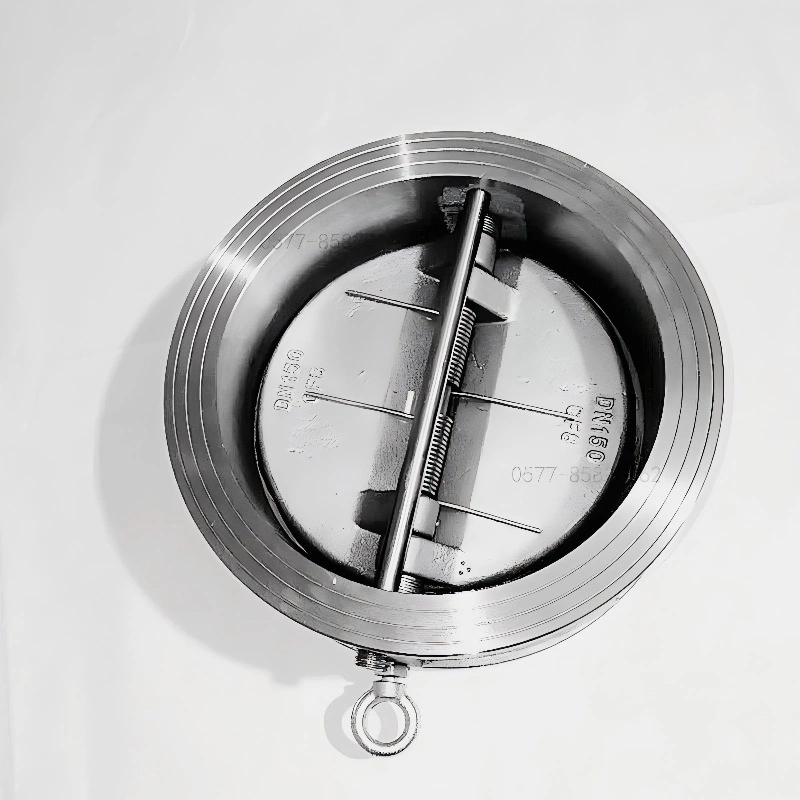
DN50–DN600, 304/316L, spring-closed, any orientation
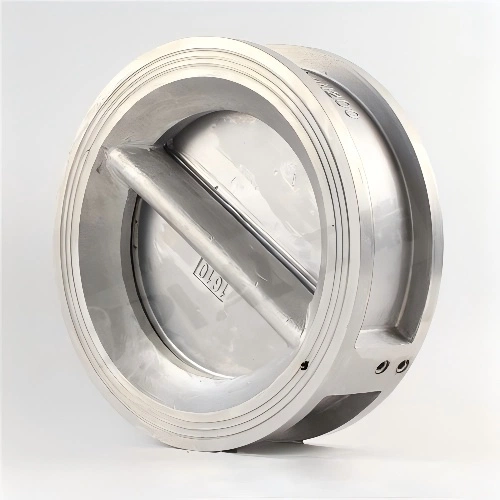
Compact, low cracking pressure, tight spaces
Gravity-closed, horizontal or upward flow
Continue Reading
Sizing, water hammer and the five common mistakes
The same orientation logic, different closing force
When the spring is worth the pressure drop
Request a Quotation — Reply Within 24 Hours
Send your line size, pressure rating, medium and quantity. Our engineers come back with price, drawing and lead time — no obligation.