
How to Choose the Right Wafer Check Valve for Your Piping System
A practical guide to wafer check valve types, sizing, water hammer, installation and common mistakes — for pumps, HVAC, water treatment and palm oil mills across Southeast Asia and the Middle East.
* Standard lead time depends on order quantity and destination country. 5–10 days to Southeast Asia, 15–20 days to the Middle East.

Quick Answer
For pump discharge, HVAC and general water service with frequent cycling, choose a dual-plate wafer check valve with EPDM seats — it closes in 0.05–0.1 s to suppress water hammer and fits between standard flanges. For large-diameter clean fluid lines, use single-plate (lower pressure drop). For slurry, palm oil or wastewater, use a wafer butterfly check valve or a flanged swing check valve instead — dual-plate springs jam on dirty fluids.
Never size a check valve by pipe diameter alone: the flow velocity must be high enough (≥ 0.5 m/s) to fully open the plate, otherwise it chatters and fails within months.
Key Takeaways
- 3 designs, 3 jobs: Dual-plate for pump/HVAC fast closure · single-plate for low-ΔP clean flow · wafer butterfly for slurry / dirty service.
- Sizing rule of thumb: A DN80 line flowing 100 m³/h runs at ~5.8 m/s — well above the 0.5–1.0 m/s minimum opening velocity, so the plate opens fully and stays stable (no chattering).
- Water hammer control: Dual-plate closure in 0.05–0.1 s keeps surge pressure under 2 bar — safe for PN16 piping even on fast pump trips.
- Coastal / seawater rule: Always CF8M (316) body and plates — ductile iron GGG40 pits and fails in 2–3 years in salt spray or seawater.
On This Page
- What Is a Wafer Check Valve?
- Three Main Types of Wafer Check Valves
- Dual Plate vs Single Plate: Which Do You Need?
- How to Size a Wafer Check Valve
- Worked Example: Pump Discharge Sizing
- Viscosity Correction & Advanced Sizing
- Material Selection Guide
- Common Installation Mistakes
- When to Use a Swing Check Valve Instead
- Southeast Asia & Middle East Market
- FAQ
A wafer check valve is one of the most common yet most misunderstood components in industrial piping. Its job is simple — allow flow in one direction and prevent backflow — but choosing the wrong type or size can cause water hammer, vibration, and premature failure.
In this guide, we break down the three main wafer check valve designs, when to use each, and how to size them correctly for your application. This is based on our experience supplying wafer check valves to palm oil mills, water treatment plants, and HVAC systems across Southeast Asia and the Middle East.
1. What Is a Wafer Check Valve?
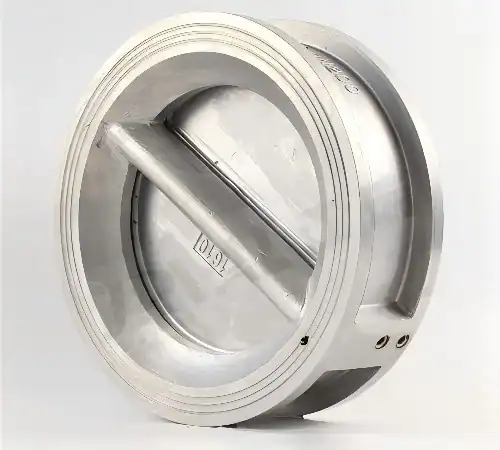
A wafer check valve is a compact, wafer-style (between-flanges) check valve that installs directly between two pipe flanges. Compared to flanged check valves, it is lighter, shorter, and more cost-effective — making it the preferred choice for most medium-sized piping systems.
Unlike swing check valves which use a hinged disc, wafer check valves rely on spring-loaded or pressure-actuated plates that close faster when flow reverses. This faster closure helps reduce water hammer.
2. Three Main Types of Wafer Check Valves
| Type | How It Works | Best For | Pros | Cons |
|---|---|---|---|---|
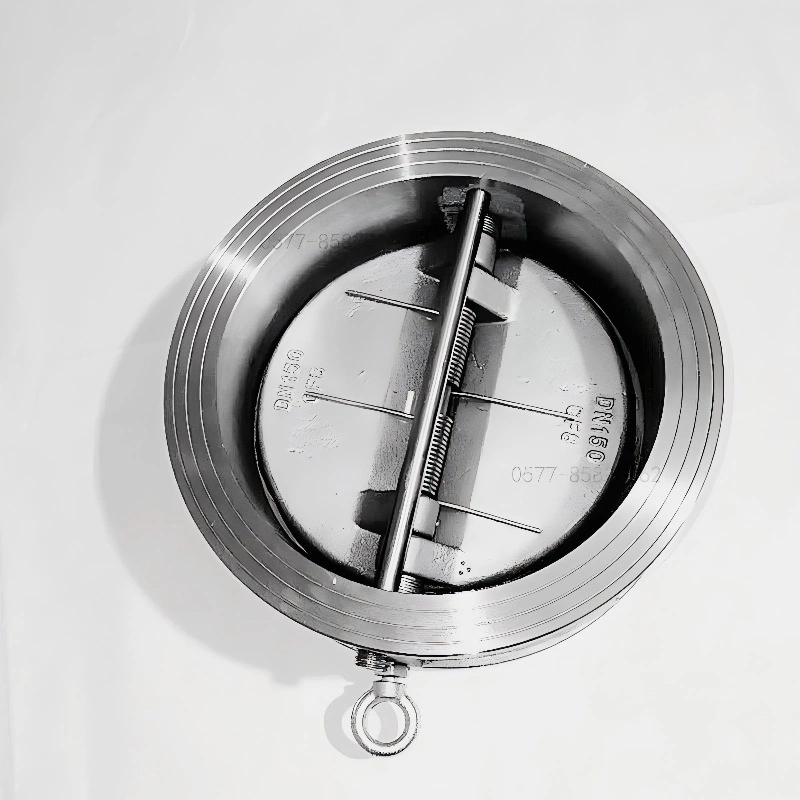
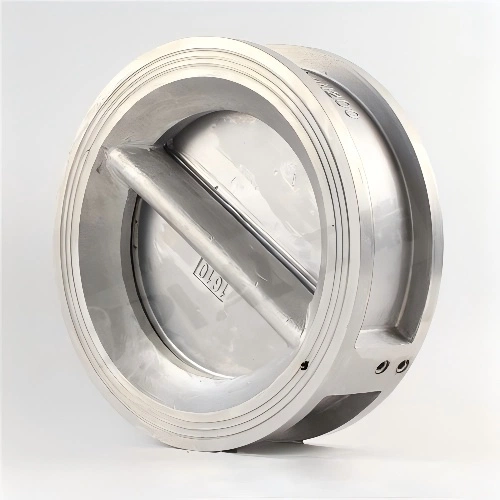
| Dual Plate | Two spring-loaded plates in the center | Water, HVAC, pump discharge, general industry | Compact, fast closure, low pressure drop | Spring wears out over time |
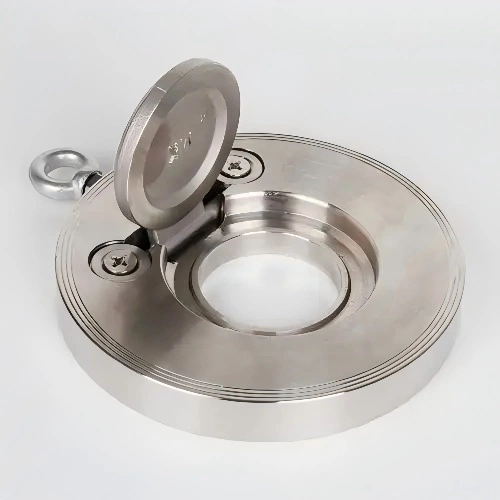
| Single Plate (Tilting Disc) | One tilting disc with hinge | High flow, low pressure systems | Full open area, minimal turbulence | Slower closure, more water hammer |
| Wafer Butterfly Check | Butterfly-style disc with spring | Large diameter lines, sewage, slurry | Handles solids, low cost for large sizes | Higher pressure drop |
3. Dual Plate vs Single Plate: Which One Do You Need?
Choose dual plate if you have:
- Pumps that start/stop frequently (fast closure prevents backflow)
- High vibration or noise concerns (spring-loaded plates close quietly)
- Limited space between flanges (wafer style is already compact)
Choose single plate if you have:
- High flow rate with low pressure drop requirements
- Clean fluids without solids or debris
- Lower cost is a priority for large diameters
Most of our customers in palm oil mill and water treatment applications choose the dual plate wafer check valve because it handles frequent pump cycling and reduces water hammer damage to downstream equipment. For stainless steel process lines, our single plate check valve in CF8M is also a popular option.
4. How to Size a Wafer Check Valve
Sizing a check valve is not just matching the pipe diameter. You need to consider:
- Flow velocity: The valve needs enough flow to fully open. If the velocity is too low, the disc will flutter (chatter), causing noise and damage. Typical minimum opening velocity is 1–3 ft/s (0.3–0.9 m/s) depending on size.
- Pressure rating: Match the flange pressure class (PN16, PN40, ANSI 150#, etc.) to your system. Never use a lower-rated check valve than the system pressure.
- Body material: For water treatment use ductile iron (GGG40) or cast iron. For chemical, food or corrosive service, use 304/316 stainless steel.
- Connection type: Wafer style fits between any standard flanges (EN1092, ANSI B16.5, JIS). Make sure the bolt holes match your flange standard.
International Standards Reference
| Standard Category | US / API | European / EN | Japanese / JIS |
|---|---|---|---|
| Design | API 594 / ASME B16.34 | EN 12266-1 | JIS B2002 |
| Face-to-Face | API 594 (wafer pattern) | EN 558-1 | JIS B2002 |
| Flange Compatibility | ASME B16.5 Class 125/150/300 | EN 1092-1 PN10/PN16/PN40 | JIS B2220 5K/10K/20K |
| Pressure Rating | ANSI Class 125–300 | PN10–PN40 | 5K–20K |
| Testing | API 598 / ISO 5208 | EN 12266-1 | JIS B2003 |
| Seat Materials | EPDM / NBR / Viton / PTFE | EPDM / NBR / Viton / PTFE | EPDM / NBR / Viton / PTFE |
| End Connection | Wafer / Lug | Wafer / Lug | Wafer / Lug |
Note: API 594 specifically covers wafer, lug and butt-weld check valves — it is the primary US standard for wafer check valve dimensions and materials.
Worked Example: Pump Discharge Check Valve Sizing
Let’s size a check valve for a pump discharge line at a palm oil mill in Medan, Indonesia.
Step 1 — Design flow rate and pipe size
Pump discharge flow: 100 m³/h (440 GPM). Discharge pipe: DN80 (3″) schedule 40, internal diameter ≈ 77.9 mm (3.07″).
Actual velocity v = Q ÷ A = (100/3600) ÷ (π × 0.0779² ÷ 4) = 0.0278 ÷ 0.00477 ≈ 5.8 m/s — this is high (typical 2-3 m/s recommended). The line is undersized, but we still need a check valve that opens fully at this velocity.
Step 2 — Check minimum opening velocity
A DN80 dual plate wafer check valve typically requires 0.5–1.0 m/s to fully open. At 5.8 m/s, the plates will be fully open and stable — no chattering risk.
Step 3 — Estimate pressure drop
Pressure drop across an open dual plate check valve at 5.8 m/s: ≈ 0.05–0.10 bar. Acceptable for pump discharge (typical allowable ΔP = 0.3–0.5 bar).
Step 4 — Water hammer assessment
Dual plate closure time ≈ 0.05–0.1 seconds (fast). With fast closure the surge is < 2 bar above operating pressure — well within PN16 margin.
Step 5 — Final selection
• Valve: DN80 wafer dual plate check valve
• Body: Ductile iron GGG40 (palm oil process water)
• Plates: 304 stainless with EPDM seat
• Pressure: PN16 / ANSI 150#
• Ends: Wafer, EN1092 PN16 flange compatible
Why Palm Oil & Water EPCs Choose Chuanglan
Wafer dual-plate, single-plate and butterfly check valves from DN50 to DN600 in stock
factory operating under ISO 9001:2015, shell and seat pressure tested, EN 10204 3.1 MTC included
MOQ: 1 piece — sample valve for pump OEM line testing before bulk EPC order
Viscosity Correction & Advanced Sizing
For viscous fluids (oil, syrup, polymer solutions), the standard Cv formula needs correction. Higher viscosity increases pressure drop and requires larger valve sizes.
Viscosity Correction Factor:
| Viscosity (cSt) | Correction Factor | Example (Cv = 80) |
|---|---|---|
| 1 (water) | 1.0 | Cv = 80 |
| 10 (light oil) | 1.2 | Cv = 96 |
| 50 (medium oil) | 1.8 | Cv = 144 |
| 200 (heavy oil) | 2.5 | Cv = 200 (need DN100) |
Example: If the fluid is heavy oil at 200 cSt, the required Cv becomes 80 × 2.5 = 200. A DN80 valve (Cv=80) is too small — you need to upsize to DN100 (Cv≈160) or DN150 (Cv≈300). For oil and gas applications, we recommend flanged ball valves together with check valves for complete system isolation.
Material Selection Guide
Choosing the right body and seat material prevents corrosion and ensures long service life.
| Body Material | Seat Material | Temperature Range | Typical Application |
|---|---|---|---|
| 304SS | EPDM | -10°C to 120°C | Water, HVAC, general industrial |
| 316LSS | EPDM | -10°C to 120°C | Chemical, seawater, food grade |
| 316LSS | PTFE | -50°C to 200°C | Strong chemicals, high temp |
| 316LSS | NBR | -20°C to 100°C | Oil, gas, non-corrosive fluids |
| WCB (cast steel) | NBR | -20°C to 100°C | Oil, gas, steam (non-corrosive) |
| Ductile Iron (GGG40) | EPDM | -10°C to 120°C | Water treatment, HVAC, budget projects |
Need Help Sizing Your Wafer Check Valve?
Send us your pipe size, pressure rating, fluid type and flow rate — our engineers will recommend the right valve type and material within 24 hours.
Get Free Sizing Report → WhatsApp us5. Common Installation Mistakes
We see the same installation errors repeatedly on site: the valve is installed backwards, the spring is damaged during handling, or there is not enough straight pipe before/after the valve. Avoid these four:
Mistake 1: Installing upside down. Most wafer check valves have an arrow on the body indicating flow direction. Always point the arrow in the direction of flow. If you install it backwards, the valve will not close and you will get full backflow.
Mistake 2: Overtightening the flange bolts. Wafer check valves have thinner bodies than flanged valves. Overtightening can warp the body and cause the disc to stick. Tighten bolts evenly in a crisscross pattern to the manufacturer’s torque spec.
Mistake 3: Not providing straight pipe. Installing a check valve too close to an elbow, pump, or tee causes turbulence and disc flutter. Best practice is 5–10 pipe diameters of straight pipe upstream.
Mistake 4: Using a dual plate valve on dirty fluids. Palm oil, pulp, wastewater or slurry can jam the spring-loaded plates. For dirty fluids, choose a wafer butterfly check valve or a flanged swing check valve instead.
6. When to Use a Swing Check Valve Instead
Wafer check valves are great for most applications, but there are cases where a flanged swing check valve is a better choice:
- If your fluid contains large solids or slurries (swing valves handle debris better)
- If you need low pressure drop at high flow rates
- If the valve must be serviced inline without removing from the pipeline
For most standard industrial and HVAC applications, though, wafer style is the most cost-effective and space-saving option.
Southeast Asia & Middle East Market
Wafer check valves are specified across a huge range of projects in Southeast Asia — Indonesia, Malaysia, Thailand, Vietnam and Singapore — and the Middle East: Saudi Arabia, UAE, Qatar and Oman. Two regional considerations drive material selection:
- Palm oil and agro-processing (Indonesia & Malaysia): Palm oil mills in Sumatra, Kalimantan and Peninsular Malaysia use huge volumes of process water and condensate. Specify 304/316 stainless plates with EPDM seats to resist acidic condensate and prevent galvanic corrosion on the carbon steel body.
- District cooling and water transmission (Gulf): Large seawater and district cooling pipelines in Dubai, Riyadh and Doha rely on DN300+ wafer dual plate check valves. For seawater service, always specify 316 (CF8M) body and plates — ductile iron will pit within 2-3 years in salt-laden coastal air.
Chuanglan Valve directly supplies wafer dual plate, single plate and butterfly check valves to EPC contractors, pump OEMs and MEP consultants across Southeast Asia and the Middle East, with a direct quotation and 7–15 day delivery for standard sizes.
Serving EPC Contractors Across Southeast Asia & Middle East · ISO 9001:2015 · Established in 2009
7. Troubleshooting: Six Field Failures and What Actually Causes Them
Nearly every wafer check valve complaint we get from a plant falls into six patterns. The table maps the symptom to the mechanism, so the fix is not a guess.
| Symptom | Most likely cause | What to check first | Fix |
|---|---|---|---|
| Chatter or vibration | Velocity below the range that holds the disc steady, or the disc striking a downstream elbow | Actual duty flow rate; straight run downstream of the valve | Restore velocity, add one to two diameters of straight run, or move to a spring-closed body |
| Leaks past the seat at low backflow | Seat face eroded by solids, or two gaskets of unequal thickness pinching the body | Seat face condition; whether both flanges use matched gaskets | Replace the seat; use matched gaskets on both faces |
| Heavy slam when the pump stops | Disc closing faster than the column can decelerate | Static head, downstream pipe length, closing time | Heavier spring option, damped closure, and a surge allowance in the line rating |
| Pump runs to shutoff head | Valve installed against the flow | Body arrow against pump rotation direction | Reinstall the valve in the correct direction |
| High pressure drop at design flow | Undersized body, or a spring heavier than the duty needs | Measured ΔP against the published curve at the same velocity | Go one size up, or specify a lighter cracking spring |
| No backflow protection on a vertical riser | A swing check on a line flowing downward — the disc hangs open | Flow direction relative to gravity, not the pipe route | Replace with a dual plate wafer check; see our installation orientation guide |
Two of the six are orientation problems, not product problems: reversed installation and a gravity-closed valve on a downward-flow riser. Both are settled with a tape measure and a look at the pump, before any valve is replaced. The other four are duty problems — velocity, gasket stack, closing time and spring range — and all four are cheaper to fix in the specification than in the plant.
FAQ
What is the difference between a wafer check valve and a swing check valve?
A wafer check valve installs between two flanges and is compact and light. A swing check valve bolts directly to flanges and uses a hinged disc. Wafer valves close faster (reducing water hammer) but swing valves handle solids and slurries better.
Which way does a wafer check valve install?
Always follow the flow arrow cast on the valve body. The arrow points in the direction of flow (from pump outlet toward the system). Installing it backwards means no backflow protection at all.
What size wafer check valve do I need?
Match the nominal pipe size, but verify that the minimum opening velocity (typically 0.5–1.0 m/s) is exceeded at your design flow. If the valve is oversized, the disc will flutter and wear prematurely.
Can a wafer check valve be installed horizontally or vertically?
Most dual plate wafer check valves work in any orientation — horizontal, vertical up-flow or vertical down-flow. Single plate and tilting disc types are orientation-sensitive; check the manufacturer’s installation manual.
Why is my wafer check valve making noise or vibrating?
Usually the valve is oversized for the flow — the disc is not fully opening and is fluttering against the seat. Or there is turbulence from an elbow or tee too close upstream. Resize the valve or add 5–10 pipe diameters of straight run.
What body material should I use for seawater service?
Always use 316 stainless (CF8M) body and plates for seawater or coastal salt-spray exposure. Ductile iron or cast iron bodies will pit and fail within 2–3 years in marine environments.
What is your MOQ and lead time for wafer check valves?
MOQ is 1 piece for standard sizes. Lead time is 7–15 days for ductile iron and 316 stainless wafer dual plate check valves in stock; special alloys and large sizes (DN300+) take 15–30 days.
Why is my wafer check valve leaking after only 12 months in service?
Almost always the seat, not the body. Solids or scale score the elastomer face, or two gaskets of different thickness load the body asymmetrically and the disc never seats flat. Pull the valve, inspect the seat face for a groove or a flat spot, and check that both flange gaskets came from the same batch. A leaking wafer check on a clean line is a gasket-stack problem more often than a valve problem.
How do I stop check valve slam when the pump stops?
Reduce the volume that has to be stopped, then slow the closure. Mount the valve within one to two pipe diameters of the pump discharge so the returning column is short, and specify the heaviest spring the duty will tolerate — a faster closing disc with a short column produces a smaller surge than a slow disc with a long one. If the static head is large, the surge calculation, not the valve data sheet, decides the line rating.
Can a wafer check valve be installed at 45 degrees?
Physically yes, but the published cracking and pressure-drop figures are measured horizontal, and neither the horizontal nor the vertical data applies cleanly at an angle. Tell the supplier the actual mounting angle and take the recommendation in writing. On an inclined run, specify the valve by the angle rather than by “vertical or horizontal”.
References & Standards
- API 594: Check Valves — Wafer, Lug, and Butt-Weld Type
- ASME B16.34: Valves — Flanged, Threaded, and Welding End
- EN 12266-1: Industrial valves — Pressure testing of metallic valves
- MSS SP-71: Globe, Gate, and Check Valves for General Service
- AWWA C504: Rubber-Seated, Iron Body Check Valves for Water Works Service
Related Products
Continue Reading
Request a Quotation — Reply Within 24 Hours
Send your line size, pressure rating, medium and quantity. Our engineers come back with price, drawing and lead time — no obligation.
Get a Quote for Your Wafer Check Valve Project
MOQ: 1 piece · ISO 9001:2015 · 3.1 MTC included · shell and seat pressure tested
Southeast Asia: Indonesia, Malaysia, Thailand, Vietnam, Singapore, Philippines, Myanmar
Middle East: Saudi Arabia, UAE, Qatar, Kuwait, Oman, Bahrain
Other Regions: Europe, North America, South America, Africa, Australia
Delivery: 5–10 days to Southeast Asia · 15–20 days to the Middle East · 25–35 days to Europe / the Americas
Payment: T/T 30% deposit + 70% before shipment · L/C at sight · Warranty: 12 months after shipment for material and manufacturing defects · Packing: export plywood case / fumigation-free pallet · Shipping: FOB Ningbo/Shanghai · Documents: EN 10204 3.1 MTC + packing list + commercial invoice · Third-party inspection welcome: SGS / Bureau Veritas / Intertek
Get Free Quote »