

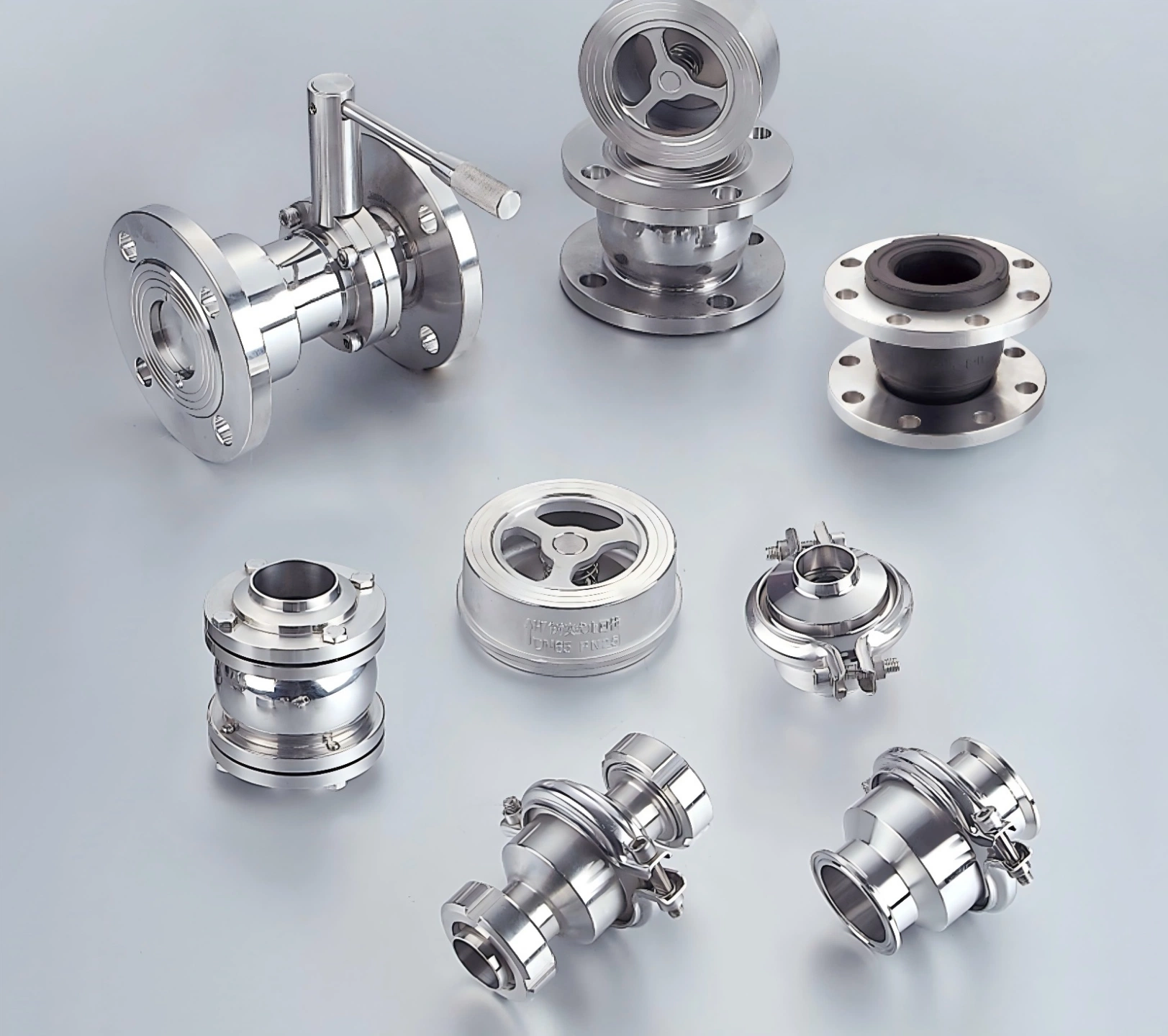
A sanitary check valve prevents backflow in hygienic process lines — tri-clamp ends, fully polished SS316L body, clean-in-place friendly design. Built for food, beverage, dairy, brewery, pharma and personal-care production where food-grade hygiene compliance and no dead corners are required.
Our sanitary check valve is available in sizes 1″–4″ (DN25–DN100), SS316L body Ra≤0.8μm. Available in spring-loaded (lift) or swing disc patterns. food-grade EPDM, Silicone or PTFE seats. Tri-Clamp ends (3A), butt-weld optional. Standard cracking pressure ~0.05 bar. For on/off isolation see sanitary ball valve; for CIP divert see 3-way ball. get a detailed quotation with size, disc type and operating pressure.
Every valve is shell + seat pressure tested before shipment. The spring-loaded disc closes fast and seals tightly — ideal for low pressure, frequent cycling, and any mounting orientation. The swing disc has lower pressure drop and higher flow — better for large lines (≥3″) bulk transfer. Both designs are CIP/SIP cleanable with no dead leg. We directly serve EPC contractors and valve distributors in Southeast Asia (Indonesia, Malaysia, Thailand, Vietnam) and the Middle East (Saudi Arabia, UAE, Qatar, Kuwait).
Southeast Asia & Middle East Market Notes
Thailand / Vietnam breweries: 2″–3″ spring-loaded check valves on CIP return lines — prevent beer backflow into the CIP tank. EPDM seat handles hot caustic.
Indonesia / Malaysia dairy: 1.5″–2″ spring-loaded valves on milk pump discharge — stop milk draining back to the feed tank when pump trips. EPDM seat, 0.05 bar cracking.
Saudi Arabia / UAE bottled water & pharma: 1″–2″ check valves on filler inlet lines and WFI return loops. 3-A / EHEDG cleanability declaration on request.
Building a CIP skid? We supply matched check + ball + butterfly valves + clamps + gaskets in one shipment with one MTR.
Get Free Skid Take-Off →Spring-Loaded vs Swing vs Wafer Dual-Plate vs Ball Check Comparison
| Valve Type | Best For | Pressure Drop | Mounting | Cost |
|---|---|---|---|---|
| Sanitary Spring-Loaded (Lift) | Low pressure, frequent cycling, any orientation | Medium (spring + disc) | Any angle | Baseline |
| Sanitary Swing Disc | Large lines, bulk transfer, low loss | Very low | Horizontal only | ~0.9× spring |
| Sanitary Wafer Dual-Plate | Compact skid, high pressure | Low | Horizontal only | ~0.8× spring |
| Sanitary Ball Check | Slurry, abrasive media | Medium | Any angle | ~1.3× spring |
| Sanitary Diaphragm Check | Pharma WFI, ultra-pure | Low | Any angle | ~1.8× spring |
Technical Specifications
| Size Range | 1″ - 4″ (DN25 - DN100); 6″+ on request |
| Disc Type | Spring-loaded (lift) or swing disc |
| End Connection | Tri-Clamp (3A standard), butt-weld optional |
| Body Material | SS316L (1.4404) investment casting, internal Ra ≤ 0.8 μm |
| Disc | SS316L mirror polished |
| Seat | EPDM / Silicone / PTFE (21 CFR 177) |
| Cracking Pressure | ~0.05 bar standard spring; custom 0.02–0.5 bar on request |
| Orientation | Spring-loaded: any angle. Swing: horizontal only, hinge at top |
| Pressure Rating | PN10 / 10 bar (at 20°C) |
| Temperature Range | -10°C ~ +140°C EPDM; +180°C PTFE; +200°C Silicone |
| Testing | shell & seat pressure test per API 598 |
| Material Certificates | EN 10204 3.1 MTC (material test reports) included |
| Standard | 3A, 21 CFR 177, ISO, DIN 11850, EHEDG cleanable |
Dimension Table — Sanitary Check Valve (mm)
| Size | DN | L (Face-to-Face) | H (Overall Height) |
|---|---|---|---|
| 1" | 25 | 76 | 85 |
| 1.5" | 40 | 90 | 100 |
| 2" | 50 | 110 | 120 |
| 2.5" | 65 | 135 | 145 |
| 3" | 80 | 160 | 170 |
| 4" | 100 | 200 | 210 |
* Dimensions may vary by spring-loaded / swing type; contact us for complete drawing.
Worked Example: 2″ Spring-Loaded Check on a Bangkok Brewery CIP Return
Project: Bright beer tank CIP return line. After CIP, caustic solution drains back to the CIP tank. Problem: when the CIP pump stops, beer from the product line siphons backward into the CIP tank — contaminating the next batch's caustic. The brewery needs a check valve on the CIP return header to prevent this backflow.
Step 1 — Spring-loaded or swing? The CIP return pipe runs vertically (from the tank top down to the CIP room). A swing disc on vertical piping will not close — gravity opens it the wrong way. We must choose spring-loaded (lift), which works in any orientation. This is the #1 reason we ask about piping orientation.
Step 2 — Cracking pressure: CIP pump discharge is 2.5 bar. The standard 0.05 bar spring opens easily at 2.5 bar — no problem. But at pump shutdown, beer siphon pressure is only ~0.15 bar. We need a spring that closes tightly at 0.15 bar reverse flow. Standard 0.05 bar spring would chatter — we supply a custom 0.1 bar cracking spring for this duty.
Step 3 — Seat: CIP weekly hits 85°C NaOH. EPDM seat — good to 140°C, handles caustic, elastic. PTFE would be overkill and require higher cracking pressure.
Step 4 — Outcome: 2″ spring-loaded check valve, Tri-Clamp, EPDM seat, custom 0.1 bar cracking spring. Installed on the vertical CIP return line. When CIP pump stops, the spring closes the disc before beer can siphon back. No more caustic contamination. Tri-Clamp design allows easy seat inspection during scheduled CIP audits.
4 Common Mistakes When Ordering Sanitary Check Valves
Mistake 1 — Swing disc on vertical piping: Swing valves rely on gravity to close. On vertical or upside-down piping, gravity opens the disc the wrong way — it will leak continuously. Always specify spring-loaded for vertical lines.
Mistake 2 — Using standard spring on low-pressure lines: If your operating pressure is 0.2 bar but the standard spring requires 0.05 bar to open, the valve chatters and wears out the seat in weeks. Tell us your actual operating pressure — we match the spring. Too soft = chatter; too stiff = pressure loss.
Mistake 3 — Installing check valve too close to pump: Check valves within 2–3 pipe diameters of a pump discharge cause water hammer when the pump trips. Position the check valve 5–10 pipe diameters downstream, or add a slow-closing dashpot for high-speed pumps.
Mistake 4 — Confusing check valve with shutoff valve: A check valve only prevents backflow — it does NOT provide bubble-tight shutoff for maintenance. If you need to isolate a line for repair, add a ball valve upstream of the check valve. Never rely on a check valve as an isolation valve.
Commercial Terms & Shipping
Payment: T/T 30% deposit + 70% before shipment; L/C at sight accepted for orders above USD 20,000. PayPal for sample orders.
Warranty: 12 months after shipment for material and manufacturing defects. Covers casting defects, seat leakage and spring failure. Damage from misuse, improper CIP chemicals or abrasive media beyond specified limits is not covered.
Packaging: Export plywood case (fumigation-free). Each valve packed in individual plastic bag with Tri-Clamp end caps to protect polished surfaces during transit.
Shipping Documents: EN 10204 3.1 MTC, 3-A compliance declaration on request, food-grade seat certificate, packing list, commercial invoice. Certificate of origin available on request.
Shipment Port: FOB Ningbo / Shanghai, China. Can also arrange CIF / DAP to your destination port.
Third-Party Inspection: SGS, Bureau Veritas or Intertek pre-shipment inspection supported at your cost.
Need Sizing Help or a Quote?
Send size (DN), pressure (PN/ANSI), material (304/316L), seat (EPDM/Viton) and quantity — we reply within 24 hours.
Get Free Quote »FAQ
Spring-loaded or swing disc — which do I choose?
Spring-loaded (lift) closes fast and seals tightly — ideal for low pressure, frequent cycling, and any mounting orientation. Swing disc has lower pressure drop and higher flow — better for large lines (≥3″) bulk transfer. Most hygienic skids 1″–2″ use spring-loaded; 3″–4″ horizontal lines typically use swing.
Can this valve be installed vertically?
Spring-loaded — yes, any orientation (vertical, horizontal, upside down) because the spring forces the disc closed. Swing disc — must be installed horizontally with the disc hinge at the top; on vertical piping gravity will not close the disc. If your line runs vertically, specify spring-loaded.
What does "cracking pressure" mean? Can I change it?
Cracking pressure is the minimum upstream pressure needed to open the valve — standard spring is ~0.05 bar. Too soft = valve chatters and leaks; too stiff = pressure loss. We supply custom springs for 0.02 bar (low-pressure water) or 0.2–0.5 bar (system with frequent reverse flow / water hammer). Tell us your operating pressure and we match the spring.
Will this valve prevent water hammer?
It prevents backflow, but fast-closing check valves themselves can cause water hammer when pumps trip. For high-speed pump discharge, add a slow-closing dashpot or position the check valve 5–10 pipe diameters downstream of the pump.
PTFE or EPDM seat — which is right?
EPDM is the hygienic default for water-based food / dairy / CIP caustic and SIP steam up to ~140°C. PTFE for aggressive solvents, dairy CIP acids and chemical resistance. Silicone for ultra-high-temp SIP (~200°C). All seats meet 21 CFR 177 requirements.
Can I use this check valve as an isolation valve for maintenance?
No. A check valve prevents backflow only — it does NOT provide bubble-tight shutoff. Always add a sanitary ball valve upstream of the check valve for positive isolation during maintenance. Relying on a check valve for lockout/tagout is a safety hazard.
MOQ, stock and lead time?
MOQ is 1 piece. 1″–2″ EPDM Tri-Clamp spring-loaded valves are usually in stock (7–15 days). 3″–4″, swing disc, PTFE / Silicone seats, butt-weld, custom cracking springs, or Ra ≤ 0.4 μm finish takes 15–30 days. We ship together with sanitary ball, butterfly, gaskets and clamps in one container.
What is the warranty period for your valves?
We provide a 12-month warranty after shipment for material and manufacturing defects. This covers casting defects, seat leakage and spring failure. Damage from misuse, improper CIP chemicals or abrasive media beyond specified limits is not covered.
📚 Further reading:
• Butterfly Valve Selection Guide (Size, Pressure, Material)
• How to Select a Wafer Butterfly Valve for Seawater Service
• Wafer Check Valve vs Swing Check Valve (2026 Guide)
You May Also Need
Related Technical Guides
Request a Quote for This Sanitary Check Valve
Tell us the size, pressure and quantity you need. We reply within one working day.