
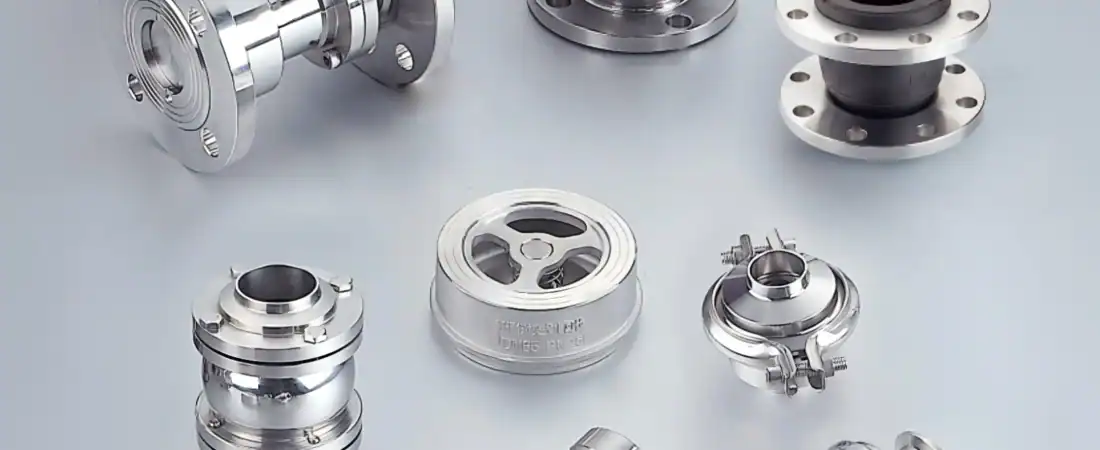
Sanitary Check Valve: Tri-Clamp Non-Return Hygienic Guide
The complete 2026 guide to hygienic sanitary check valves — lift vs ball vs swing vs spring-loaded, seal materials (EPDM / silicone / PTFE), installation orientation, CIP / SIP compatibility, and buying checklist for food, dairy, beverage and pharma projects in Southeast Asia and the Middle East.
* Standard lead time depends on order quantity and destination country. 5–10 days to Southeast Asia, 15–20 days to the Middle East.

Quick Answer
A sanitary check valve is an automatic, actuator-free non-return valve with a 316L electropolished body (Ra ≤ 0.8 μm), tri-clamp ends, and an FDA 21 CFR 177 style EPDM / silicone / PTFE seal — designed for food, dairy, beverage and pharma lines. For 80% of hygienic projects, the lift check (straight-through) with an EPDM seal is the default choice. Use a ball check for viscous / slurry products, and a spring-loaded check only when you need fast closing or vertical downflow installation. Never use an industrial cast-iron swing check on a CIP or bright-beer line — it will backflow and trap residue.
Key Takeaways
- Type: lift check = default · ball check = slurry / viscous · swing check = horizontal only · spring-loaded = any orientation / fast close.
- Seal: EPDM for CIP (80–90 °C) · silicone for SIP (121–130 °C) · PTFE for aggressive chemicals.
- Orientation: gravity types must not be installed vertically with flow going down — only spring-loaded works there.
- Cracking pressure: typical 0.05-0.2 bar for lift check · specify low-crack variant for low-flow systems.
On This Page
1. What Is a Sanitary Check Valve?
A sanitary check valve (also called a hygienic non-return valve) prevents backflow in food, beverage, and pharmaceutical piping systems — it lets product flow one way and closes automatically if flow reverses. As a sanitary valve manufacturer with export experience since 2009, we’ll walk you through everything you need to know.
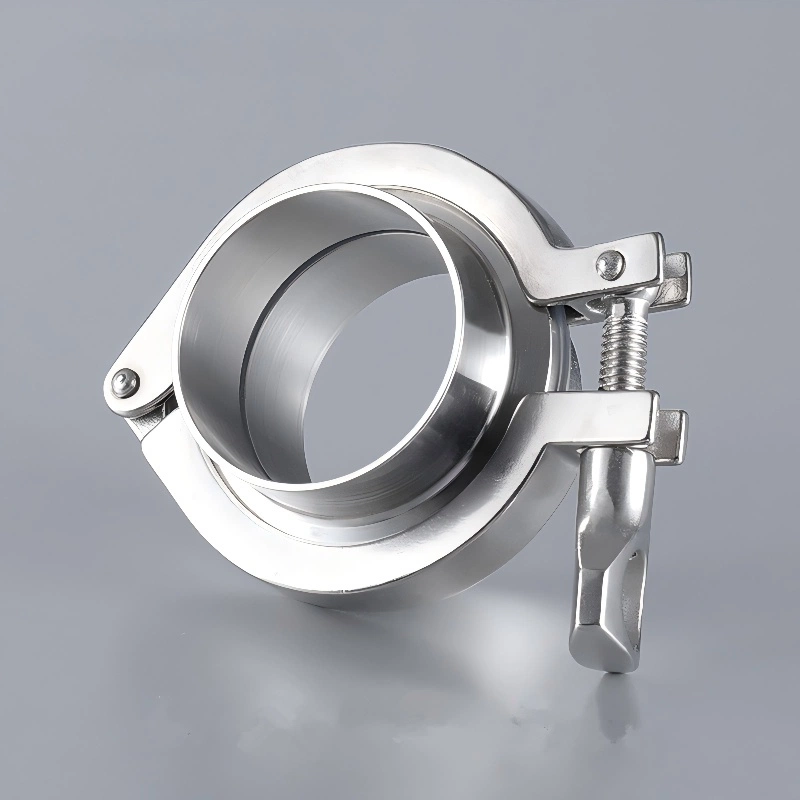
A sanitary check valve is an automatic valve that allows flow in only one direction. It has no actuator — it opens when upstream pressure pushes the disc off the seat, and closes automatically when flow stops or reverses.
Unlike industrial check valves, sanitary check valves have:
- All wetted parts are 316L stainless steel
- Internal surfaces electropolished (Ra ≤ 0.8 μm food · Ra ≤ 0.4 μm pharma)
- No crevices or dead legs — nowhere for product to trap
- Tri-clamp end connections (no threaded flanges)
- FDA 21 CFR 177 style EPDM, silicone, or PTFE seals
- 3A or EHEDG rated hygienic design
2. Main Types of Sanitary Check Valves
| Type | Design | Best For |
|---|---|---|
| Lift Check (Straight-Through) | Vertical disc lifts off seat by flow, drops back by gravity | Most common · horizontal or vertical-up · tight shutoff |
| Ball Check | Ball moves off seat by flow, rolls back by gravity | Viscous products, slurries, CIP / SIP systems |
| Swing Check | Hinged disc swings open (like a door) | Large sizes, low ΔP, horizontal only |
| Spring-Loaded Check | Spring-assisted disc, fast closing, any orientation | Fast closing needed · vertical downflow · low flow |
Most common choice: Lift check (straight-through) for most hygienic applications. Ball check for viscous / slurry products. Spring-loaded for fast closing or vertical installation. For non-sanitary industrial service, see our wafer dual-plate and swing check valves.
3. Seal & Gasket Materials
| Seal | Temperature Range | FDA 21 CFR 177 | Best For |
|---|---|---|---|
| EPDM | −40 °C to +150 °C | Yes | Dairy, beer, juice, CIP cleaning (most common) |
| Silicone (VMQ) | −60 °C to +200 °C | Yes | High-temperature CIP, hot filling, SIP |
| PTFE | −200 °C to +200 °C | Yes | Chemicals, abrasive products, high temp |
Most common choice: EPDM seal for dairy, beer, juice, and general CIP (about 80% of applications). Silicone for SIP / high temperature. PTFE for aggressive chemicals.
4. Hygienic Design Requirements
Not all “sanitary” check valves are truly hygienic. Look for these design features:
- Full port design — no step between pipe and valve bore
- Electropolished internal surface — Ra ≤ 0.8 μm (food) / Ra ≤ 0.4 μm (pharma)
- No crevices — no gaps where product can trap
- Seat is flush with pipe wall — no dead space behind seat
- Tri-clamp ends — no threads, no bolt holes in product contact area
- 3A or EHEDG certification — third-party verified hygienic design
- CIP / SIP compatible — can be cleaned and sterilized in place
Avoid: Industrial swing check valves with bolt holes in the body — they have crevices where bacteria can grow, and they’re not truly hygienic. Always pair with proper sanitary pipe fittings and unions for a complete hygienic system.
5. Worked Example: Brewery CIP Return Fix (Da Nang, Vietnam)
Step 1 — Problem
A 50,000 hL/year craft brewery in Da Nang, Vietnam had a recurring off-flavor issue in their lager batches. Quality control eventually traced it to the CIP return line check valve allowing caustic soda solution to backflow into the bright beer tank during CIP cycles. One 200 hL batch had to be dumped — a measurable loss of product.
Step 2 — Root cause
The existing check valve was an industrial cast-iron swing check valve (not sanitary). It had a hinged disc that closed slowly, allowing several liters of caustic solution to backflow each CIP cycle. The internal crevices also trapped beer residue and were impossible to clean.
Step 3 — Retrofit
• Replaced the DN50 (2″) industrial swing check with a 316L sanitary lift check valve (tri-clamp ends, EPDM seal, Ra 0.8 μm electropolished)
• Added a second sanitary check valve on the CIP supply line for double isolation
• Paired with sanitary butterfly valves at the tank inlet for manual isolation
• Replaced the adjacent sanitary union with 316L tri-clamp for easy disassembly inspection
Step 4 — Result after 6 months
• Zero off-flavor incidents — lift check closes in about 0.2 seconds, no backflow
• CIP cycles now pass quality check every time
• No more batch dumping — the brewery recovered the lost product and downtime entirely
• Total retrofit cost was a small fraction of a single batch loss
Why EPC Contractors Specify Sanitary Check Valves with Chuanglan
316L lift / ball / spring-loaded sanitary check valves · DN15–DN100 · tri-clamp ends
Ra ≤ 0.8 μm standard · Ra ≤ 0.4 μm electropolished available · 3A / EHEDG / DIN 11850
ISO 9001:2015 · shell and seat pressure tested · EN 10204 3.1 MTC · FDA 21 CFR 177 style EPDM / silicone / PTFE seals
Need a Sanitary Check Valve Quote?
Send us your size, installation orientation, medium, and CIP / SIP temperature — our engineers will recommend lift vs ball vs spring-loaded within 24 hours.
Get Free Sizing Report → WhatsApp us6. Installation Orientation
| Valve Type | Horizontal | Vertical (Flow Up) | Vertical (Flow Down) |
|---|---|---|---|
| Lift Check (Gravity) | Yes | Yes (disc lifts by flow, drops by gravity) | No (gravity keeps disc open) |
| Ball Check | Yes | Yes (ball lifts up, rolls back) | No (gravity keeps ball open) |
| Swing Check | Yes | No (disc hangs open) | No |
| Spring-Loaded Check | Yes | Yes (spring closes disc) | Yes (spring closes disc) |
Important: Always check installation orientation before ordering. If you need to install vertically with flow going down, you need a spring-loaded check valve — gravity will keep a lift or ball check open.
7. CIP & SIP Compatibility
Sanitary check valves must be compatible with CIP (Clean-In-Place) and SIP (Sterilize-In-Place):
CIP (Clean-In-Place): Cleaned in place with hot water (80–90 °C), caustic soda (NaOH 2–5%), and acid (nitric). EPDM and silicone seals are resistant to these chemicals.
SIP (Sterilize-In-Place): Sterilized with saturated steam at 121 °C for 30+ minutes. EPDM and silicone seals withstand repeated SIP cycles. PTFE is also fine.
8. Southeast Asia & Middle East Market Notes
For clients in Southeast Asia (Vietnam, Thailand, Indonesia, Malaysia, Philippines) working on breweries, dairy, beverage, and food processing, 316L sanitary lift check valves with tri-clamp ends and EPDM seals are the standard. Vietnamese craft breweries (Da Nang, Ho Chi Minh), Thai dairy plants (Chiang Mai, Khon Kaen), and Malaysian palm-oil food-grade processing all specify 3A or DIN 11850 sanitary check valves. Indonesian pharma projects (Jakarta) increasingly request 316L electropolished (Ra ≤ 0.4 μm) with silicone seals for WFI loops.
For clients in the Middle East (Saudi Arabia, UAE, Qatar, Kuwait, Oman) working on dairy (Almarai and similar), bottled water, juice, and pharma, 316L is the default due to the coastal saline environment. Saudi Vision 2030 local food manufacturing projects commonly specify EHEDG rated sanitary check valves with full 3.1 material certificates and FDA 21 CFR 177 style seals. UAE dairy and juice plants (Dubai, Abu Dhabi) also require repeated SIP cycles at 130 °C — specify silicone or PTFE seals for those applications.
Chuanglan Valve supplies the full range of sanitary check valves, plus matching sanitary butterfly valves, pneumatic sanitary butterfly valves, sanitary ball valves, pneumatic sanitary ball valves, sanitary 3-way ball valves, sanitary unions, and sight glasses. Serving EPC Contractors Across Southeast Asia & Middle East · ISO 9001:2015 · Established in 2009 · MOQ 1 piece.
Common Mistakes to Avoid
- Specifying 304 stainless for coastal or chloride service. If your project is in Southeast Asia (coastal, cooling tower, deicing salts) or the Middle East (desalination, SWRO, humid Gulf climate), 304 will pit within 1–3 years. Specify CF8M (316) or duplex 2205.
- Ignoring pressure-temperature derating. PN16 / Class 150 ratings apply at room temperature only. At 200°C the allowable pressure drops by roughly 40–50%. Always check the manufacturer’s P-T chart before specifying for steam, hot oil, or thermal fluid.
- Buying on price without MTC verification. “Stainless steel” is not enough — ask for EN 10204 3.1 MTC tied to the heat number, and arrange PMI (XRF) witness at the factory if the price is 20% below market. 304 passed off as 316L is the single most common failure in this industry.
- Forgetting face-to-face and flange drilling. A “PN16” wafer valve from one manufacturer may not match the existing flange drilling or face-to-face of another. Always confirm dimensions against EN 558 / API 609 / ASME B16.10 before replacing an installed valve.
FAQ
What is the difference between a sanitary check valve and an industrial check valve?
Sanitary check valves use 316L electropolished bodies (Ra ≤ 0.8 μm), tri-clamp ends, FDA 21 CFR 177 style seals, and no crevices. Industrial check valves use cast iron or carbon steel with flanged / threaded ends and bolt holes — they are not suitable for food, beverage, or pharma because bacteria can grow in the crevices.
Which type of sanitary check valve is most common?
The lift check (straight-through) is the most common — it works in horizontal or vertical-up installation, provides tight shutoff, and is easy to clean. Ball check valves are used for viscous products and slurries. Swing check is rarely used in sanitary applications because it only works horizontal.
Can sanitary check valves be used for vertical downflow installation?
Only spring-loaded sanitary check valves. Lift check, ball check, and swing check all rely on gravity to close — if you install them vertically with flow going down, gravity will hold the disc or ball open and the valve won’t close.
What seal material should I use for CIP vs SIP?
For CIP with caustic and acid at 80–90 °C, EPDM is the standard. For SIP with saturated steam at 121–130 °C, use silicone or PTFE. EPDM can handle occasional SIP but degrades faster with repeated steam cycles. For aggressive chemicals (strong acids, solvents), use PTFE.
How often should I inspect or rebuild a sanitary check valve?
Most breweries and dairy plants inspect sanitary check valves every 6-12 months during scheduled maintenance. Replace the EPDM / silicone seal every 12-24 months depending on CIP frequency. The 316L body and disc last 10+ years with proper CIP / SIP.
What is the minimum pressure needed to open a sanitary check valve?
Typical cracking pressure is 0.05-0.2 bar (0.7–3 PSI) for lift check valves, depending on size and spring. Ball check valves need slightly higher pressure (0.1-0.3 bar). For low-flow or low-pressure systems, specify a low-crack-pressure variant.
What is the lead time for sanitary check valves from Chuanglan?
Standard 316L tri-clamp lift check valves (DN25–DN100, EPDM seal, Ra 0.8 μm) are in stock and ship in 7–15 days. 316L electropolished (Ra 0.4 μm), PTFE seals, and custom sizes (DN125–DN150) take 15–30 days. Full EN 10204 3.1 MTC and FDA 21 CFR 177 declarations included.
References & Standards
- 3-A Sanitary Standards: Inlet/outlet Bungs and Fittings for Tanks (02-xx)
- EHEDG: Hygienic design of valves and fittings
- DIN 11850: Stainless steel tubes for food and chemical industries
- ASME BPE: Bioprocessing Equipment standard
- FDA 21 CFR 177.2600: Rubber articles intended for repeated use
Related Products
Continue Reading
Request a Quotation — Reply Within 24 Hours
Send your line size, pressure rating, medium and quantity. Our engineers come back with price, drawing and lead time — no obligation.