

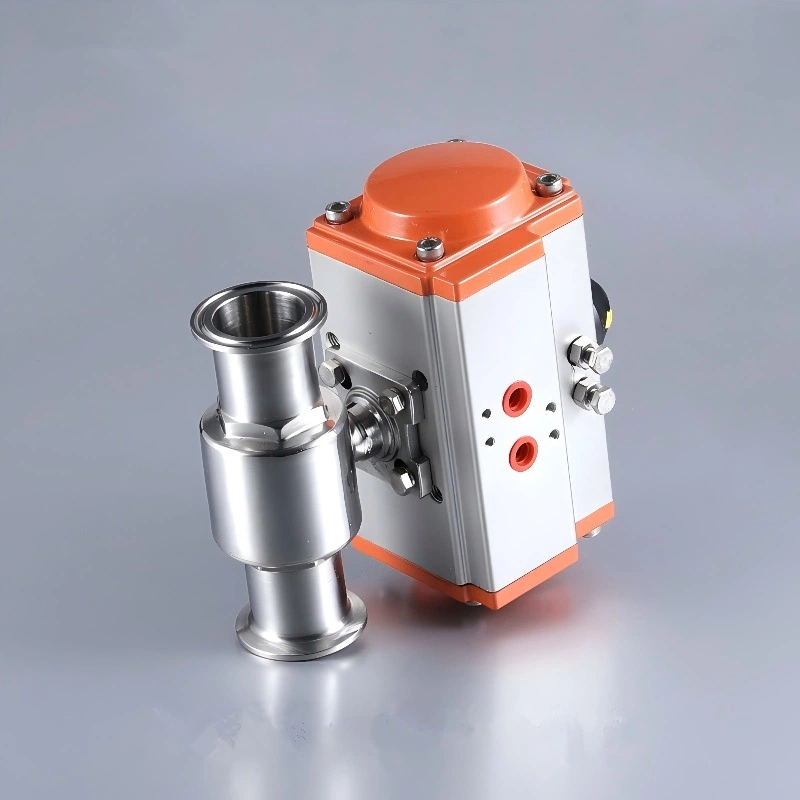
A pneumatic sanitary ball valve pairs a 3A-compliant tri-clamp ball body with an aluminum rack-and-pinion actuator for automated CIP/SIP control. Built for food, beverage, dairy, brewery, pharma and personal-care process lines where hygienic design, cleanability and PLC integration are mandatory.
Our pneumatic sanitary ball valve is available in sizes 1″–4″ (DN25–DN100), body SS316L with internal polish Ra≤0.8μm, mirror-polished ball. food-grade EPDM, Silicone or PTFE seals. Tri-Clamp ends (3A standard), butt-weld optional. Double-acting or spring-return fail-close actuator, 5–7 bar air supply. NAMUR solenoid, limit switch box and positioner available. For manual operation see sanitary ball valve; for flow diversion see 3-way ball. get a detailed quotation with your seal and actuator action (DA/SR).
Every valve is shell + seat pressure tested plus actuator stroke tested before shipment. The double-acting actuator provides equal torque in both directions; the spring-return actuator provides fail-safe shutoff if air fails. The NAMUR interface lets you bolt on a 5/2-way solenoid, inductive limit switches or a 4–20 mA positioner without any bracket. All accessories are pre-wired with a 4-pin M12 connector. We directly serve EPC contractors and valve distributors in Southeast Asia (Indonesia, Malaysia, Thailand, Vietnam) and the Middle East (Saudi Arabia, UAE, Qatar, Kuwait).
Southeast Asia & Middle East Market Notes
Thailand / Vietnam breweries: 2″–3″ pneumatic ball valves on bright beer tank outlet, SR fail-close with NAMUR solenoid — PLC closes automatically on CIP cycle. PTFE seat handles hot caustic.
Indonesia / Malaysia dairy & personal care: 1″–2″ SR fail-close valves on milk pasteurizer skids with limit switch box feedback. ABB / Siemens PLC integrates via 24 VDC.
Saudi Arabia / UAE pharma & bottled water: 1″–1.5″ DA valves with positioner (4–20 mA) for blending loops. 3-A / EHEDG cleanability declaration on request.
Building an automated CIP/SIP skid? We supply matched automated ball + butterfly + check valves pre-wired, air-tested, with one MTR.
Get Free Skid Take-Off →Pneumatic Sanitary Ball vs Butterfly vs Diaphragm vs 3-Way Comparison
| Valve Type | Best For | Actuator Torque | Shutoff Tightness | Cost (auto.) |
|---|---|---|---|---|
| Pneumatic Ball | Tight shutoff, tank outlet, CIP divert, product isolation | Medium (ball torque) | Bubble-tight per API 598 | Baseline |
| Pneumatic Butterfly | Large lines, bulk transfer, low-cost automation | High (seat break torque) | Weeps after cycles | ~0.6× ball |
| Pneumatic Diaphragm | Pharma WFI, ultra-aggressive CIP chemicals | Low | Zero dead space | ~1.8× ball |
| Pneumatic 3-Way Ball | Automated CIP divert, product / CIP switching | Medium | ~2× ball | |
| Manual Ball (no actuator) | Isolation, sampling, rarely-opened points | — | ~0.3× automated |
Technical Specifications
| Size Range | 1″ - 4″ (DN25 - DN100); 6″+ on request |
| End Connection | Tri-Clamp (3A standard), butt-weld optional |
| Body Material | SS316L (1.4404) investment casting, internal Ra ≤ 0.8 μm |
| Ball | SS316L mirror polished, full bore |
| Seat / Seal | PTFE / EPDM / Silicone (21 CFR 177) |
| Actuator | Aluminum rack & pinion, double-acting (DA) or spring-return (SR / FC) |
| Air Supply | 5 – 7 bar (dry, filtered, lubrication-free) |
| Pressure Rating | PN16 / 16 bar (at 20°C) |
| Temperature Range | -10°C ~ +140°C EPDM; +180°C PTFE; +200°C Silicone |
| Accessories | NAMUR solenoid (24 VDC), limit switch box (ITS-100), positioner (4–20 mA) |
| Testing | shell + seat pressure test + actuator stroke test per API 598 |
| Material Certificates | EN 10204 3.1 MTC (material test reports) included |
| Standard | 3A, 21 CFR 177, ISO, DIN 11850, EHEDG cleanable |
Dimension Table — Pneumatic Sanitary Ball Valve (mm)
| Size | DN | L (Face-to-Face) | H (Overall Height) |
|---|---|---|---|
| 1" | 25 | 64 | 180 |
| 1.5" | 40 | 76 | 200 |
| 2" | 50 | 89 | 220 |
| 2.5" | 65 | 102 | 240 |
| 3" | 80 | 127 | 260 |
| 4" | 100 | 152 | 280 |
* Dimensions may vary by actuator size (DA vs SR); contact us for complete drawing with solenoid / limit switch mounted.
Worked Example: 2″ Pneumatic Ball Valve on an Jakarta Dairy CIP Skid
Project: UHT milk line, 2″ (DN50) automated ball valve on the CIP return divert. PLC must switch product flow → CIP return on every cleaning cycle. Air supply unreliable due to factory compressor cycling.
Step 1 — DA vs SR: Because the compressor cycles, we must choose spring-return (SR) fail-close. If air pressure drops below 4 bar, the spring closes the valve automatically — preventing milk from draining into the CIP return when no one is watching. Double-acting would freeze mid-position on air loss, which is unsafe for a product line.
Step 2 — Seat: CIP cycles hit 2% NaOH at 85°C, rinse, 1% nitric acid at 70°C. PTFE seat — chemically inert to both, 21 CFR 177, good to 180°C. EPDM would degrade in hot caustic within months.
Step 3 — Accessories: NAMUR solenoid (24 VDC, ATEX for food area), limit switch box with inductive proximity switches giving open/closed feedback to PLC. Pre-wired with 4-pin M12 connector — the skid integrator just plugs in.
Step 4 — Documentation: 3-A compliance declaration on request, food-grade seal cert, EN 10204 3.1 MTR, pressure test report, actuator stroke test report. Valve ships as a complete pre-tested assembly — integrator mounts it, plugs in air + signal, done.
4 Common Mistakes When Ordering Automated Sanitary Ball Valves
Mistake 1 — Choosing DA on an unreliable air supply: If the factory compressor cycles, double-acting valves freeze mid-position. For product / CIP isolation, always specify SR fail-close unless you have reliable instrument air at >5 bar.
Mistake 2 — Forgetting the limit switch box: Without open/closed feedback, the PLC "thinks" the valve is closed but has no proof. HACCP audits require position confirmation — always specify a limit switch box (ITS-100) on product isolation valves.
Mistake 3 — Mixing 220 VAC solenoid on a 24 VDC PLC: Most modern food plant PLCs are 24 VDC. A 220 VAC solenoid means extra relays, extra wiring, extra failure points. Specify 24 VDC NAMUR solenoid unless the PLC cabinet is explicitly 220 VAC.
Mistake 4 — Ignoring air preparation: Actuators fail early if air is wet, oily or unfiltered. Always install a 5 μm FRL (filter-regulator-lubricator) within 2 m of the actuator. Dry instrument air at 5–7 bar doubles actuator life.
Commercial Terms & Shipping
Payment: T/T 30% deposit + 70% before shipment; L/C at sight accepted for orders above USD 20,000. PayPal for sample orders.
Warranty: 12 months after shipment for material and manufacturing defects. Covers casting defects, seat leakage, actuator stroke failure and solenoid non-conformance. Damage from misuse, improper CIP chemicals, abrasive media beyond specified limits, or lack of air filtration is not covered.
Packaging: Export plywood case (fumigation-free). Each valve packed in individual plastic bag with Tri-Clamp end caps and actuator protected in foam to prevent transit damage.
Shipping Documents: EN 10204 3.1 MTC, 3-A compliance declaration on request, food-grade seat certificate, pressure test report, actuator stroke test report, packing list, commercial invoice. Certificate of origin available on request.
Shipment Port: FOB Ningbo / Shanghai, China. Can also arrange CIF / DAP to your destination port.
Third-Party Inspection: SGS, Bureau Veritas or Intertek pre-shipment inspection supported at your cost.
Need Sizing Help or a Quote?
Send size (DN), pressure (PN/ANSI), material (304/316L), seat (EPDM/Viton) and quantity — we reply within 24 hours.
Get Free Quote »FAQ
Double-acting (DA) or spring-return (SR) actuator — which do I choose?
DA for normal automated CIP/SIP lines with reliable air supply and equal open/close torque. SR (fail-close / FC) for any process where loss of air must close the valve — pressurized tanks, sterile barriers, product mixing, safety interlocks. For fail-open service we can also supply SR with the spring acting in the opening direction.
EPDM, Silicone or PTFE seal — which is right?
EPDM is the default for water-based food & beverage, CIP caustic / acid, and SIP steam up to ~140°C. Silicone for ultra-high-temp SIP (~200°C) and oily / fatty media. PTFE for aggressive chemicals, solvents, dairy CIP acids. All seals meet 21 CFR 177 requirements.
Tri-Clamp or butt-weld end?
Tri-Clamp is the hygienic industry standard — tool-free disassembly, no crevice, 3A-compliant. Butt-weld for permanent fully-welded process skids in pharma WFI. Most breweries / dairies / pharma plants use Tri-Clamp.
What accessories do I need for PLC integration?
Minimum = 5/2-way NAMUR solenoid valve (24 VDC). For position feedback add a limit switch box (inductive proximity, open/closed to PLC). For modulating duty add a pneumatic positioner with 4–20 mA input. We pre-assemble and pre-wire with a 4-pin M12 connector.
What hygiene standards does the valve meet? What is the inner surface finish?
Yes — built to 3-A dimensional and surface-finish standards. Body internal surface electro-polished to Ra ≤ 0.8 μm (mirror), ball mirror-polished, all crevices eliminated. On request we can supply Ra ≤ 0.5 μm for pharma-grade (USP Class VI), plus EN 10204 3.1 MTC, material cert to 21 CFR 177, and pressure test report per serial number.
Can I upgrade from manual to pneumatic later?
Yes — every sanitary ball valve shares a standard ISO 5211 top flange. Start with manual lever, bolt on a rack-and-pinion actuator in 10 minutes without replacing the body. We sell the actuator as a retro-fit kit with mounting bracket, hardware and solenoid.
MOQ, stock and lead time?
MOQ is 1 piece. 1″–2″ EPDM DA valves are usually in stock (7–15 days). 3″–4″, Silicone / PTFE, SR fail-close, pre-assembled solenoid / positioner, or Ra ≤ 0.5 μm finish takes 15–30 days. We ship together with sanitary butterfly, pipe fittings & unions and gaskets in one container.
What is the warranty period for your valves?
We provide a 12-month warranty after shipment for material and manufacturing defects. This covers casting defects, seat leakage, actuator stroke failure and solenoid non-conformance. Damage from misuse, improper CIP chemicals, abrasive media beyond specified limits, or lack of air filtration is not covered.
📚 Further reading:
• Butterfly Valve Selection Guide (Size, Pressure, Material)
• How to Select a Wafer Butterfly Valve for Seawater Service
• Wafer Check Valve vs Swing Check Valve (2026 Guide)
You May Also Need
Related Technical Guides
Sanitary Ball Valve Guide · Pneumatic Actuator Selection · Sanitary Valves for Pharma
Request a Quote for This Pneumatic Sanitary Ball Valve
Tell us the size, pressure and quantity you need. We reply within one working day.