


Wafer Check Valve 2026: Working Principle, Types, Sizing & Selection Guide
A compact, cost-effective non-return valve that prevents backflow in piping systems. Working principle, 6 types, Cv sizing, viscosity correction and wafer vs swing comparison.
* Standard lead time depends on order quantity and destination country. 5–10 days to Southeast Asia, 15–20 days to the Middle East.
⚡ Quick Answer
Choose a dual-plate wafer check valve for most industrial applications — it closes in under 0.1 second, has the lowest pressure drop, and weighs 50–70% less than a flanged swing check valve of the same size.
For a typical DN80 cooling water line at 50 m³/h, a PN16 304SS dual-plate wafer check valve with EPDM seat is the standard pick. Use a tilting-disc or nozzle-type design only for high-pressure steam or compressor service.
🔑 Key Takeaways
- Default pick: Dual-plate wafer check valve closes in <0.1 s with the lowest pressure drop — the go-to design for most water, oil and gas piping.
- Sizing rule: Always verify Cv against allowable ΔP. For 50 m³/h cooling water at DN80, a Cv≈80 dual-plate valve gives ΔP≈0.39 bar (under the 0.5 bar limit).
- Material match: 304SS+EPDM for HVAC/water · 316L+EPDM for seawater/food · 316L+PTFE for chemicals/steam · 316L+NBR for oil/gas.
- Don’t size by line size alone: Viscosity over 2 cP (heavy oil, glycol) needs a 10-20% ΔP margin or one size up — never assume the line size is the valve size.
On This Page
What Is a Wafer Check Valve?
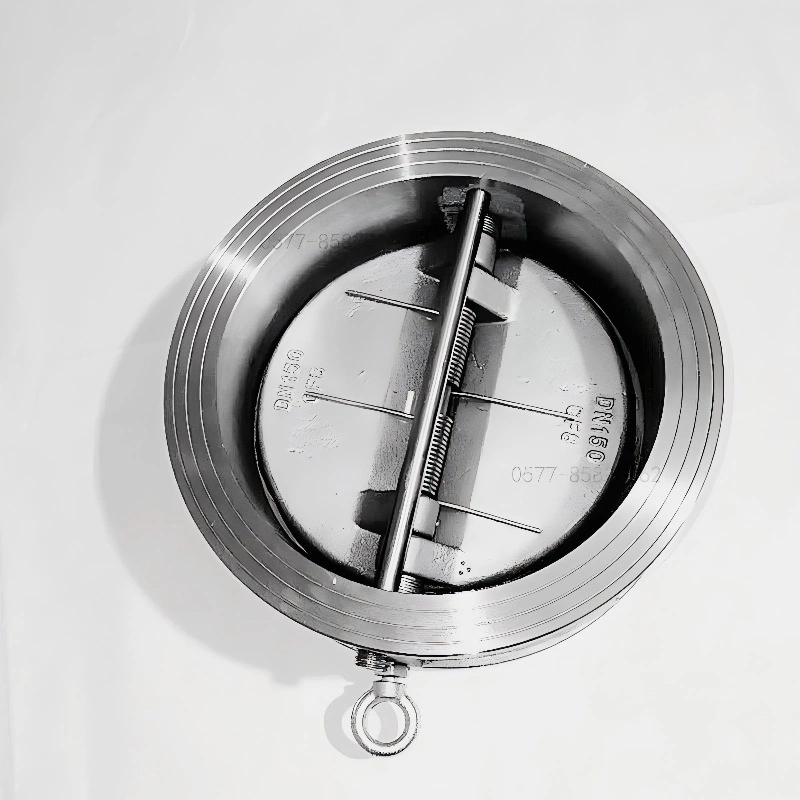
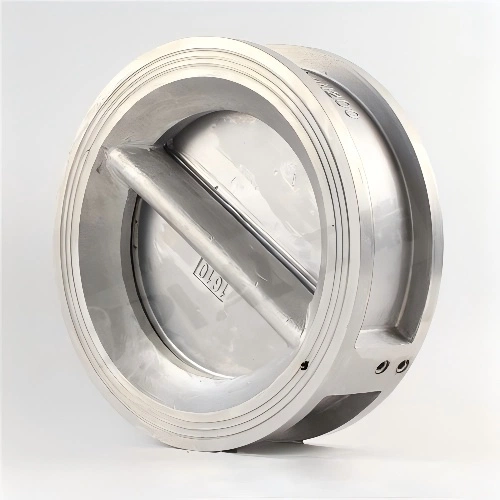
A wafer check valve is a short-face-to-face check valve designed to be installed between two pipeline flanges. Unlike flanged check valves that have their own flanges, wafer check valves rely on the flanges of adjacent pipes to hold them in place. This compact design reduces weight, upfront cost, and installation space significantly.
We manufacture stainless steel wafer check valves in sizes DN25–DN300 (1″–12″), pressure ratings PN10–PN40, with 304/316L body materials suitable for water, oil, gas, and chemical applications. For larger pipelines, we also supply flanged swing check valves in sizes up to DN600.
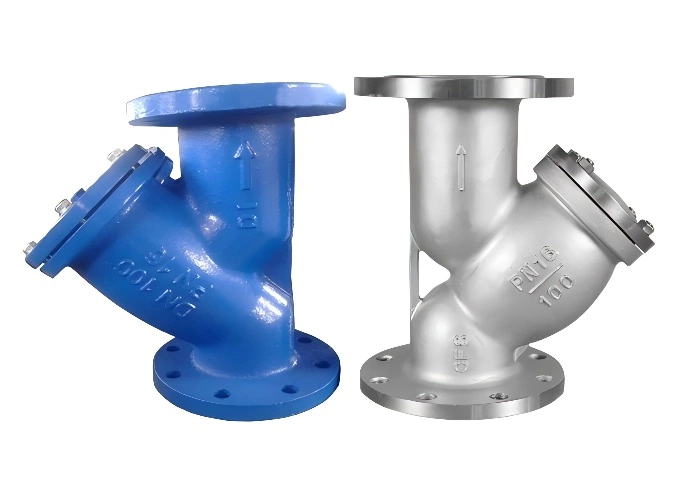
Related products in our range include wafer butterfly valves, flanged ball valves, and Y-strainers — all commonly used together in industrial piping systems.
Working Principle
Wafer check valves operate on a simple principle: forward flow pushes the disc open, while reverse flow pushes the disc closed against the seat. The valve automatically opens and closes without external actuation, making it a passive safety device.
There are two main operating mechanisms:
- Lift (piston) type: A circular disc moves vertically along guides. Flow lifts the disc; reverse flow pushes it back down onto the seat. Similar to the internal mechanism of a globe valve but fully automatic.
- Swing (flap) type: A hinged flap swings open with forward flow and closes against reverse flow. Faster response than lift type.
- Dual plate type: Two spring-loaded half-discs rotate around a central hinge. Fastest closure, minimal pressure drop. This is the most popular design for wafer check valve applications today.
Types of Wafer Check Valves
Different designs suit different applications. Here’s a complete comparison of all common types:
| Type | Working Principle | Pressure Drop | Best For |
|---|---|---|---|
| Dual Plate (wafer) | Two spring-loaded half-discs | low | Low pressure drop, fast closure, general purpose |
| Lift (piston) wafer | Vertical disc movement | Moderate | High pressure, clean fluids, vertical installation |
| Swing (flap) wafer | Hinged flap | Low | Slurry, dirty fluids, large diameters |
| Tilting disc wafer | Offset pivot disc | low | High pressure, high temperature, steam service |
| Silent check valve | Spring-loaded guided disc | Moderate | Low noise, pump discharge, HVAC systems |
| Nozzle type check valve | Venturi-shaped disc | low | Compressors, high pressure gas, critical systems |
Sizing Guide: Worked Example
Proper sizing ensures the valve opens at design flow and closes without water hammer. Here’s a real-world example:
Problem: Select a wafer check valve for a cooling water system with flow rate = 50 m³/h, pipe size = DN80 (3″), allowable pressure drop = 0.5 bar, water temperature = 30°C.
Step 1: Calculate flow velocity
Pipe cross-section area = π × (0.08/2)² = 0.005 m²
Velocity = 50 m³/h ÷ 3600 s/h ÷ 0.005 m² = 2.8 m/s
Step 2: Check recommended velocity range
For water systems, recommended velocity = 1.5–3.0 m/s. Our calculated 2.8 m/s is within range, so DN80 is appropriate. This is similar to the sizing methodology we explain in our Y-strainer sizing guide.
Step 3: Verify pressure drop using Cv method
A DN80 dual plate wafer check valve typically has Cv ≈ 80.
Pressure drop ΔP = (Q/Cv)² × SG = (50/80)² × 1.0 ≈ 0.39 bar
0.39 bar < 0.5 bar allowable limit
Result: Select DN80 (3″) PN16 dual plate wafer check valve, body material 304SS, EPDM seat. For installation guidance, refer to our guide on pipeline component orientation best practices.
International Standards Reference
| Standard Category | US / ANSI | European / EN | Japanese / JIS |
|---|---|---|---|
| Design | API 594 | EN 12334 | JIS B2002 |
| Face-to-Face | ASME B16.10 | EN 558 / ISO 5752 | JIS B2002 |
| Flange | ASME B16.5 (Class 150/300) | EN 1092-1 (PN10/16/25/40) | JIS B2220 (10K/20K) |
| Pressure Rating | ANSI Class 150–600 | PN10–PN40 | 10K–20K |
| Testing | API 598 / API 6D | EN 12266-1 | JIS B2003 |
| Fire Safe | API 607 / API 6FA | ISO 10497 | — |
| Waterworks | AWWA C508 | EN 12334 | — |
Note: ANSI Class and PN ratings are not directly interchangeable — always verify pressure-temperature rating tables. Our check valves are manufactured to meet all three standards above.
Viscosity Correction & Advanced Sizing
For viscous fluids (oil, syrup, polymer solutions), the standard Cv formula needs correction. Higher viscosity increases pressure drop and requires larger valve sizes.
Viscosity Correction Factor:
| Viscosity (cSt) | Correction Factor | Example (Cv = 80) |
|---|---|---|
| 1 (water) | 1.0 | Cv = 80 |
| 10 (light oil) | 1.2 | Cv = 96 |
| 50 (medium oil) | 1.8 | Cv = 144 |
| 200 (heavy oil) | 2.5 | Cv = 200 (need DN100) |
Example: If the fluid is heavy oil at 200 cSt, the required Cv becomes 80 × 2.5 = 200. A DN80 valve (Cv=80) is too small — you need to upsize to DN100 (Cv≈160) or DN150 (Cv≈300). For oil and gas applications, we recommend flanged ball valves together with check valves for complete system isolation.
💡 Why Engineers Choose Chuanglan
15+ years OEM/ODM for European & Southeast Asian distributors
304/316L body material, ISO 9001:2015 certified factory, 100% factory pressure tested
MOQ: 1 piece — small trial orders welcome
Need Help Sizing Your Check Valve?
Our engineers will calculate the correct size for your application within 24 hours.
Get Free Sizing Report →Material Selection Guide
Choosing the right body and seat material prevents corrosion and ensures long service life.
| Body Material | Seat Material | Temperature Range | Typical Application |
|---|---|---|---|
| 304SS | EPDM | -10°C to 120°C | Water, HVAC, general industrial |
| 316LSS | EPDM | -10°C to 120°C | Chemical, seawater, food grade |
| 316LSS | PTFE | -50°C to 200°C | Strong chemicals, high temp |
| 316LSS | NBR | -20°C to 100°C | Oil, gas, non-corrosive fluids |
| WCB (cast steel) | NBR | -20°C to 100°C | Oil, gas, steam (non-corrosive) |
| Ductile Iron (GGG40) | EPDM | -10°C to 120°C | Water treatment, HVAC, budget projects |
Comparison: Wafer vs Swing Check Valve
Which check valve type should you choose? Here’s a complete side-by-side comparison:
| Feature | Wafer Check Valve | Swing Check Valve (Flanged) |
|---|---|---|
| Face-to-face length | Short (1/3 of flanged, EN558 series 48) | Long (standard EN558 series 14) |
| Weight | Light (50-70% less) | Heavy (baseline for large lines) |
| Upfront cost | Lower (30-50% less than flanged) | Higher (baseline for large/high-pressure) |
| Pressure drop | Low (dual plate design) | Moderate |
| Water hammer risk | Low (fast closure, <0.1s) | High (slow closure, 0.5-1s) |
| Installation orientation | Horizontal or vertical (upward flow) | Mostly horizontal only |
| Maximum size | DN300 (12″) standard, DN600 special | DN1200+ (large sizes available) |
| Maintenance | Inline service possible (split body) | Inline service possible (cover removal) |
Southeast Asia & Middle East Applications
We export wafer check valves to Southeast Asia and the Middle East markets, where rapid industrialization drives demand for dependable non-return valves:
- Indonesia & Malaysia: Palm oil, mining, and water treatment plants commonly use 304/316L wafer check valves for corrosion resistance in tropical climates. Palm oil mills specifically require 316L with PTFE seats for high-temperature oil service, paired with Y-strainers to protect downstream equipment.
- Saudi Arabia & UAE: Desalination plants, oil & gas facilities, and district cooling systems require high-quality check valves that withstand high temperatures and saline water, supplied with SGS/BV inspection and 3.1 MTC.
- Thailand & Vietnam: Food processing, beverage, and pharmaceutical factories prefer 316LSS with EPDM seats for sanitary applications. Our valves meet FDA and 3-A sanitary standards.
- Philippines: Power plants and water distribution systems use ductile iron wafer check valves for budget-friendly, dependable performance, often paired with wafer butterfly valves for isolation.
Serving EPC Contractors Across Southeast Asia & Middle East · ISO 9001:2015 Certified · 15+ Years Factory Experience
Common Mistakes to Avoid
- Specifying 304 stainless for coastal or chloride service. If your project is in Southeast Asia (coastal, cooling tower, deicing salts) or the Middle East (desalination, SWRO, humid Gulf climate), 304 will pit within 1–3 years. Specify CF8M (316) or duplex 2205.
- Ignoring pressure-temperature derating. PN16 / Class 150 ratings apply at room temperature only. At 200°C the allowable pressure drops by roughly 40–50%. Always check the manufacturer’s P-T chart before specifying for steam, hot oil, or thermal fluid.
- Buying on price without MTC verification. “Stainless steel” is not enough — ask for EN 10204 3.1 MTC tied to the heat number, and arrange PMI (XRF) witness at the factory if the price is 20% below market. 304 passed off as 316L is the single most common failure in this industry.
- Forgetting face-to-face and flange drilling. A “PN16” wafer valve from one manufacturer may not match the existing flange drilling or face-to-face of another. Always confirm dimensions against EN 558 / API 609 / ASME B16.10 before replacing an installed valve.
FAQ
Can a wafer check valve be installed vertically?
Yes, dual plate and lift-type wafer check valves can be installed in vertical pipelines where flow goes upward. Swing-type wafer check valves are recommended for horizontal installation only.
What is the typical lead time for wafer check valves?
7-15 working days for standard sizes (DN25–DN200) in stock; 15–30 days for custom sizes, special materials, or large diameters (DN250+).
What is the difference between wafer and dual plate check valves?
“Wafer” refers to the compact flange-to-flange design, while “dual plate” refers to the internal disc mechanism (two spring-loaded half-discs). Most modern wafer check valves use the dual plate design.
How do I prevent water hammer with a wafer check valve?
Choose a dual plate design with spring assist for fast closure (under 0.1 second). For critical applications, add a surge tank or pressure relief valve upstream.
What pressure ratings are available?
Standard pressure ratings include PN10, PN16, PN25, PN40 (equivalent to Class 150, 300). We can also supply Class 600 for high-pressure applications.
Do you provide MTC (Material Test Certificate)?
Yes, all valves come with EN 10204 3.1 MTC, including chemical composition and mechanical test results for body, trim, and casting.
What is the minimum order quantity (MOQ)?
MOQ is 1 piece for standard sizes. We support sample orders for testing before bulk purchase.
Can wafer check valves be used for steam service?
Yes, with PTFE or metal seats. Tilting disc wafer check valves are preferred for steam applications due to higher temperature and pressure rating.
References & Standards
- API 594: Check Valves: Flanged, Lug, Wafer and Butt-Weld
- EN 12334: Industrial valves — Metal bellows shut-off valves for gas
- ASME B16.34: Valves — Flanged, Threaded, and Welding End
- MSS SP-80: Specification for Thermoplastic Industrial Valves
- AWWA C508: Standard for Flow Control Valves for Waterworks Service
Related Products
Continue Reading
Request Your Free Check Valve Quote within 24 Hours
MOQ: 1 piece · ISO 9001:2015 certified · 3.1 MTC included
Southeast Asia: Indonesia, Malaysia, Thailand, Vietnam, Philippines, Myanmar
Middle East: Saudi Arabia, UAE, Qatar, Kuwait, Oman, Bahrain
Other Regions: Europe, North America, South America, Africa, Australia — 20+ countries total
Delivery: 5–10 days to Southeast Asia · 15–20 days to the Middle East · 25–35 days to Europe / the Americas
Payment: T/T 30% deposit + 70% before shipment · L/C at sight · Warranty: 12 months after shipment for material and manufacturing defects · Packing: export plywood case / fumigation-free pallet · Shipping: FOB Ningbo/Shanghai · Documents: EN 10204 3.1 MTC + packing list + commercial invoice · Third-party inspection welcome: SGS / Bureau Veritas / Intertek
Contact Our Engineers »Need a quote or datasheet? Tell us size, pressure class and material – reply within 24 hours.
Request a Quote