

Pneumatic Actuators for Valves: Sizing, Fail-Safe Modes and Selection
A practical selection guide for double-acting and spring-return pneumatic actuators on ball valves and butterfly valves — torque calculation, safety factor, air supply, mounting standards and worked sizing numbers for DN80 and DN150 valves in Southeast Asia and Middle East projects.
* Standard lead time depends on order quantity and destination country. 5–10 days to Southeast Asia, 15–20 days to the Middle East.

Quick Answer
Size the actuator on valve torque at the minimum air pressure you actually have on site, then apply a 1.5–2.0 safety factor. A DN80 soft-seated ball valve with 45 N·m break torque needs 68 N·m of actuator output at 5 bar, which is one frame above the catalogue minimum. Choose spring-return whenever loss of air must close (fuel gas, steam, chemical dosing) and double-acting only where the valve may stay in position on air failure.
<Key Takeaways
- Torque basis: size the actuator on valve break torque at the minimum air pressure you actually have on site, then apply a 1.5-2.0 safety factor.
- DN80 example: a soft-seated ball valve with 45 N·m break torque needs 68 N·m of actuator output at 5 bar.
- Fail-safe choice: spring-return where loss of air must close the valve; double-acting only where the valve may stay in position on air failure.
- Mounting: the actuator flange and shaft must match the valve to ISO 5211 before torque is compared.
On This Page
What a Pneumatic Valve Actuator Does
A pneumatic actuator converts compressed air into the quarter-turn motion that opens and closes a ball valve or butterfly valve. Air pressure pushes against pistons inside a rack-and-pinion or scotch-yoke housing, rotating the output shaft through 90 degrees. Compared with manual lever or gear operation, an actuated valve can be driven remotely from a PLC or solenoid panel, cycled repeatedly on automated lines, and configured to move to a safe position the moment plant air or control power is lost.
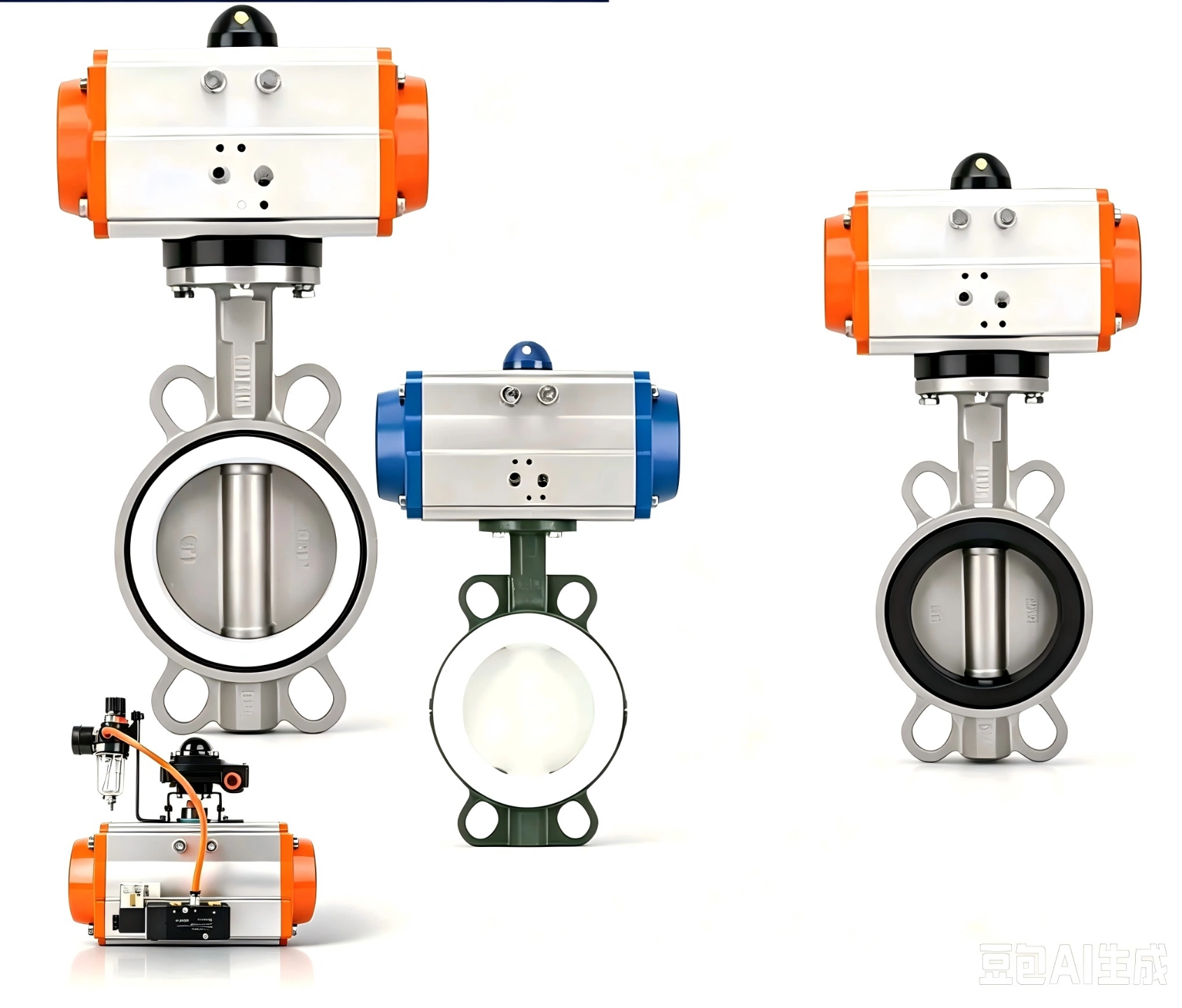
For engineering contractors and distributors specifying automated packages, the actuator is not a separate afterthought. It has to be matched to the valve’s break torque, the differential pressure across the seat, the available air pressure and the required failure action. An undersized actuator stalls under load; an oversized one wastes compressed air, costs more and can shock the stem and coupling. Our actuated valve range is shipped as a factory-assembled and tested valve-actuator package rather than loose components.
Double-Acting vs Spring-Return
Double-acting (DA) actuators use air to move in both directions. Air to port A opens, air to port B closes. They are compact for a given torque output, lower in cost, and hold position only as long as air is supplied. If air fails, the valve stays where it was — acceptable for general process isolation but not where a defined safe state is mandatory.
Spring-return (SR), or single-acting actuators use air in one direction and a compressed spring in the other. When air is vented on loss of supply or signal, the spring drives the valve to either fail-close (FC) or fail-open (FO). Steam, fuel gas, chemical dosing and tank inlet shut-off duties typically fail close; cooling water and pump recirculation lines often fail open to protect equipment. The spring housing makes SR units longer and more expensive for the same torque, which is why fail-safe requirements should be settled before quoting.
How to Size Actuator Torque
Three torque values matter. Break (or unseating) torque is the peak needed to start movement from a closed, pressurized seat and is always the highest. Running torque keeps the valve moving through the stroke. End (or seating) torque closes against the seat. Sizing is based on break torque, never the average running figure.
The correct procedure is:
- Take the valve manufacturer’s break torque at the actual working pressure differential. Torque rises with pressure and is higher for soft seats after long idle periods.
- Apply a safety factor: 1.25–1.5 for clean, dry, frequently cycled valves; 1.5–2.0 for high-cycle, damp or sticky media, and for spring-return units where the spring stroke must still seat the valve.
- Read the actuator’s torque output at the minimum guaranteed air pressure at the point of use, not the compressor nameplate pressure. A unit rated at 6 bar may see only 4.5 bar at the end of a long header.
- For spring-return, verify both the air stroke torque and the spring stroke torque independently — the spring end, not the air end, usually governs.
Worked Example: Sizing a DN80 Ball Valve
Suppose a DN80 (NPS 3) flanged stainless steel ball valve on a water line has a published break torque of 45 N·m at the 10 bar differential pressure it will see in service. The plant guarantees a minimum of 5 bar air at the actuator, and the duty is general isolation with a 1.5 safety factor.
- Required torque = 45 N·m × 1.5 = 67.5 N·m.
- At 5 bar supply, the candidate double-acting actuator catalogue shows 72 N·m output — above 67.5 N·m, so the DA unit is accepted. The same frame rated at 6 bar would show roughly 86 N·m, but sizing must use the 5 bar figure.
- If the specification is changed to fail-close, the equivalent spring-return frame must deliver at least 67.5 N·m on the spring end at zero air. In practice this moves the package one frame size up, because spring-end output is lower than air-end output on the same body.
Repeating this calc at real pressure and real air supply is the step that prevents a field stall. Every package we ship is torque-checked against these numbers before it leaves the factory, with the result recorded against the EN 10204 3.1 material certificate for the valve body.
Send us your valve size, pressure and available air pressure — we will return a calculated actuator selection with torque and fail-safe data.
Air Supply, Mounting and Controls
Air quality: supply should be filtered to 50 µm and regulated, with a lubricator only where the actuator manufacturer specifies oiled air — most modern rack-and-pinion units run grease-packed for life and are damaged by over-lubrication. Water in the header is the most common cause of slow stroke and internal corrosion in humid climates.
Mounting: quarter-turn packages mount to ISO 5211 flanges with a square or double-square drive, and the solenoid interface follows the NAMUR pattern for direct mounting without external tubing. Confirm the ISO 5211 flange code (for example F05/F07) and the drive size match the valve stem.
Controls: a 5/2 solenoid drives double-acting actuators and a 3/2 solenoid drives spring-return units. Add a filter regulator, limit switch box for open/closed feedback, and a manual override for commissioning. Positioners are only needed for modulating control; simple open/close duties do not justify them.
Selection Comparison Table
| Selection factor | Double-acting | Spring-return |
|---|---|---|
| Action on air loss | Stays in last position | Fails open or closed |
| Solenoid valve | 5/2 way | 3/2 way |
| Size for equal torque | Smaller, lighter | Longer, one frame up |
| Air consumption per cycle | Both strokes use air | One stroke uses air |
| Typical duty | Process isolation, sequencing | Fuel, steam, safety shut-off |
| Safety factor applied | 1.25–1.5 | 1.5–2.0 |
| Cost level | Lower | Higher |
Southeast Asia and Middle East Considerations
Southeast Asia (Indonesia, Malaysia, Thailand, Vietnam): high ambient humidity and monsoon seasons put water condensate in air headers. Filter-regulators and drain traps are not optional, and stainless steel actuator fasteners and external brackets avoid the external rust that appears on carbon steel hardware within months. Palm oil mills and water treatment plants frequently specify spring-return fail-close on transfer lines, with Y strainers installed upstream to keep seat-damaging solids out of the valve.
Middle East (Saudi Arabia, UAE, Qatar): the governing issues are high ambient temperature, dusty air and sometimes low point-of-use pressure on large sites. Actuators should be sized on the minimum end-of-header pressure rather than compressor output, and solenoid coils rated for the site temperature range. Petrochemical and district-cooling packages tend to require fail-safe spring-return units with limit switch feedback and NAMUR mounting as standard. For data-center cooling duties we also cover CDU liquid cooling valve automation separately.
Frequently Asked Questions
Get a Free Actuator Sizing Report
Send valve size, pressure class, differential pressure and available air pressure — we return a calculated torque selection with a matched solenoid and limit switch within 24 hours.
Get Free Sizing Report WhatsApp usWhat air pressure do pneumatic valve actuators need?
Most rack-and-pinion actuators are rated for a 2–8 bar operating range with a nominal 6 bar. Sizing must always use the minimum pressure actually delivered at the actuator, commonly 4.5–5 bar on real sites, because output torque scales directly with supply pressure.
How do I choose fail-open or fail-close?
Ask which position protects people and equipment when air is lost. Fuel gas, steam and chemical feed valves fail close to stop the source; cooling water and pump minimum-flow lines usually fail open to keep protection in service. Record this on the P&ID before selecting the actuator frame.
Why does my actuator stall even though its catalogue torque looks high enough?
Usually because it was sized at 6 bar while point-of-use pressure is lower, or because average running torque was used instead of break torque. Re-run the calculation using break torque at the real pressure differential and the minimum air pressure, with the safety factor applied.
Do I need a positioner for an open/close valve?
No. A positioner is only justified for modulating control that holds intermediate positions. On-off duties need only a solenoid valve, filter regulator and, where feedback is required, a limit switch box.
What is the difference between ISO 5211 and NAMUR mounting?
ISO 5211 defines the mechanical flange and drive between the actuator and valve stem. NAMUR defines the interface pattern for mounting the solenoid directly onto the actuator. A correctly specified automated package states both.
Can a double-acting actuator be converted to fail-safe later?
Not in the same frame. A fail-safe action requires the spring cartridge of a spring-return model, which usually means replacing the actuator with one frame size larger and changing the solenoid from 5/2 to 3/2. It is cheaper to settle the fail-safe requirement at order stage.
References & Standards
- ISO 5211: Industrial valves — Part-turn actuator attachments
- EN 15714-2: Industrial valves — Actuators — Pneumatic quarter-turn actuators
- ISO 8573-1: Compressed air — Contaminants and purity classes
- EN 12266-1: Industrial valves — Pressure testing
- EN 10204 3.1: Metallic products — Inspection documents (MTC)
Related Products
Continue Reading
Request a Quotation — Reply Within 24 Hours
Send your line size, pressure rating, medium and quantity. Our engineers come back with price, drawing and lead time — no obligation.