

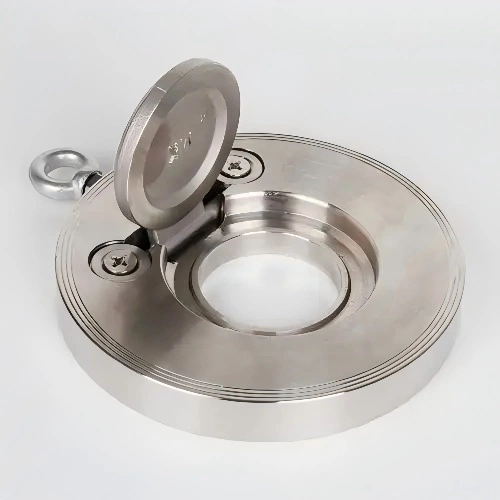
A wafer butterfly check valve (also called dual-plate check valve) is a compact, spring-loaded check valve that automatically prevents backflow on HVAC chilled/condenser water circuits, cooling towers, pump stations and industrial piping. Its two synchronized half-discs swing open under forward flow and snap shut within 0.1–0.2 seconds on reverse flow — minimizing water hammer and protecting pumps.
Chuanglan manufactures wafer dual-plate check valves in CF8M (316) and CF8 (304) stainless steel as premium range. Ductile iron (GGG50) and cast iron (GG25) are standard for HVAC / water service. Sizes DN40–DN700 (NPS 1½″–28″), wafer body fits between DIN EN 1092-1 PN10/PN16 / ANSI B16.5 Class 150 / JIS 10K flanges. Discs in SS304/SS316 with NBR, EPDM or Viton seat. For larger tight-shutoff lines, compare our flanged swing check valve; for steam / boiler feed, see our lift check valve. get a detailed quotation for your project.
The main advantage of a wafer dual-plate check valve over flanged swing / lift check valves is its compact size and light weight. Face-to-face is only 39–229 mm depending on size, compared to 150–1350 mm for flanged swing check valves. This makes it ideal for retrofitting existing pipelines where space is limited. The spring-loaded twin-disc design also closes 5–10× faster than a single flap valve, dramatically reducing water hammer. At Chuanglan Valve, we have been manufacturing wafer check valves for over 15 years, exporting to Southeast Asia (Indonesia, Malaysia, Thailand, Vietnam) and the Middle East (Saudi Arabia, UAE, Qatar, Kuwait).
When selecting a wafer butterfly check valve, consider: size (DN40–DN700), pressure rating (PN10 / PN16 / ANSI 150#), body material (cast iron for water/HVAC, ductile iron for general, WCB for oil/gas, CF8M for corrosive service), seat material (NBR for water/oil up to +80°C, EPDM for chilled water/HVAC up to +120°C, Viton for chemical/oil up to +200°C), spring material (SS304 standard, SS316 for corrosive), and cracking pressure (standard / low / high). For ultra-tight shutoff on larger lines, compare our single plate check valve. Always install a Y-strainer upstream to protect the discs from welding slag.
🌏 Southeast Asia & Middle East Market Notes
Singapore / Malaysia / Indonesia data centers & HVAC: Ductile iron body, EPDM seat, wafer dual-plate — standard for chilled water and condenser water circuits in commercial buildings, data centers and semiconductor fabs. Compact wafer body fits tight AHU plant rooms.
Vietnam / Thailand water treatment & power plants: Ductile iron GGG50 body, NBR seat, PN10 flanges — used on cooling tower return lines, pump discharge and circulating water systems. Fast closure prevents pump damage on trip.
Saudi Arabia / UAE oil & gas & desalination: CF8M body, SS316 discs, Viton seat, ANSI 150# flanges — used on SWRO high-pressure pump discharge, chemical dosing and hydrocarbon circuits. Corrosion-resistant for coastal chloride environments.
Not sure whether to use wafer dual-plate, swing or lift check? Send us your pump flow rate, line size and medium.
Get Free Sizing Report →Wafer Dual-Plate vs Swing vs Lift Check Valve
| Feature | Wafer Dual-Plate (This) | Swing Check | Lift Check |
|---|---|---|---|
| Closure speed | 0.1–0.2 s (fastest) | Slow (slam risk) | Medium |
| Face-to-face | 39–229 mm (shortest) | 150–1350 mm | 130–750 mm |
| Water hammer | Lowest | High risk | Medium |
| Pressure drop | Medium | Lowest | Highest |
| Weight | Lightest (wafer) | Heavy (flanged body) | Heavy |
| Orientation | Any (spring-loaded) | Horizontal only | Horizontal only |
| Handles slurries | Limited | Yes | No (guides jam) |
| Best for | HVAC, cooling water, pump discharge, retrofits | Large water, wastewater, slurry | Steam, boiler feed, high-pressure oil |
| Our product | Wafer Dual-Plate | Swing Check | Lift Check |
Technical Specifications
| Size Range | DN40 – DN700 (NPS 1½” – 28″) |
| End Connection | Wafer type, fits between DIN EN 1092-1 PN10/PN16 / ANSI B16.5 Class 150 / JIS 10K flanges |
| Body Material | CF8M (316) / CF8 (304) — premium; WCB / GGG50 / GG25 on request |
| Disc | SS304 / SS316, NBR / EPDM / Viton soft seat |
| Spring | SS304 / SS316 stainless steel |
| Pressure Rating | PN10 / PN16 / ANSI 150# |
| Temperature Range | -10°C ~ +120°C (NBR) / -20°C ~ +120°C (EPDM) / up to +200°C (Viton) |
| Applicable Media | Water, cooling water, HVAC, oil, gas, pump discharge lines |
| Testing | shell & seat pressure test per API 594 (bubble-tight acceptance) |
| Material Certificates | EN 10204 3.1 MTC per heat, included with shipment |
| Standard | API 594, EN 558, ISO 5752 |
Dimension Table — Wafer PN16 (mm)
L = wafer body thickness (face-to-face). D = OD, D1 = bolt circle, D2 = inner disc diameter, R = sealing radius, T = body thickness reference.
| NPS | DN | D (OD) | D1 (Bolt Circle) | D2 (Disc) | L (Face-to-Face) | R | T |
|---|---|---|---|---|---|---|---|
| 1½” | 40 | 100 | 88 | 67 | 39 | 36.1 | 20 |
| 2″ | 50 | 110 | 102 | 67 | 39 | 28.2 | 19 |
| 2½” | 65 | 130 | 122 | 82 | 45 | 36.1 | 20 |
| 3″ | 80 | 149 | 133 | 96 | 59 | 43.4 | 27 |
| 4″ | 100 | 172 | 158 | 117 | 59 | 52.8 | 27 |
| 5″ | 125 | 208 | 184 | 146 | 71 | 65.7 | 30 |
| 6″ | 150 | 238 | 212 | 171 | 70 | 78.6 | 31 |
| 8″ | 200 | 296 | 268 | 225 | 85 | 104.4 | 33 |
| 10″ | 250 | 356 | 320 | 264 | 108 | 127 | 35 |
| 12″ | 300 | 413 | 370 | 312 | 110 | 148.3 | 43 |
| 14″ | 350 | 450 | 430 | 366 | 125 | 172.4 | 45 |
| 16″ | 400 | 515 | 480 | 412 | 135 | 197.4 | 52 |
| 18″ | 450 | 565 | 530 | 453 | 156 | 217.8 | 58 |
| 20″ | 500 | 620 | 580 | 507 | 155 | 241 | 58 |
| 24″ | 600 | 730 | 680 | 626 | 178 | 295.4 | 73 |
| 28″ | 700 | 815 | 800 | 680 | 229 | 354 | 98 |
* PN10 drilled pattern available on request. ANSI Class 150 / JIS 10K flange drilling also available.
🧮 Worked Example: Specifying a DN200 Wafer Dual-Plate Check for a Data Center Chilled Water Pump
Project: 5,000 m² data center in Johor Bahru, Malaysia. Chilled water primary pump discharge.
Given: DN200 (8″) line, Q = 300 m³/h, water at 7°C chilled water, PN16, pump trips can cause water hammer on the chiller tube bundle.
Step 1 — Confirm velocity:
Pipe area A = π × (0.2/2)² = 0.0314 m². Velocity v = 300 / (3600 × 0.0314) = 2.66 m/s — within acceptable range for chilled water (1.5–3.0 m/s). But on pump trip, reverse flow will slam a slow swing check and damage the chiller.
Step 2 — Why wafer dual-plate (not swing or lift)?
Chilled water is clean (no solids), so guide-jam concerns don’t apply. Fast closure (0.1–0.2 s) protects the chiller from water hammer. Compact wafer body (85 mm face-to-face) fits in the tight pump room between flanges — no room for a 550 mm long flanged swing check.
Step 3 — Seat & body material:
Chilled water at 7°C — non-corrosive. Specify ductile iron GGG50 body, EPDM seat (best for chilled water and HVAC, handles up to +120°C on the condenser side). No need for CF8M unless coastal chloride environment.
Step 4 — Flange & installation:
DIN EN 1092-1 PN16 flanges (D=340 mm, K=295 mm, 12×Φ22 bolt holes). Install vertically or horizontally — spring-loaded discs close regardless of orientation. Add a Y-strainer upstream to protect discs from installation debris.
⚠️ 4 Common Mistakes When Selecting Wafer Check Valves
Mistake 1 — Installing without a Y-strainer: Welding slag, Teflon tape and pipe scale will score the soft EPDM/NBR seat, causing leakage. Always install a Y-strainer upstream of a soft-seated wafer check.
Mistake 2 — Wrong seat temperature rating: NBR is fine for chilled water but fails on condenser water above +80°C. Specify EPDM for +120°C HVAC, Viton for chemical/oil up to +200°C.
Mistake 3 — Ignoring flow direction arrow: Every wafer check has a cast flow arrow. Installing backwards means the discs can’t open and the line is blocked. Verify arrow direction before tightening flange bolts.
Mistake 4 — Using wafer check on slurries or dirty water: The twin discs and springs jam on particulates. For wastewater with solids, palm oil effluent or any dirty fluid, choose a swing check valve (discs swing fully out of the flow path).
📋 Commercial Terms
Payment: T/T 30% deposit + 70% before shipment; L/C at sight accepted for EPC pump and HVAC package orders. PayPal for sample orders.
Warranty: 12 months after shipment for material and manufacturing defects — covers disc / seat non-conformance, spring failure, body dimensional non-conformance (face-to-face, flange drilling) and hinge / pin wear that manifests under rated conditions. Damage from water hammer beyond rated ΔP, wrong installation orientation (flow arrow reversed), field modification of discs or springs, media containing abrasive solids beyond the specified clean-water range, or gasket / flange mismatch on the customer-side joint is not covered. Always quote the valve serial number and heat number from the EN 10204 3.1 MTC when raising a claim.
Packaging: Export plywood case; fumigation-free pallet; flange faces and bolt holes protected; discs held open with transit clip.
Shipping Documents: EN 10204 3.1 MTC per heat, API 594 hydro / seat test report, packing list, commercial invoice.
Shipment Port: FOB Ningbo / Shanghai, China; CIF / DAP available on request.
Third-Party Inspection: SGS / Bureau Veritas / Intertek pre-shipment dimensional, hydro and seat test inspection supported at buyer cost.
Need Sizing Help or a Quote?
Send size (DN), pressure (PN/ANSI), material (304/316L), seat (EPDM/Viton) and quantity — we reply within 24 hours.
Get Free Quote »FAQ
Wafer butterfly check or dual plate check — what’s the difference?
These terms refer to the same valve type: two spring-loaded half-discs on a central hinge shaft. “Wafer butterfly check” emphasizes the wafer body style; “dual plate” emphasizes the twin-disc closure. Single plate is a different design — one full disc swinging open, used for larger lines and lower cracking pressure.
Can this valve be installed vertically?
Yes — the spring-loaded discs close mechanically regardless of gravity, so this valve works in horizontal, vertical (flow up or down) and inclined lines. This is a major advantage over swing check and lift check valves, which must be horizontal.
Why does my check valve rattle or chatter?
Chattering happens when flow velocity fluctuates — the discs open and close rapidly. Solutions: (1) use a lower cracking pressure spring, (2) move the valve further from the pump, (3) stabilize flow, or (4) switch to softer NBR seats. Contact us if you have a specific noise problem.
NBR, EPDM or Viton seat — which should I choose?
NBR (nitrile) is standard for water up to +80°C and oil service. EPDM handles up to +120°C and is preferred for chilled water, HVAC and potable water. Viton (FKM) is for chemical, acid and high-temperature oil service up to +200°C. Tell us your medium and temperature and we’ll recommend the right seat.
Does the wafer valve fit between my existing flanges?
Wafer check valves install directly between two standard flanges (DIN EN 1092-1 PN16, ANSI 150# or JIS 10K) using the flange bolts through the valve’s bolt holes. It is much shorter than a flanged valve — ideal for retrofits. Please confirm your flange standard when ordering.
What is cracking pressure? Do you offer low cracking pressure springs?
Cracking pressure is the minimum forward pressure needed to open the discs. Standard springs give ~0.05–0.1 bar cracking pressure. For low-flow or low-head applications (turbine bypass, gravity flow), we can supply low-cracking springs (~0.02 bar). Tell us your minimum flow rate.
What is the MOQ and delivery time?
MOQ is 1 piece. DN40–DN200 in cast iron / ductile iron are usually in stock (7 days). DN250 and above, WCB carbon steel or CF8M stainless takes 15–25 days. ANSI 150# drilling available on request.
What is your warranty period?
We provide a 12-month warranty after shipment for material and manufacturing defects. This covers disc / seat non-conformance, spring failure, body dimensional non-conformance and hinge / pin wear under rated conditions. Damage from water hammer beyond rated ΔP, reversed installation, field modification, or abrasive solids beyond the specified clean-water range is not covered. Always quote the valve serial number and heat number from the EN 10204 3.1 MTC when raising a warranty claim.
📚 Further reading:
• Wafer Check Valve vs Swing Check Valve (2026 Guide)
• How to Select a Wafer Butterfly Valve for Seawater Service
• Butterfly Valve Selection Guide (Size, Pressure, Material)
You May Also Need
Related Technical Guides
Wafer Check Valve 2026 Guide · What Is a Wafer Check Valve? · Types of Check Valves
Request a Quote for This Wafer Butterfly Check Valve
Tell us the size, pressure and quantity you need. We reply within one working day.