
Swing Check Valve: Installation, Sizing & Common Problems
The complete 2026 guide to swing check valves — how hinged-disc check valves work, standard vs lever-and-weight vs spring-assisted vs tilting-disc, body and seat materials, swing vs wafer vs lift comparison, critical installation rules (horizontal only!), common problems (water hammer, chattering, leaking) and how to fix them, and a buying checklist for Southeast Asia and the Middle East water, oil & gas projects.
* Standard lead time depends on order quantity and destination country. 5–10 days to Southeast Asia, 15–20 days to the Middle East.

Quick Answer
For large horizontal water / wastewater / oil pipelines (DN150 and up, constant flow), a standard cast iron or WCB swing check valve is the lowest-cost, lowest-pressure-drop choice — but it MUST be installed horizontally (stem up, ±5° max). For pump discharge on long transmission mains, upgrade to a lever-and-weight swing check or a slow-closing wafer dual-plate check to control water hammer. For vertical flow-up columns (vertical-turbine pump discharge), NEVER use a standard swing check — switch to a flanged lift check or spring-assisted wafer check, because gravity pulls the disc open instead of closed. For small lines (DN25–DN300) where water hammer matters, spring-loaded wafer dual-plate checks close faster than swing checks at slightly higher pressure drop.
Key Takeaways
- Orientation: Standard swing = horizontal only · lift / wafer dual-plate = vertical flow-up OK.
- Closing: Standard = gravity (slow) · lever-and-weight = adjustable · spring-assisted = fast (low water hammer).
- Pressure drop: Swing = low · lift = medium · wafer = higher.
- Large sizes: Swing is the value leader up to DN1200+; wafer gets expensive above DN300.
On This Page
Related reading: valve maintenance tips — what to check on a check valve before it starts chattering.
1. How a Swing Check Valve Works
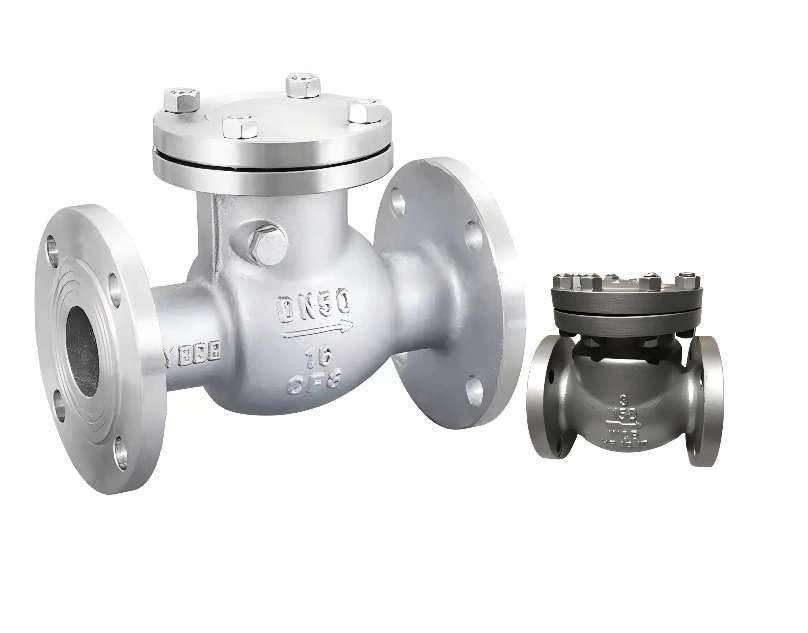
A swing check valve is the most traditional type of check valve — a hinged disc that swings open when flow goes forward and closes automatically when flow stops or reverses. It’s simple, low-cost, and works for almost any medium. But it’s also the valve most likely to cause water hammer, leak, or chatter if installed or sized wrong. See our full range of swing check valves.
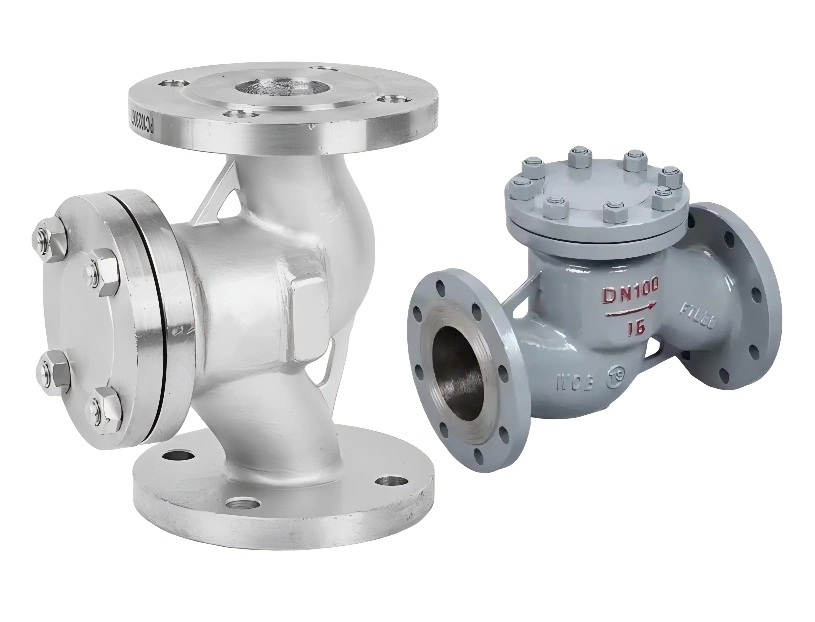
A swing check valve has a round disc that’s hinged at the top (like a door). When flow pushes forward, the disc swings open and sits nearly parallel to the flow path, so pressure drop is low. When flow stops, gravity (and any backflow) pushes the disc closed against the seat.
Unlike spring-assisted check valves, swing checks rely on gravity and backflow pressure to close. This means they’re slower to close than wafer checks, which can cause water hammer. But they’re also lower cost and have lower pressure drop, which is why they’re still the most common check valve type for large pipelines.
2. Types of Swing Check Valves
| Type | Design | Closing Speed | Best For |
|---|---|---|---|
| Standard Swing Check | Plain hinged disc, no spring | Slow (gravity only) | Large pipelines, constant flow, low pump speed |
| Lever & Weight | External lever with adjustable weight | Adjustable (weight helps close faster) | Pump discharge, medium flow, adjustable closing |
| Spring-Assisted | Internal spring helps close disc | Fast (spring-assisted) | Fast closing needed, limited vertical installation |
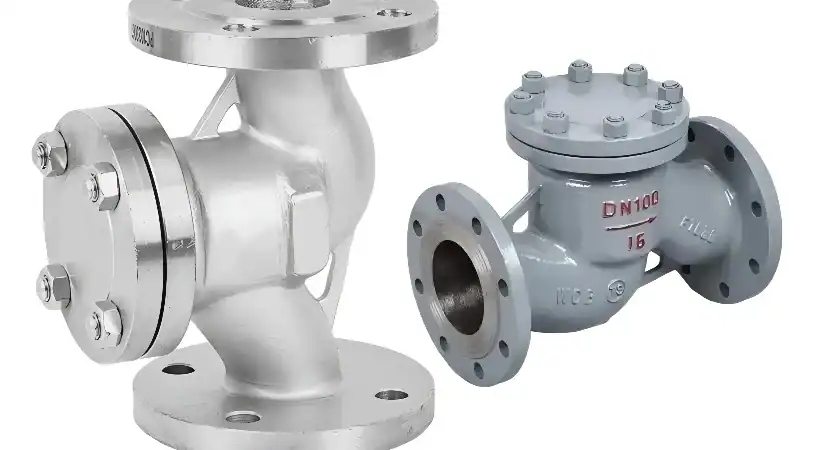
| Tilting Disc Check | Disc tilts instead of swinging fully open | Medium-fast | High flow, lower pressure drop than standard swing |
3. Body & Seat Materials
| Medium / Application | Body Material | Disc Material | Seat |
|---|---|---|---|
| Clean water, wastewater | Cast iron / ductile iron / WCB | Cast iron / bronze / stainless | Bronze / Buna-N / EPDM |
| Oil, gas, hydrocarbons | WCB (carbon steel) | Stainless 304 / bronze | NBR / Viton / PTFE |
| Corrosive chemicals | CF8 / CF8M (304 / 316 SS) | CF8M (316 SS) | PTFE / EPDM |
| Steam, high temp | WCB / WC6 / CF8M | Stainless 304 / chrome-plated | Metal (stainless / stellite) |
4. Worked Example: Bangkok Water Plant Vertical Installation Mistake
Step 1 — Problem
The Metropolitan Waterworks Authority (MWA) Bang Khen water treatment plant in Bangkok had 6 × vertical turbine pumps (DN350 discharge) feeding a 600 mm clear-water trunk main. Each pump was fitted with a standard cast iron swing check valve on the vertical discharge column (flow going up, pump pushing water up to the header). After 8 months of operation, operators noticed: (1) every time a pump stopped, water drained back down the column into the wet well, wasting pump energy; (2) on pump restart, a loud bang and pressure spike rattled the pipe supports; (3) pump #3 had a cracked discharge flange after a power trip.
Step 2 — Root cause analysis
The mechanical contractor installed the standard swing check valves on the vertical discharge column because “it’s a check valve, it should work any orientation.” But swing check valves rely on gravity to close — the disc hinge is at the top. When installed vertically with flow going UP, gravity pulls the disc DOWN (into the open position), not against the seat. So the disc hung open at roughly 20° even when flow stopped. Backflow drained freely down the column. On pump restart, the entire column of water had to be accelerated, causing water hammer and the pressure spike that cracked the flange.
Step 3 — Correct retrofit
Two options were evaluated:
Option A: Re-pipe each pump discharge to horizontal (huge civil work, two-week plant outage) — rejected.
Option B: Replace the vertical swing checks with flanged lift check valves (piston-style, works vertically with flow up — gravity pushes the piston down onto the seat when flow stops). This was the correct engineering fix.
Retrofit scope: 6 × DN350 flanged lift check valves, ductile iron body, 316SS disc, EPDM seat, PN16, flanges drilled to match existing PN16 bolt holes. No re-piping needed — bolted in place in half a day per pump during scheduled outages.
Step 4 — Outcome
• The lift-check retrofit was a bolt-in swap on each existing flange — no civil work, no re-piping, half a day per pump during scheduled outages
• Water no longer drained back down the column; measured pump energy dropped about 4% because the plant was no longer pumping the same column twice on every restart
• Water hammer on pump restart disappeared; pipe supports stopped rattling
• The cracked discharge flange on pump #3 was the only mechanical damage, and it was repaired during the same outage
• The retrofit cost was a small fraction of what a horizontal re-pipe of all six pump columns would have cost, and avoided the multi-day plant shutdown that re-piping would have required
• Lesson: swing check valves are HORIZONTAL only (stem up). For vertical flow-up installations, use lift check or spring-assisted wafer dual-plate check valves — never a standard swing check
Why EPC Contractors Specify Check Valves with Chuanglan
Swing (standard / lever-and-weight / spring-assisted / tilting disc) · flanged lift · wafer single-plate · wafer dual-plate · wafer butterfly
DN15–DN1200 · cast iron / ductile iron / WCB / CF8M 304 / 316L · PN6–PN40 / Class 125–Class 300
API 6D · API 594 · EN 12334 · ASME B16.34 · full EN 10204 3.1 MTC · ISO 15156 trim for sour service on request
Need Help Selecting the Right Check Valve?
Tell us your pipe size, flow direction (horizontal / vertical), medium, pump type, and pressure — our engineers will recommend the right check valve (swing / lift / wafer dual-plate / wafer single-plate) within 24 hours.
Get Free Sizing Report → WhatsApp us5. Swing Check vs Other Check Valves
| Feature | Swing Check | Wafer Single Plate (Silent) | Lift Check |
|---|---|---|---|
| Pressure Drop | low (disc fully open) | Higher (disc in flow) | Medium |
| Closing Speed | Slow (gravity) | Fast (spring) | Medium-fast |
| Water Hammer Risk | High | Low (fast closing) | Medium |
| Size Range | DN50–DN1200+ | DN25–DN300 | DN15–DN300 |
| Large-size Cost | Lowest | Higher | Medium |
| Orientation | Horizontal only (±5°) | Horizontal or vertical (flow up) | Horizontal or vertical (flow up) |
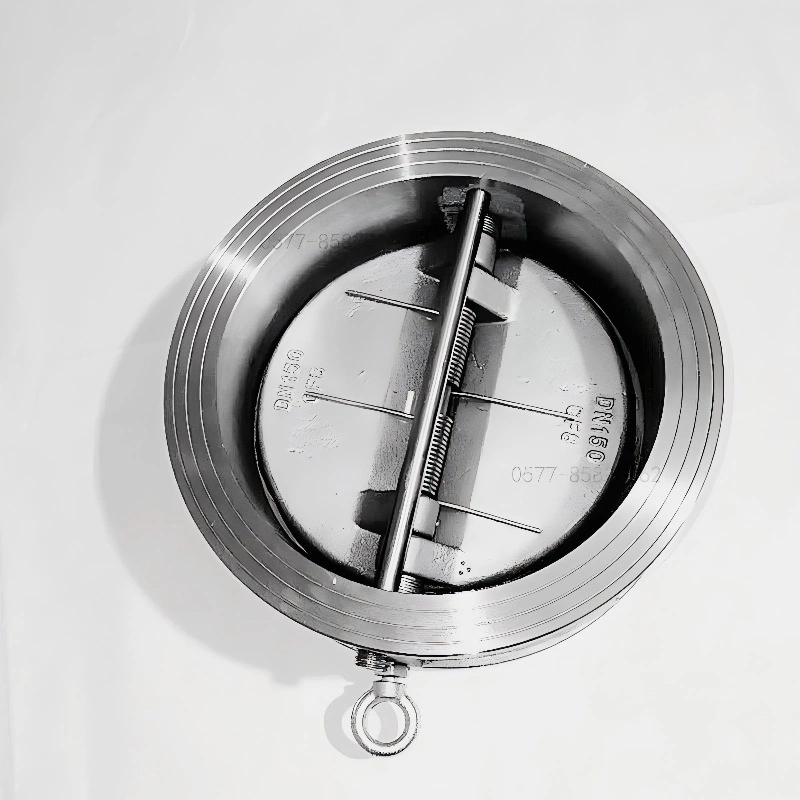
For smaller lines (DN25–DN300) where water hammer is a concern, see our wafer single-plate check valves and wafer dual-plate check valves. For large pipelines (DN350+) in water / wastewater, swing check remains the best value. For butterfly-pump-discharge applications, see wafer butterfly check valves.
6. Critical Installation Rules
Rule 1: Install horizontally, stem up. Swing check valves rely on gravity to close. If you install it vertically with flow going up, the disc will hang open and won’t close properly. If you must install vertically, use a lift check or spring-assisted wafer check instead.
Rule 2: Follow the flow arrow. The valve body has an arrow showing flow direction. If you install it backwards, it won’t close and will leak. Double-check before tightening flanges.
Rule 3: Leave space above for the cover. Swing check valves have a bolted cover on top to access the disc and seat for maintenance. Leave at least 30 cm (1 ft) above the valve so you can remove the cover.
Rule 4: Install 5–10 pipe diameters of straight pipe upstream. If there’s an elbow or tee right before the check valve, the flow will be turbulent and the disc will rattle and vibrate. Install at least 5× pipe diameter of straight pipe before the valve for stable operation.
Rule 5: For pump discharge, use a lever-and-weight or spring-assisted check. A standard swing check closes too slowly when the pump stops, causing water hammer. The weight or spring makes it close faster and reduces water hammer.
7. Common Problems & How to Fix Them
| Problem | Cause | Solution |
|---|---|---|
| Loud banging / water hammer | Disc slams shut when pump stops | Add lever-and-weight, or replace with spring-assisted wafer dual-plate check |
| Disc chatters / vibrates | Flow too low, or turbulent flow upstream | Add straight pipe upstream, or use lighter disc |
| Leaks when closed | Debris on seat, or worn seat / disc | Clean seat and disc, or replace seat insert |
| Disc won’t open fully | Flow too low, or disc is stuck (corrosion, debris) | Inspect and free disc, use lighter disc for low flow |
| High pressure drop | Valve undersized, or disc doesn’t open fully | Size up the valve, or check disc is not stuck |
| Disc won’t close (leaks backward) | Installed vertically (flow up) | Reinstall horizontally, or use lift check for vertical |
8. Pros & Cons of Swing Check Valves
Pros:
- low pressure drop (disc fully out of flow)
- Lowest-cost check valve type (especially large sizes)
- Available in large sizes (up to DN1200 and bigger)
- Simple design, few moving parts, long service life
- Works for almost any medium (with the right seat material)
- Easy to maintain (cover comes off, seat is replaceable)
Cons:
- Slow closing → water hammer risk (especially pump discharge)
- Must install horizontally (not vertical)
- Disc slams shut → loud noise, can wear out over time
- Not bubble-tight (minor backflow possible)
- Not good for pulsating flow (disc will rattle)
9. Buying Checklist
When you send an RFQ for a swing check valve, include:
- Size (DN / inch)
- Pressure rating (PN / Class)
- Body material (cast iron / ductile iron / WCB / CF8M)
- Disc material (cast iron / bronze / stainless 304 / 316)
- Seat type (metal / Buna-N / EPDM / PTFE)
- End connection (flanged / threaded / welded)
- Medium (water, oil, steam, chemical)
- Temperature
- Style (plain / lever-and-weight / spring-assisted)
- Standard (API 6D / API 594 / EN 12334 / ASME B16.34)
10. Southeast Asia & Middle East Market Notes
For clients in Southeast Asia (Thailand, Vietnam, Indonesia, Malaysia, Philippines), water treatment (MWA Bangkok, PWA Thailand, Saigon Water, PDAM Jakarta, Syarikat Air Johor), palm oil, and food-processing plants are the biggest buyers of swing check valves in large sizes (DN200–DN600). The most common mistake in Thai and Vietnamese pump stations is installing standard swing checks on vertical-turbine pump discharge columns — the Bang Khen case above is typical. Always specify lift check or wafer dual-plate for vertical installations. Indonesian refineries and Malaysian petrochemical plants specify WCB carbon steel swing checks per API 6D for oil / gas service. For coastal plants, the body must be CF8M (316 stainless) or epoxy-coated ductile iron — bare cast iron rusts quickly in tropical humidity.
For clients in the Middle East (Saudi Arabia, UAE, Qatar, Kuwait, Oman, Bahrain), water transmission networks (NWC Saudi, DEWA Dubai, ADWEA Abu Dhabi, Qatar Power & Water), SWRO desalination plants (Jubail, Yanbu, Ras Al Khair, Taweelah), and oil / gas gathering systems (Saudi Aramco, ADNOC, KOC) universally specify large-bore swing check valves (DN300–DN1200) with ductile iron or WCB bodies, ISO 15156 sour-service trim for oil / gas, and EPDM / NBR seats for water. Middle East water plants have massive water-hammer issues due to long transmission mains — lever-and-weight swing checks or slow-closing wafer dual-plate checks are mandatory on all pump discharge. For seawater / brine service, 316L body is required (not 304) due to high Gulf chloride.
Chuanglan Valve supplies swing check valves (standard / lever-and-weight / spring-assisted / tilting disc), flanged lift check valves, wafer dual-plate check valves, wafer single-plate check valves, and wafer butterfly check valves — in cast iron, ductile iron, WCB carbon steel, and CF8M 316 stainless, with full EN 10204 3.1 MTC certificates. Serving EPC Contractors Across Southeast Asia & Middle East · ISO 9001:2015 · Established in 2009 · MOQ 1 piece.
If you are choosing between a swing body and a wafer body on a vertical run, the disc mechanics decide it rather than the pressure rating — see vertical check valve installation and flow direction.
FAQ
Can a swing check valve be installed vertically?
No — standard swing check valves must be installed horizontally (stem up) within ±5°. The disc closes by gravity; if installed vertically with flow going up, gravity pulls the disc into the open position and it won’t seal. For vertical flow-up installations, use a lift check valve, a spring-assisted wafer check, or a tilt-disc check rated for vertical service.
What is the difference between a swing check and a wafer check valve?
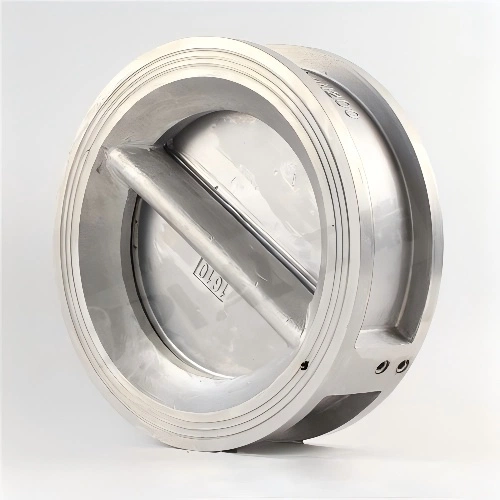
Swing check has a hinged disc inside a full body with a bolted cover — low pressure drop, low cost in large sizes, but slow closing (water-hammer risk) and horizontal only. Wafer check is a thin short-body valve with a spring-loaded single or dual plate — fast closing (low water hammer), works vertical or horizontal, but higher pressure drop and higher cost in large sizes. Use swing for large horizontal water / oil lines; use wafer for pump discharge where water hammer matters.
Why does my swing check valve make a loud banging noise?
The disc is slamming shut against the seat when flow stops (water hammer). This happens when (1) the valve is on pump discharge and the pump trips, (2) the flow rate is high, or (3) no lever / weight or spring assist is installed. Fix: add a lever-and-weight to slow the disc closing, or replace with a spring-assisted wafer dual-plate check. Severe water hammer can crack cast-iron bodies and damage pipe supports.
What pressure rating do swing check valves come in?
Standard swing check valves are available from PN6 / Class 125 (cast iron, water) up to PN40 / Class 300 (WCB carbon steel, oil / gas). Higher ratings (Class 600+) are available in flanged lift check or special bolted-cover designs. Most water / wastewater applications use PN10 / PN16 / Class 125 / 150.
How do I know if my swing check valve is failing?
Signs of failure: (1) visible backflow or leaking when pump is off, (2) loud chattering or vibration during operation, (3) pressure drop higher than spec, (4) cover gasket weeping. Inspect every 12 months: remove the cover, check the disc for wear / cracks, check the seat for pitting / debris, replace the seat insert if scored. Typical service life is 10–20 years in clean water with annual maintenance.
Can I use a swing check valve on steam?
Yes, but only with a metal-to-metal seat (stainless or stellite). Soft seats (EPDM, NBR, Viton, PTFE) degrade quickly at steam temperatures (200°C+). Specify WCB or WC6 body with stainless disc and metal seat for steam service. For steam applications, lever-and-weight swing checks are common — they close fast enough to prevent water hammer in steam-condensate lines.
What is the lead time from Chuanglan?
Standard sizes (DN50–DN300, PN16, ductile iron / WCB, flanged) are in stock and ship in 7–15 days. Large sizes (DN350–DN1200), lever-and-weight, spring-assisted, 316 stainless, ISO 15156 sour service, and Class 300+ take 15–30 days. Full EN 10204 3.1 MTC and dimensional drawings included. We export to Indonesia, Malaysia, Thailand, Vietnam, Saudi Arabia, UAE, and more.
References & Standards
- API 6D: Pipeline Valves (ball, gate, plug, check)
- API 594: Check Valves — Butterfly, Lug, Wafer, and Flanged End
- EN 12334: Industrial valves — cast iron check valves (Europe)
- ASME B16.34: Valves — Flanged, Threaded, and Welding-End
- ISO 15156: Sour-service materials for oil & gas production
Related Products
Continue Reading
Request a Quotation — Reply Within 24 Hours
Send your line size, pressure rating, medium and quantity. Our engineers come back with price, drawing and lead time — no obligation.