

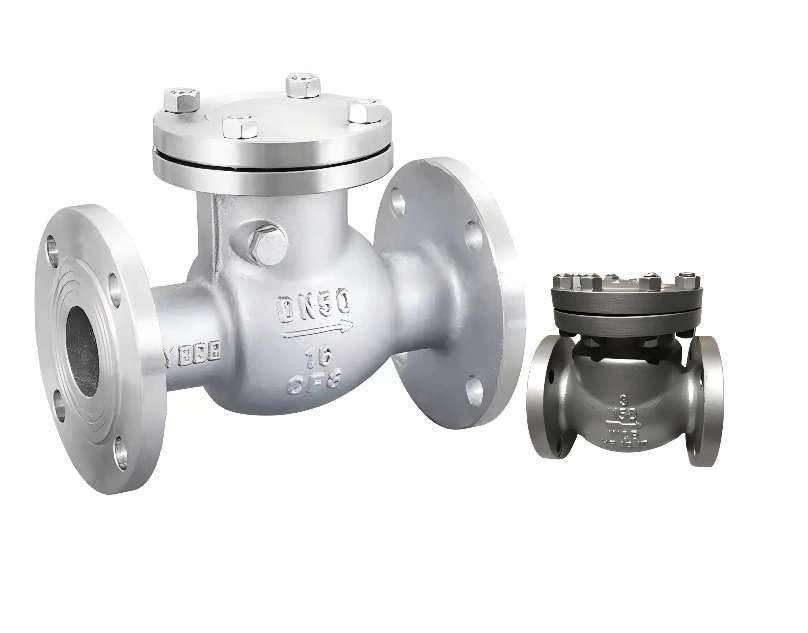
A lift check valve is a backflow prevention device that uses a disc guided by precision-machined vertical guides in the valve body. When forward pressure lifts the disc off its seat, flow passes through; when flow stops or reverses, the disc drops by gravity onto the seat — creating a tight, square seal on steam lines, boiler feed, oil pipelines and high-pressure hydraulic circuits.
Chuanglan manufactures flanged lift check valves in CF8M (316) and CF8 (304) stainless steel as standard range. WCB carbon steel, ductile iron (GGG50) and cast iron (GG25) are available for non-corrosive service. Sizes DN15–DN300 (NPS 1/2″–12″), flanged ends per DIN EN 1092-1 PN16 / ANSI B16.5 Class 150 / JIS 10K. For large-bore water or dirty fluids, compare our swing check valve; for compact pump discharge, see our dual plate check valve.
The main advantage of a lift check valve over swing check valves is tighter shutoff and longer service life. Because the disc moves vertically and is guided by precision-machined guides, the lift check provides better sealing performance and less wear over time. It handles high-pressure and high-temperature steam service better than swing types. We directly serve EPC contractors and valve distributors in Southeast Asia (Indonesia, Malaysia, Thailand, Vietnam) and the Middle East (Saudi Arabia, UAE, Qatar, Kuwait).
When selecting a lift check valve, consider: size (DN15–DN300), pressure rating (PN16 / PN25 / PN40 / ANSI 150#–300#), body material (ductile iron for water, WCB for oil/gas/steam, CF8M for corrosive service), installation orientation (horizontal only — disc must move vertically), disc material (SS316 standard, PTFE/NBR face for bubble-tight shutoff), and guide material (bronze for water, SS304/SS316 for chemical/steam). Always install a Y-strainer upstream to protect the precision guides from debris; pair with a globe valve for throttling on the same line.
Southeast Asia & Middle East Market Notes
Thailand / Indonesia sugar mills & food plants: CF8M (316) body, PTFE soft seat, horizontal lift check — used on steam condensate and CIP return lines where tight shutoff prevents product contamination.
Vietnam / Malaysia power & boiler feed: WCB body, PN40 pressure class, graphite/SS spiral-wound gasket — standard for boiler feedwater and high-pressure steam (up to +425°C).
Saudi Arabia / UAE oil & gas & desalination: CF8M body, ANSI 150# flanges, PTFE soft seat — used on hydrocarbon injection, chemical dosing and SWRO high-pressure pump skids where backflow prevention is critical.
Need help choosing lift, swing, dual-plate or wafer check valve for your steam / water / oil line? Send us your medium, pressure and size.
Get Free Sizing Report →Lift vs Swing vs Dual-Plate Check Valve
| Feature | Lift Check (This) | Swing Check | Dual-Plate (Wafer) Check |
|---|---|---|---|
| Closure speed | Fast | Slow (slam risk) | Fastest (spring-loaded plates) |
| Shutoff tightness | Tightest (guided disc) | Medium | Medium |
| Pressure drop | High | Lowest | Medium |
| Max pressure/temp | PN40 / +425°C | PN16 / +300°C typical | PN16 typical |
| Handles slurries | No (guides jam) | Yes | Limited |
| Orientation | Horizontal only | Horizontal only | Any orientation |
| Best for | Steam, boiler feed, high-pressure oil, clean fluids | Large water, wastewater, slurry | Pump discharge, compact installations |
| Our product | Lift Check | Swing Check | Dual-Plate |
Technical Specifications
| Size Range | DN15 – DN300 (NPS 1/2″ – 12″) |
| End Connection | Flanged RF, DIN EN 1092-1 PN16 / ANSI B16.5 Class 150 / JIS 10K |
| Body Material | CF8M (316) / CF8 (304) — premium; WCB / GGG50 / GG25 on request |
| Disc | SS316 / SS420, PTFE or NBR gasket face option |
| Guide | Bronze (water) / SS304 / SS316 (steam & chemical) |
| Pressure Rating | PN16 / PN25 / PN40 / ANSI 150#–300# |
| Temperature Range | -10°C ~ +200°C (cast iron) / -29°C ~ +425°C (WCB) / -196°C ~ +538°C (CF8M) |
| Installation | Horizontal only (disc must move vertically) |
| Applicable Media | Steam, boiler feed, oil, gas, chemical, high-pressure hydraulic lines |
| Testing | shell & seat pressure test per API 594 |
| Material Certificates | EN 10204 3.1 MTC (material test reports) included |
| Standard | API 594, DIN 3535, BS 1868 |
Dimension Table — DIN EN 1092-1 PN16 (mm)
L = face-to-face per DIN 3535 / API 594. D = flange OD, K = bolt circle, d = raised face, c = body thickness, n-ΦL = bolt holes. H = body height reference.
| DN | L | D (OD) | K (Bolt Circle) | d (Raised Face) | c (Thickness) | n-ΦL | H |
|---|---|---|---|---|---|---|---|
| 15 | 130 | 95 | 65 | 45 | 14 | 4-Φ14 | 90 |
| 20 | 150 | 105 | 75 | 58 | 14 | 4-Φ14 | 105 |
| 25 | 160 | 115 | 85 | 68 | 14 | 4-Φ14 | 115 |
| 32 | 180 | 140 | 100 | 78 | 14 | 4-Φ18 | 120 |
| 40 | 200 | 150 | 110 | 88 | 15 | 4-Φ18 | 130 |
| 50 | 230 | 165 | 125 | 102 | 16 | 4-Φ18 | 140 |
| 65 | 290 | 185 | 145 | 122 | 16 | 4-Φ18 | 150 |
| 80 | 310 | 200 | 160 | 138 | 18 | 8-Φ18 | 170 |
| 100 | 350 | 220 | 180 | 158 | 19 | 8-Φ18 | 185 |
| 125 | 400 | 250 | 210 | 188 | 20 | 8-Φ18 | 195 |
| 150 | 480 | 285 | 240 | 212 | 22 | 8-Φ22 | 225 |
| 200 | 550 | 340 | 295 | 268 | 24 | 12-Φ22 | 250 |
| 250 | 650 | 400 | 355 | 320 | 28 | 12-Φ26 | 270 |
| 300 | 750 | 455 | 410 | 370 | 28 | 16-Φ26 | 300 |
* PN25 / PN40 / ANSI Class 150 / JIS 10K drilled flanges available on request.
Worked Example: Selecting a DN50 Lift Check Valve for a Boiler Feed Line
Project: Boiler feedwater skid at a food processing plant in Bangkok, Thailand.
Given: DN50 (2″) feedwater line, Q = 12 m³/h, water at 105°C, pressure 25 bar (PN25), tight shutoff required to prevent backflow into the feed pump during standby.
Step 1 — Confirm pressure & temperature:
25 bar at 105°C feedwater — exceeds PN16 rating. Specify PN25 pressure class. Body material: WCB carbon steel rated to +425°C, sufficient for 105°C feedwater. CF8M not required (no chlorides).
Step 2 — Why lift check (not swing or dual-plate)?
Backflow into the feed pump during standby must be prevented with bubble-tight shutoff. Lift check with guided disc seats squarely under gravity, giving tighter shutoff than swing. Line is small (DN50) and clean (feedwater), so the guide-jam concern does not apply.
Step 3 — Soft seat for tight shutoff:
Specify PTFE-faced disc instead of bare metal-to-metal. This gives bubble-tight acceptance per API 598, preventing any backflow into the feed pump when it cycles off.
Step 4 — Flange & installation:
DIN EN 1092-1 PN25 flanges (D=165 mm, K=125 mm, 4×Φ18 bolt holes). Install horizontally with disc guides vertical (flow arrow horizontal). Add a Y-strainer upstream to protect the disc seat from any pipe scale.
4 Common Mistakes When Selecting Lift Check Valves
Mistake 1 — Installing lift check vertically: The disc relies on gravity to drop onto the seat. Vertical installation with horizontal flow traps the disc sideways in its guide — no seal. Lift check must be installed horizontally with the stem vertical.
Mistake 2 — Using lift check on slurry / dirty water: Precision guides jam on particulates. For wastewater, palm oil effluent or any dirty fluid, choose a swing check or dual-plate wafer check instead.
Mistake 3 — Under-rating pressure class for steam: A PN16 body may be fine for water at ambient, but steam at 18 bar (saturated 200°C) requires PN25 or PN40. Always check the pressure-temperature derating curve for WCB at your operating temperature.
Mistake 4 — Skipping the Y-strainer: The precision disc and seat are the most vulnerable parts. Without a strainer upstream, welding slag, PTFE tape or pipe scale will score the seat and cause leakage. Always install a Y-strainer before a lift check on new pipework.
Need Sizing Help or a Quote?
Send size (DN), pressure (PN/ANSI), material (304/316L), seat (EPDM/Viton) and quantity — we reply within 24 hours.
Get Free Quote »Applications
Power & Boiler Feed: Boiler feedwater, condensate return, turbine bypass.
Oil & Gas: Refineries, production skids, chemical injection lines.
Food & Pharmaceutical: CIP return, clean steam, process piping.
Desalination: SWRO high-pressure pump discharge, brine lines.
Commercial Terms & Shipping
Payment: T/T 30% deposit + 70% before shipment; L/C at sight accepted for orders above USD 20,000. PayPal for sample orders.
Warranty: 12 months after shipment for material and manufacturing defects. Covers casting defects, seal leakage and material non-conformance. Damage from misuse, improper installation or corrosion beyond specified limits is not covered.
Packaging: Export plywood case (fumigation-free) or seaworthy pallet. Suitable for FCL container and LCL consolidation.
Shipping Documents: EN 10204 3.1 MTC, pressure test certificate, packing list, commercial invoice. Certificate of origin and BL available on request.
Shipment Port: FOB Ningbo / Shanghai, China. Can also arrange CIF / DAP to your destination port.
Third-Party Inspection: SGS, Bureau Veritas or Intertek pre-shipment inspection supported at your cost.
FAQ
Lift check or swing check valve — which is better for steam service?
For steam, boiler feed and high-pressure service, lift check valves are preferred because the guided disc seats squarely and gives tighter shutoff at high pressure/temperature. Swing check valves are better for large-bore, low-pressure water and dirty fluids.
Why must a lift check valve be installed horizontally?
The disc works by gravity dropping onto the seat. If installed vertically, the disc may not seal properly against gravity and can stick in the guide. Horizontal installation ensures the disc moves vertically in its guides under forward pressure and drops straight back onto the seat.
Can a lift check valve handle dirty or slurry fluids?
Not recommended. The precision guides can jam on particulates. For slurries, wastewater with solids or dirty fluids, choose a swing check valve (disc swings fully out of the flow path) or a dual plate wafer check valve instead.
What is the difference between horizontal lift check and Y-type lift check?
Horizontal lift check valves have a horizontal flow path with vertical disc movement — compact and standard. Y-type (oblique) lift check valves angle the body at 45°, reducing pressure drop by up to 30% and handling viscous fluids better.
Do you offer PTFE soft seat for bubble-tight shutoff?
Yes. We can fit PTFE or NBR-faced disc seats for bubble-tight acceptance per API 598, commonly required for gas, vacuum and toxic chemical service. Standard metal-to-metal seats are fine for water and general oil service.
What pressure class do you offer for steam service?
Standard PN16. For steam and boiler feed we commonly supply PN25 and PN40 bodies (WCB / CF8M). ANSI Class 150 / 300 flanges are also available for Middle East oil & gas customers.
What is the MOQ and delivery time for lift check valves?
MOQ 1 piece. Standard sizes (DN15–DN50) in WCB are usually in stock — ship in 7–15 days. DN65 and above, CF8M, or PN40 special orders take 15–30 days.
What is the warranty period for your valves?
We provide a 12-month warranty after shipment for material and manufacturing defects. This covers casting defects, seal leakage and material non-conformance. Damage from misuse, improper installation or corrosion beyond specified limits is not covered.
📚 Further reading:
• Wafer Check Valve vs Swing Check Valve (2026 Guide)
• Butterfly Valve Selection Guide (Size, Pressure, Material)
• How to Select a Wafer Butterfly Valve for Seawater Service
You May Also Need
Related Technical Guides
Request a Quote for This Lift Check Valve
Tell us the size, pressure and quantity you need. We reply within one working day.