
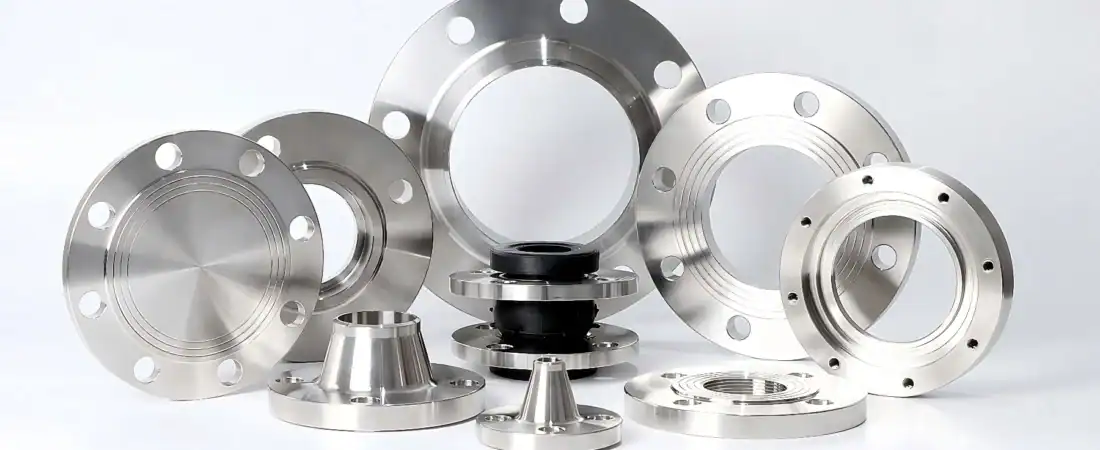
Stainless Steel Flanges: Types, Pressure Ratings & Selection Guide
The complete 2026 guide to stainless steel pipe flanges — WN vs SO vs SW vs lap joint vs blind, PN vs Class pressure ratings, RF / FF / RTJ face types, 304 vs 316 materials, ASME B16.5 vs EN 1092-1 standards, and a buying checklist for Southeast Asia and the Middle East projects.
* Standard lead time depends on order quantity and destination country. 5–10 days to Southeast Asia, 15–20 days to the Middle East.

Quick Answer
For 90% of general-industry stainless piping in Southeast Asia and the Middle East, the default is a 304 / 304L raised-face (RF) slip-on (SO) flange at PN16 (or Class 150 per ASME B16.5), bolted with a spiral-wound 316/graphite gasket. For seawater, brine, or coastal Gulf service (Jubail, Yanbu, Dammam, Abu Dhabi), switch to 316L — 304 pits badly in Gulf brine within 12–24 months. To save money on large-bore 316L lines, use a lap-joint (LJ) loose flange (304L body) with a 316L stub end: only the wetted stub end is expensive alloy. Never mix PN (EN 1092-1) and Class (ASME B16.5) flanges — the bolt-circle is different and they won’t bolt up.
Key Takeaways
- Type: SO = general industry · WN = high pressure / oil & gas · LJ = cost-saving on 316L · Blind = isolate ends.
- Pressure: PN16 ≈ Class 150 (NOT interchangeable) · PN40 ≈ Class 300 · RTJ for Class 600+.
- Material: 304L = clean water / indoor · 316L = seawater / brine / coastal / chloride >200 ppm.
- Standard: ASME B16.5 (US / oil & gas / Saudi Aramco) vs EN 1092-1 (Europe / Southeast Asia general) — never mix.
On This Page
1. What Is a Pipe Flange?
A stainless steel flange is a ring (usually made of metal) that’s welded or threaded to the end of a pipe. Two flanges are bolted together with a gasket between them to create a leak-proof joint. Flanges make it easy to disassemble piping systems for maintenance, inspection, or modification. See our full range of stainless steel flanges.
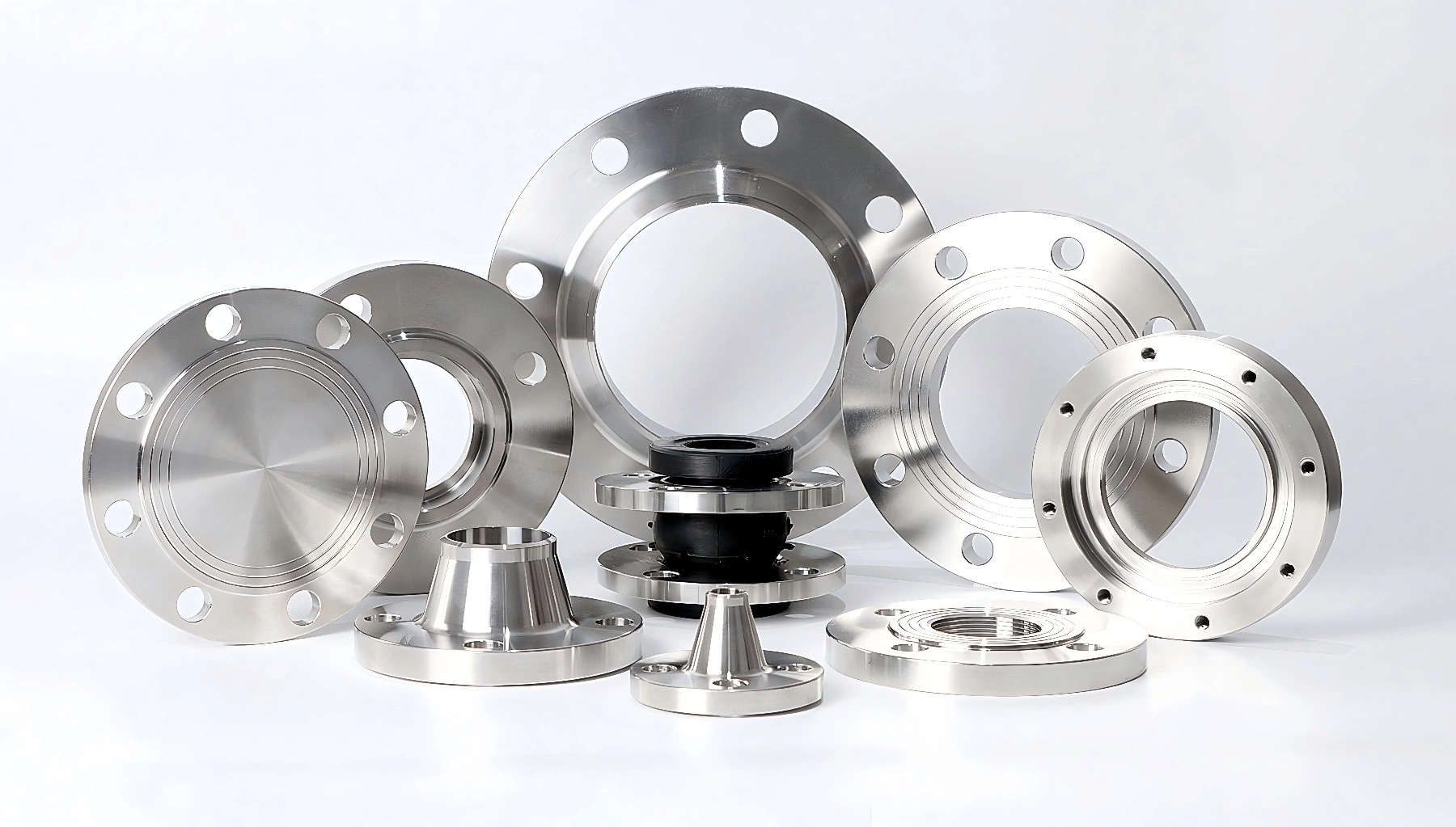
Flanges come in different materials (carbon steel, stainless 304 / 316, alloy steel), pressure ratings (PN6 to Class 2500), and face types (RF, FF, RTJ, tongue & groove). Choosing the wrong flange type can lead to leaks, vibration, or premature failure. Flanges are used together with stainless seamless pipes, butt weld elbows, and butt weld pipe fittings.
2. Main Flange Types
| Type | Design | Pressure Range | Best For |
|---|---|---|---|
| WN (Weld Neck) | Long tapered neck, butt-welded to pipe | PN6 to Class 2500 (highest) | High pressure, high temp, critical service, oil & gas |
| SO (Slip-On) | Pipe slips inside, fillet welded both sides | PN6 to Class 600 (medium) | General industry, water, HVAC, lower cost |
| SW (Socket-Weld) | Pipe slides into socket, fillet welded | Class 300 to Class 2500 (high) | Small sizes, high pressure, oil & gas piping |
| Threaded (NPT / BSPT) | Threads onto threaded pipe | PN10 to Class 300 (low–medium) | Small sizes, low pressure, easy assembly |
| Lap Joint (LJ) | Loose flange, used with a stub end | PN6 to Class 300 (medium) | Stainless systems (cost saver), frequent disassembly |
| Blind (BL) | Solid disc, no hole — closes the end | All pressure ratings | Closing pipe ends, future expansion, isolation |
Most popular choice: SO (Slip-On) flanges for general industry (about 70% of all flanges used). WN for high pressure / oil & gas. Lap joint for stainless systems where you want to save money. Blind to close pipe ends.
3. Pressure Ratings: PN vs Class
There are two common pressure rating systems: PN (European) and Class (American). They’re not exactly equivalent, but here’s a rough conversion:
| PN Rating (Europe) | Approx. Class (USA) | Max Pressure (room temp) | Common Use |
|---|---|---|---|
| PN6 | Class 150 (approx.) | 6 bar (87 psi) | Low pressure, water, HVAC |
| PN10 | Class 150 (approx.) | 10 bar (145 psi) | Most common, water, wastewater, general |
| PN16 | Class 150 / Class 300 (approx.) | 16 bar (232 psi) | General industry, oil, gas |
| PN25 | Class 300 (approx.) | 25 bar (362 psi) | Medium–high pressure, process industry |
| PN40 | Class 300 (approx.) | 40 bar (580 psi) | High pressure, oil & gas, steam |
| PN63 | Class 600 (approx.) | 63 bar (913 psi) | high pressure, refinery |
Important note: PN and Class ratings are NOT directly interchangeable — the bolt hole pattern is different. A PN16 flange will NOT bolt onto a Class 150 flange. Always match the rating system to your piping standard.
4. Worked Example: Jubail SWRO Brine Line Corrosion Fix
Step 1 — Problem
A 500,000 m³/day SWRO (seawater reverse osmosis) desalination plant in Jubail Industrial City, Saudi Arabia had 304L WN flanges on the DN300 (12″) brine discharge line at PN16 RF rating. After 18 months of operation, inspection found severe pitting corrosion on the flange sealing faces — up to 0.8 mm deep in some spots. Two joints started weeping brine, and management worried about a major leak.
Step 2 — Root cause analysis
• Brine concentration: 4.5% chloride (seawater is 3.5%), flowing at low velocity (0.8 m/s — sediment and chloride pockets formed on flange faces)
• 304L stainless is NOT resistant to chloride pitting above ~200 ppm chloride — needs 316L (with 2–2.5% molybdenum) for marine service
• Original engineer specified 304L to save material cost — a classic mistake for coastal Middle East projects
• RF face has a small raised ring (6 mm) that traps sediment and accelerates crevice corrosion
Step 3 — Correct retrofit
Instead of replacing all 120 joints (240 flanges) with all-316L WN flanges, the engineering team switched to lap joint (LJ) design with 316L stub ends:
• Loose flange body: 304L (never touches the process — only the outside of the stub end)
• Stub end (wetted part): 316L (resists chloride pitting)
• Face: RF 316L stub end — matches existing flange bore
• Bolt holes: same PN16 EN 1092-1 pattern — no re-drilling needed
• 120 joints × (1× 304L loose flange + 1× 316L stub end)
Step 4 — Outcome
• The lap-joint retrofit delivered full 316L corrosion resistance on every wetted face at roughly one-third of the cost of all-316L WN flanges — because only the short stub end is expensive alloy, while the thick flange body stays 304L
• Bolt-circle dimensions matched the existing piping, so no re-drilling or re-welding was needed
• Weeping joints stopped within one week of commissioning the retrofit
• The retrofit cost a small fraction of what a forced shutdown and environmental fine would have cost
• Lesson: for marine / chloride service, lap-joint 316L stub ends give full corrosion resistance at a fraction of the cost of all-316L WN flanges
Why EPC Contractors Specify Flanges with Chuanglan
WN / SO / SW / threaded / lap joint / blind · DN15–DN600 · 304 / 304L / 316 / 316L / A105 / F11 / F22
ASME B16.5 · EN 1092-1 · JIS B2220 · DIN 2527/2573/2576 · RF / FF / RTJ / tongue & groove
ISO 9001:2015 · EN 10204 3.1 MTC · matched stud-bolt + gasket kits (B7/2H, A4-70, spiral-wound 316/graphite)
Need Flange Sizing or Material Selection Help?
Tell us your line size, pressure rating, fluid (including chloride content), and required standard (ASME B16.5 / EN 1092-1 / JIS / DIN) — our engineers will recommend the right flange type and material within 24 hours.
Get Free Sizing Report → WhatsApp us5. Face Types
| Face Type | Description | Best For |
|---|---|---|
| RF (Raised Face) | Small raised ring (1.5 mm or 6 mm) in the center | Most common, general industry, oil, gas, water |
| FF (Flat Face) | Flat surface, no raised ring | Cast iron flanges, low pressure, water treatment |
| RTJ (Ring Type Joint) | Groove for a metal ring gasket | high pressure / temp, Class 600+, oil & gas |
| Tongue & Groove | Tongue on one, groove on other | Precise alignment, corrosive service |
Most common: Raised Face (RF) — about 90% of all flanges sold. Use RTJ only for high pressure Class 600+. Use FF only when mating with cast iron flanges.
6. Material Options
| Material | Grade | Relative Cost | Best For |
|---|---|---|---|
| Stainless 304 / 304L | CF8 / CF3 | Medium | General corrosion resistance, food, chemical |
| Stainless 316 / 316L | CF8M / CF3M | Higher | Coastal, saltwater, corrosive chemicals, pharma |
| Carbon Steel | A105 / A105N | Lowest | Oil, gas, steam, general industry (non-corrosive) |
| Alloy Steel | F11 / F22 | Premium | High temperature, refinery, power plants |
7. Key Standards
| Standard | Region | What It Covers |
|---|---|---|
| ASME B16.5 | USA / International | Pipe flanges NPS ½” to 24″, Class 150 to Class 2500 |
| EN 1092-1 | Europe | European flanges PN6 to PN100 |
| JIS B2220 | Japan | Japanese flanges (5K, 10K, 20K, etc.) |
| DIN 2527 / 2573 / 2576 | Germany / Europe | German standard flanges |
Important: ASME B16.5 and EN 1092-1 flanges are NOT interchangeable — bolt hole circles and pressure ratings are different. Always specify which standard you need.
8. Buying Checklist
When you send an RFQ for stainless steel flanges, include:
- Flange type (WN / SO / SW / threaded / lap joint / blind)
- Size (NPS / DN, inches or mm)
- Pressure rating (PN / Class)
- Material (304 / 304L / 316 / 316L)
- Face type (RF / FF / RTJ)
- Standard (ASME B16.5 / EN 1092-1 / JIS / DIN)
- Quantity
- Required certification (MTC / EN 10204 3.1)
9. Southeast Asia & Middle East Market Notes
For clients in Southeast Asia (Thailand, Vietnam, Indonesia, Malaysia, Singapore, Philippines), most EPC contractors and palm-oil, brewery, food-processing, and water-treatment plants specify EN 1092-1 PN10 / PN16 SO flanges in 304 / 304L for general service. Singaporean and Malaysian offshore & marine projects require 316L with certificate of compliance (CoC) and 3.1 material test reports. Indonesian refineries and Thai petrochemical plants often specify ASME B16.5 Class 150 / 300 WN flanges in A105 carbon steel with PTFE or spiral-wound gaskets. For food & brewery plants, all wetted flanges must be 304 / 316L with RF face and food-grade gaskets.
For clients in the Middle East (Saudi Arabia, UAE, Qatar, Kuwait, Oman, Bahrain), oil & gas, petrochemical, SWRO desalination, and power projects (Saudi Aramco, ADNOC, SABIC, SEC, DEWA, FEWA) universally require ASME B16.5 flanges — either Class 150 / 300 WN in A105 for oil / gas, or 316L for seawater / brine service. RTJ face is mandatory for Class 600+ high-pressure applications. Coastal plants in Jubail, Yanbu, Dammam, Abu Dhabi, and Ras Al Khaimah MUST use 316L (not 304) for any wetted flange — the high chloride in Gulf seawater causes rapid pitting corrosion on 304 within 12–24 months. Lap-joint 316L stub ends are the cost-effective solution for large-bore brine and seawater lines.
Chuanglan Valve supplies stainless steel flanges (WN / SO / SW / lap joint / blind) in 304 / 304L / 316 / 316L, with full MTC EN 10204 3.1 certificates, ASME B16.5 / EN 1092-1 / JIS / DIN standards, RF / FF / RTJ face types, and bolted kits with gaskets and nuts / bolts. Serving EPC Contractors Across Southeast Asia & Middle East · ISO 9001:2015 · Established in 2009 · MOQ 1 piece.
Common Mistakes to Avoid
- Specifying 304 stainless for coastal or chloride service. If your project is in Southeast Asia (coastal, cooling tower, deicing salts) or the Middle East (desalination, SWRO, humid Gulf climate), 304 will pit within 1–3 years. Specify CF8M (316) or duplex 2205.
- Ignoring pressure-temperature derating. PN16 / Class 150 ratings apply at room temperature only. At 200°C the allowable pressure drops by roughly 40–50%. Always check the manufacturer’s P-T chart before specifying for steam, hot oil, or thermal fluid.
- Buying on price without MTC verification. “Stainless steel” is not enough — ask for EN 10204 3.1 MTC tied to the heat number, and arrange PMI (XRF) witness at the factory if the price is 20% below market. 304 passed off as 316L is the single most common failure in this industry.
- Forgetting face-to-face and flange drilling. A “PN16” wafer valve from one manufacturer may not match the existing flange drilling or face-to-face of another. Always confirm dimensions against EN 558 / API 609 / ASME B16.10 before replacing an installed valve.
FAQ
What is the difference between WN and SO flanges?
WN (weld neck) has a long tapered neck that butt-welds to the pipe, providing a smooth stress transition — it’s used for high pressure, high temperature, and critical service. SO (slip-on) just slips over the pipe and is fillet-welded on both sides — cheaper and easier to install, but only for medium pressure. WN typically runs 2–3× the price of an SO flange of the same size and rating.
Can PN16 flanges bolt onto Class 150 flanges?
No. Although PN16 and Class 150 have similar pressure ratings, the bolt-hole diameter, bolt-circle diameter, and flange outside diameter are different. They won’t line up. Always match the standard (ASME B16.5 vs EN 1092-1) before ordering.
When should I use 316L instead of 304L?
Use 316L when: (1) the application is near the sea / coastal / seawater, (2) the fluid has chloride above ~200 ppm (brine, saltwater, some chemicals), (3) food / pharma / hygienic service, or (4) outdoor exposure in humid environments. 316L has 2–2.5% molybdenum which resists chloride pitting. 304L is fine for clean water, HVAC, indoor general industry, and non-chloride chemicals.
What is a lap joint flange and when do I use it?
A lap joint flange is a loose (rotatable) flange used with a short “stub end” that butt-welds to the pipe. The loose flange is never wetted — only the stub end touches the fluid. Use it when: (1) the pipe is expensive 316L and you want to save money (flange body can be 304L or carbon steel), (2) the joint needs frequent disassembly for alignment, or (3) you need to bolt up in tight spaces (the flange rotates freely).
What is the difference between RF and RTJ face?
RF (raised face) has a small raised ring in the center that compresses a soft gasket (spiral wound, PTFE, rubber). It’s used for roughly 90% of applications up to Class 600. RTJ (ring type joint) has a machined groove that holds a solid metal oval / octagonal ring gasket — used for high pressure (Class 600+) and high-temperature oil / gas service where soft gaskets would fail.
Do you supply bolts and gaskets with the flanges?
Yes. We can supply matched bolt kits (stud bolts + nuts) in B7 / 2H carbon steel or A4-70 stainless, plus gaskets (spiral-wound 316 / graphite, PTFE, EPDM, or RTJ metal ring) per ASME B16.20. Specify when RFQ. Full EN 10204 3.1 MTC for both flanges and fasteners.
What is the lead time from Chuanglan?
Standard sizes (DN15–DN300, PN10 / PN16 / Class 150, 304 / 316L, RF, SO / WN) are in stock and ship in 7–15 days. Large sizes (DN350–DN600+), RTJ face, high pressure PN40 / PN63 / Class 300 / 600, and special materials take 15–30 days. We export to Indonesia, Malaysia, Thailand, Vietnam, Saudi Arabia, UAE, and more.
References & Standards
- ASME B16.5: Pipe Flanges and Flanged Fittings — NPS ½ through NPS 24
- EN 1092-1: European standard flanges — PN6 to PN100
- JIS B2220: Japanese steel pipe flanges
- DIN 2527 / 2573 / 2576: German standard flanges
- ASME B16.20: Metallic gaskets for pipe flanges (spiral-wound, jacketed, ring-joint)
Related Products
Continue Reading
Request a Quotation — Reply Within 24 Hours
Send your line size, pressure rating, medium and quantity. Our engineers come back with price, drawing and lead time — no obligation.
Get a Quote for Your Flange Project
MOQ: 1 piece · ISO 9001:2015 · 3.1 MTC included · shell and seat pressure tested
Southeast Asia: Indonesia, Malaysia, Thailand, Vietnam, Singapore, Philippines
Middle East: Saudi Arabia, UAE, Qatar, Kuwait, Oman, Bahrain
Other Regions: Europe, North America, South America, Africa, Australia
Delivery: 5–10 days to Southeast Asia · 15–20 days to the Middle East · 25–35 days to Europe / the Americas
Payment: T/T 30% deposit + 70% before shipment · L/C at sight · Warranty: 12 months after shipment for material and manufacturing defects · Packing: export plywood case / fumigation-free pallet · Shipping: FOB Ningbo/Shanghai · Documents: EN 10204 3.1 MTC + packing list + commercial invoice · Third-party inspection welcome: SGS / Bureau Veritas / Intertek
Get Free Quote »