
Butt-Weld Pipe Fittings: What You Need to Know (2026 Guide)
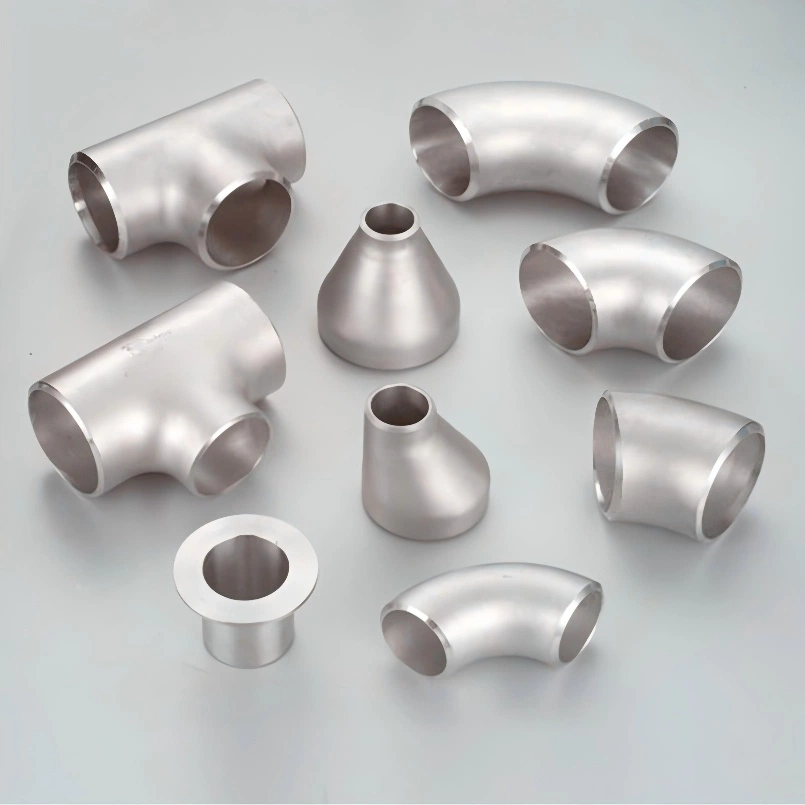
The complete 2026 engineering guide to butt-weld pipe fittings — 90°/45° elbows, concentric/eccentric reducers, equal/reducing tees, caps, and lap joint stub ends; material selection (304/304L/316/316L / A234 WPB / 2205 duplex); schedule ratings (SCH10S/40S/80S); ASME B16.9 / EN 10253 standards; welding preparation (bevel, root gap, alignment); common failures (304-for-316L material substitution, poor weld penetration); and a worked example from a Surabaya palm oil B100 biodiesel plant.
* Standard lead time depends on order size and destination. 5–10 days to Southeast Asia, 15–20 days to the Middle East.

Quick Answer
Butt-weld pipe fittings are elbows, tees, reducers, caps, and stub ends welded directly to the ends of pipes to form a permanent, leak-proof monolithic joint. They are the standard choice for high-pressure, high-temperature, and critical process piping (refineries, power plants, chemical, pharma, food). Unlike threaded or flanged fittings (which can be disassembled), a butt-welded joint has bubble-tight risk at the joint and smooth internal flow. The single most important rule: always PMI-test every fitting before welding it into critical piping — 304-for-316L substitution is the most common and most expensive failure in butt-weld systems, and a hand-stamped 3.1 certificate is not proof of material.
Key Takeaways
- Material match: 316L for chloride / biodiesel / pharma · 304 for clean water / HVAC · A234 WPB for steam / oil & gas · 2205 duplex for seawater / SWRO brine
- Schedule: SCH10S light · SCH40S standard industrial · SCH80S high-pressure / corrosive — match wall thickness to pipe schedule
- Documentation: Original mill EN 10204 3.1 MTC (not a re-stamped PDF) + on-site PMI XRF on every fitting before installation
- Weld quality: 37.5° bevel, 1.5 mm root face, 2–3 mm root gap, argon purge on stainless TIG root pass, qualified WPS / PQR per ASME B31.3
On This Page
What Are Butt-Weld Pipe Fittings?
Butt-weld pipe fittings (elbows, tees, reducers, caps) are welded directly to the ends of pipes to create a permanent, leak-proof piping system. They are the standard choice for high-pressure, high-temperature, and critical process applications. Unlike threaded or flanged fittings (which can be disassembled), a butt-welded joint is monolithic — the fitting and pipe become one continuous piece of metal. This gives the highest structural strength, bubble-tight risk at the joint, and smooth internal flow (no threads, no gasket, no flange face to obstruct flow).
Butt-weld fittings are specified in almost every industrial piping system from refineries to power plants, pharmaceutical plants, semiconductor fabs, and food processing. See our product line: butt-weld pipe fittings, butt-weld elbows, and matching stainless seamless pipe and stainless steel flanges.
Common Fitting Types
| Fitting Type | Purpose | Common Use |
|---|---|---|
| 90° elbow (long radius / short radius) | Change flow direction by 90° | Pipe turns, equipment connections |
| 45° elbow | Change flow direction by 45° | Gradual turns to reduce pressure drop |
| Concentric reducer | Reduce pipe size evenly (centerline aligned) | Pump discharge, pressure let-down |
| Eccentric reducer | Reduce pipe size with offset (flat on top or bottom) | Pump suction (flat top to avoid air pockets), horizontal steam lines |
| Equal tee | Split flow into three equal branches | Branch connections, sampling points |
| Reducing tee | Split flow with a smaller branch size | Instrument branches, small-branch takeoff |
| Cap | Close the end of a pipe | Dead-end piping, future extension |
| Lap joint stub end | Tie to a lap joint flange (for removable joint) | Pipes that need periodic disassembly |
| Cross | Split flow into four directions | Manifolds, distribution headers |
We supply 90° and 45° elbows, concentric and eccentric reducers, equal and reducing tees, caps, and lap joint stub ends. All fittings are supplied with EN 10204-3.1 material certificates.
Key Specifications
| Parameter | Specification |
|---|---|
| Size Range | 1/2″–24″ (DN15–DN600); larger on request |
| Material | 304 / 304L / 316 / 316L Stainless Steel; A234 WPB carbon steel; 2205 duplex |
| Schedule | SCH10S / SCH40S / SCH80S (stainless); SCH40 / SCH80 / SCH160 (carbon steel) |
| Standard | ASME B16.9 (US); EN 10253 (EU); JIS B2312 (Japan) |
| End Preparation | Beveled ends (37.5° bevel) for butt welding; plain ends for socket weld |
| Wall Thickness Tolerance | Per ASME B16.9: ±12.5% on wall thickness |
| Surface Finish | Black (carbon steel), pickled (stainless), electro-polished (sanitary/pharma) |
| Documentation | EN 10204 3.1 MTC, PMI report, hydrotest (if pressure-rated) |
Material Selection Guide
| Material | Use For | Do NOT Use For |
|---|---|---|
| 304 / 304L (18/8 stainless) | Clean water, HVAC, general mild corrosive, food (non-acidic) | Chloride service (>200 ppm), seawater, bleach, acidic foods |
| 316 / 316L (16% Cr, 10% Ni, 2% Mo) | Chloride service, seawater (intermittent), food, pharmaceutical, biodiesel, chemical processing | Continuous seawater at >40°C (use 2205); strong acids |
| A234 WPB (carbon steel) | Oil & gas, steam, high-pressure water, non-corrosive hydrocarbons | Corrosive media, outdoor unpainted (rusts), potable water |
| 2205 duplex | Seawater, SWRO, chloride-rich brine, acid gas (sour service) | High-temperature service (>250°C — sigma phase embrittlement) |
| A234 WP11 / WP22 (alloy steel) | High-temperature refinery service (<+550°C) | Room-temperature corrosive service |
Choosing the right fitting material is critical — material substitution (304 used where 316L is required) is one of the most common and expensive failures in butt-weld piping.
Worked Example: Surabaya B100 Biodiesel Corrosion
Step 1 — Problem
A palm oil biodiesel plant in Surabaya, East Java, Indonesia produced B100 (100% palm biodiesel) for export and domestic blending. The plant’s product piping system (from centrifuge outlet to storage tanks and loading racks) was specified as 316L stainless steel butt-weld fittings and pipe throughout — biodiesel is mildly corrosive due to residual free fatty acids (FFA ~0.5%), glycerin, and trace chloride from the palm oil feedstock. During construction, the piping subcontractor sourced the butt-weld fittings (90° elbows, tees, reducers) from a local supplier at a price roughly 40% below the 316L market rate, claiming they were “316L equivalent.” The supplier provided a hand-stamped 3.1 certificate claiming 316L chemical composition (16-18.5% Cr, 10–14% Ni, 2.0-2.5% Mo). After 9 months of operation, the plant began reporting iron contamination in the B100 product batch — lab tests showed Fe at 12 ppm (B100 export spec: <1 ppm). At the same time, visual inspection of weld joints revealed orange-brown staining and pitting corrosion at the heat-affected zone (HAZ) of many elbows and tees.
Step 2 — Root cause analysis
Maintenance pulled a suspect 90° elbow from the system and sent it for PMI (Positive Material Identification) and lab analysis. The PMI XRF result showed: Cr = 18.2%, Ni = 9.1%, Mo = 0.05%. This is 304 stainless, not 316L — the supplier had substituted 304 fittings (which contain no molybdenum) and stamped them as 316L. The lab MTC provided by the supplier was photoshopped; the actual mill heat number on the fitting body traced back to a steel mill that produces 304 coil only. Biodiesel with FFA and trace chloride attacked the 304 weld HAZ (which has lower corrosion resistance than the base metal due to carbon depletion during welding), causing pitting corrosion that released iron particles into the product stream. The 316L specified would have resisted this service because molybdenum in 316L prevents chloride pitting at weld HAZ.
Step 3 — Correct retrofit
The plant had to shut down the B100 product line for 14 days to replace all suspect fittings (47 elbows, 12 tees, 8 reducers, 5 caps) with genuine 316L butt-weld fittings from a verified supplier with original EN 10204 3.1 MTCs. All replacement fittings were PMI-tested on-site before installation (Mo ≥ 2.0% confirmed). The weld procedures were also revised to include post-weld pickling and passivation of the HAZ to restore corrosion resistance. The piping subcontractor was held liable for material cost but not for the production loss.
Step 4 — Cost & outcome (relative index: 1.0× = the genuine 316L fitting bundle the plant should have bought originally)
• 47 × 90° elbows DN80 SCH10S 316L (genuine, with MTC): ~1.0× the fitting bundle baseline
• 12 × reducing tees DN80 × DN50: included in bundle
• 8 × reducers DN100 × DN80, 5 × caps DN80: included in bundle
• On-site PMI testing of all replacement fittings: ~0.05× the bundle
• 14-day product line shutdown (weld removal, replacement, new welds, X-ray, pickling, passivation): ~9× the bundle
• Total retrofit cost: ~10× the fitting bundle
• 9 months of contaminated B100 product (Fe >1 ppm, rejected by export buyers): ~60× the bundle
• Export customer claim (rejected B100 shipments, buyer penalty): ~15× the bundle
• Reputation damage in Indonesian biodiesel export market (ISPO certification audit finding): not quantifiable
• Total incident cost: ~200×+ the fitting bundle.
• Lesson: The subcontractor “saved” roughly 0.35× the fitting bundle by swapping 304 for 316L (the 40% price difference on 72 fittings), but the plant lost ~200×. For critical process piping, always: (1) require the original mill’s EN 10204 3.1 MTC with the steel mill’s stamp (not the fitting factory’s stamp), (2) perform PMI XRF on every fitting before installation, (3) trace the heat number back to the actual steel producer. A PMI test costing less than 0.05× the fitting bundle prevents a ~200× material-substitution disaster. See our butt-weld elbow product line for verified 316L fittings with full documentation.
How Chuanglan Ships Every Butt-Weld Fitting
Original mill EN 10204 3.1 MTC with the steel mill’s stamp (not a re-stamped PDF from the fitting factory)
Heat number laser-marked on every fitting, traceable to the actual heat
PMI XRF report available on request (we can run it before shipment or invite your third-party inspector)
Pickled & passivated for stainless; black varnished for A234 WPB; electro-polished Ra < 0.8 μm for sanitary
100% hydrotest (when pressure-rated) and dimensional inspection per ASME B16.9
SGS / BV / Intertek third-party inspection welcomed; ISO 15156 sour-service documentation for the Middle East oil & gas
Need Verified Butt-Weld Fittings with Real EN 10204 3.1 MTC?
Every fitting from Chuanglan ships with the original steel mill’s EN 10204 3.1 certificate (not a photoshopped PDF). We support PMI on-site, X-ray weld inspection, and third-party witnessing by SGS / BV / Intertek. Tell us your size, schedule, material, and quantity — we’ll quote within 24 hours.
Get Free Sizing Report → WhatsApp usWelding Preparation & Quality
Butt-weld fittings are only as good as the weld. Common welding problems that cause joint failure:
- Misalignment: Pipe and fitting must be concentric within 10% of wall thickness. Misalignment causes stress concentration and premature failure.
- Bevel preparation: Ends must be beveled at 37.5° with a 1.5 mm root face. Without proper bevel, weld penetration is incomplete and the joint is weak.
- Root gap: 2–3 mm gap between pipe and fitting for full penetration. Too tight = incomplete fusion; too wide = burn-through.
- Shielding gas for stainless: TIG root pass with argon backing (purge) to prevent oxidation on the inside of the weld (sugaring). Without internal purge, stainless welds corrode from day one.
- Weld procedure qualification (WPS/PQR): Critical pressure piping requires a qualified WPS and welder qualification (per ASME B31.3 or EN 13480).
- NDE inspection: X-ray or ultrasonic inspection of welds for critical service (oil & gas, hazardous chemicals). Visual inspection is minimum.
- Post-weld pickling & passivation: Restores chromium oxide layer on stainless weld HAZ — without it, biodiesel / chloride / pharma service will pit the weld within months.
Southeast Asia & Middle East Market Notes
For clients in Southeast Asia, butt-weld fittings are ubiquitous in palm oil mills (Indonesia / Malaysia), biodiesel plants, pulp & paper mills, water treatment, and pharmaceutical facilities. The Surabaya case above is typical of Southeast Asian palm oil / biodiesel projects — local piping subcontractors often source cheap fittings from local distributors without verifying the material, and 304-for-316L substitution is common. Thai and Vietnamese food & pharmaceutical projects increasingly require 316L electro-polished fittings with Ra < 0.8 μm surface finish for CIP lines. Indonesian palm oil mills (Sumatera, Kalimantan, Sulawesi) use both carbon steel (A234 WPB) for high-pressure steam and 304/316L for product lines. Southeast Asian contractors must also pay attention to Indonesian SNI certification for certain piping products, and Malaysian DOSH for pressure equipment.
For clients in the Middle East, butt-weld fittings are dominated by oil & gas, petrochemical, power, and SWRO desalination projects. Aramco, ADNOC, SABIC, KNPC, and QatarEnergy all require ASME B16.9 fittings with full EN 10204 3.1 MTC, PMI test reports, and often ISO 15156 for sour service. the Middle East SWRO plants (Jubail, Taweelah, Ras Al Khair) use 2205 duplex butt-weld fittings for brine and seawater service — 316L pitting in Gulf seawater within 2-3 years (see our stainless flange case study for Jubail SWRO). Middle East contractors also require Saudi Aramco approved vendor list (AVL) status for critical piping, and SABER / SASO conformity for Saudi import. Serving EPC Contractors Across Southeast Asia & Middle East · ISO 9001:2015 · Established in 2009. Chuanglan supplies butt-weld elbows, tees, reducers, caps, and stub ends in 304 / 304L / 316 / 316L / A234 WPB / 2205 duplex to EPC contractors across Saudi Arabia, UAE, Qatar, Kuwait, Oman, and Bahrain, with full EN 10204 3.1 MTC, PMI, and third-party inspection support.
Common Mistakes to Avoid
- Specifying 304 stainless for coastal or chloride service. If your project is in Southeast Asia (coastal, cooling tower, deicing salts) or the Middle East (desalination, SWRO, humid Gulf climate), 304 will pit within 1–3 years. Specify CF8M (316) or duplex 2205.
- Ignoring pressure-temperature derating. PN16 / Class 150 ratings apply at room temperature only. At 200°C the allowable pressure drops by roughly 40–50%. Always check the manufacturer’s P-T chart before specifying for steam, hot oil, or thermal fluid.
- Buying on price without MTC verification. “Stainless steel” is not enough — ask for EN 10204 3.1 MTC tied to the heat number, and arrange PMI (XRF) witness at the factory if the price is 20% below market. 304 passed off as 316L is the single most common failure in this industry.
- Forgetting face-to-face and flange drilling. A “PN16” wafer valve from one manufacturer may not match the existing flange drilling or face-to-face of another. Always confirm dimensions against EN 558 / API 609 / ASME B16.10 before replacing an installed valve.
FAQ
What is the difference between SCH10S, SCH40S, and SCH80S?
“Schedule” (SCH) indicates wall thickness for a given pipe size. SCH10S is the thinnest (light duty, low pressure), SCH40S is standard for most industrial stainless piping, and SCH80S is heavier for high pressure or corrosive service. For example: DN100 (4″) SCH10S wall = 3.0 mm, SCH40S wall = 4.6 mm, SCH80S wall = 6.0 mm. Thicker wall = higher pressure rating but heavier and more expensive. Always match the fitting schedule to the pipe schedule — a SCH40S fitting welded to a SCH10S pipe is a weak link.
What is the difference between long radius (LR) and short radius (SR) elbows?
A long radius elbow has a centerline radius of 1.5 × pipe diameter (e.g., a 4″ LR elbow radius = 6″). A short radius elbow has radius = 1.0 × diameter. LR elbows are standard because they cause less pressure drop and less turbulence. SR elbows are used only when space is tight (inside skids, compact equipment). Most industrial piping uses LR elbows.
Should I use concentric or eccentric reducers?
Use concentric reducers on vertical piping and pump discharge (where flow is straight). Use eccentric reducers on horizontal pump suction (flat side up, to avoid air pockets that cause cavitation) and on horizontal steam lines (flat side down, to allow condensate to drain). See our elbow and reducer product line for both configurations.
How do I verify a fitting is actually 316L and not 304?
Use a PMI (XRF) gun — it reads the chemical composition in 30 seconds. For 316L, the Molybdenum (Mo) reading must be 2.0-2.5%. If Mo = 0%, it’s 304. Always PMI fittings before welding them into critical piping. A PMI test costing a fraction of one fitting prevents a material-substitution failure that can run to hundreds of times the fitting bundle cost — the Surabaya case above is typical.
What is ASME B16.9?
ASME B16.9 is the US standard for factory-made wrought butt-weld fittings (elbows, tees, reducers, caps). It defines dimensions, tolerances, materials, pressure ratings, and marking. EN 10253 is the European equivalent (Part 1 for general service, Part 2 for pressure service), and JIS B2312 is the Japanese equivalent. If your project specifies ASME B16.9, the fitting must be marked with the manufacturer’s symbol, material grade, schedule, and heat number.
Can butt-weld fittings be used for high-pressure steam?
Yes — but use A234 WPB (carbon steel) or WP11 / WP22 (alloy) fittings, not stainless. Stainless 304 / 316 is suitable for steam up to ~+200°C; above that, use alloy steel. For boiler steam service (40 bar, +400°C), WP11 / WP22 fittings are standard. Always match the fitting material to the pipe material — welding 316 fittings to carbon steel pipe creates galvanic corrosion risk in moist service.
What is the lead time for Chuanglan butt-weld fittings?
DN15–DN100 SCH10S / 40S 304 / 316L elbows, tees, reducers: in stock, ship in 7 days. DN150–DN300: 15–30 days. 2205 duplex, alloy WP11 / WP22, large sizes DN350+: 25–35 days. Every fitting ships with original mill EN 10204 3.1 MTC (not a re-stamped PDF), PMI report available, SGS / BV / Intertek inspection welcomed. MOQ 1 piece.
References & Standards
- ASME B16.9 — Factory-made wrought butt-weld fittings (dimensions, tolerances, pressure ratings)
- EN 10253 — Butt-welding pipe fittings (Part 1 general, Part 2 pressure use, EU equivalent)
- JIS B2312 — Butt-welding long radius seamless pipe fittings (Japanese standard)
- ASME B31.3 — Process piping (WPS / PQR / welder qualification for butt-welded joints)
- EN 10204 3.1 — Metallurgical product inspection documents (material test certificate)
- ISO 15156 — Sour service materials for oil & gas (Middle East H2S service)
Related Products
Continue Reading
Request a Quotation — Reply Within 24 Hours
Send your line size, pressure rating, medium and quantity. Our engineers come back with price, drawing and lead time — no obligation.
Request a Butt-Weld Fittings Quote
MOQ: 1 piece · ISO 9001:2015 · Original mill EN 10204 3.1 MTC included · shell and seat pressure tested
Southeast Asia: Indonesia, Malaysia, Thailand, Vietnam, Myanmar, Singapore, Philippines
Middle East: Saudi Arabia, UAE, Qatar, Kuwait, Oman, Bahrain
Other Regions: Europe, North America, South America, Africa, Australia
Delivery: 5–10 days to Southeast Asia · 15–20 days to the Middle East · 25–35 days to Europe / the Americas
Payment: T/T 30% deposit + 70% before shipment · L/C at sight · Warranty: 12 months after shipment for material and manufacturing defects · Packing: export plywood case / fumigation-free pallet · Shipping: FOB Ningbo/Shanghai · Documents: EN 10204 3.1 MTC + packing list + commercial invoice · Third-party inspection welcome: SGS / Bureau Veritas / Intertek
Get Free Quote »