
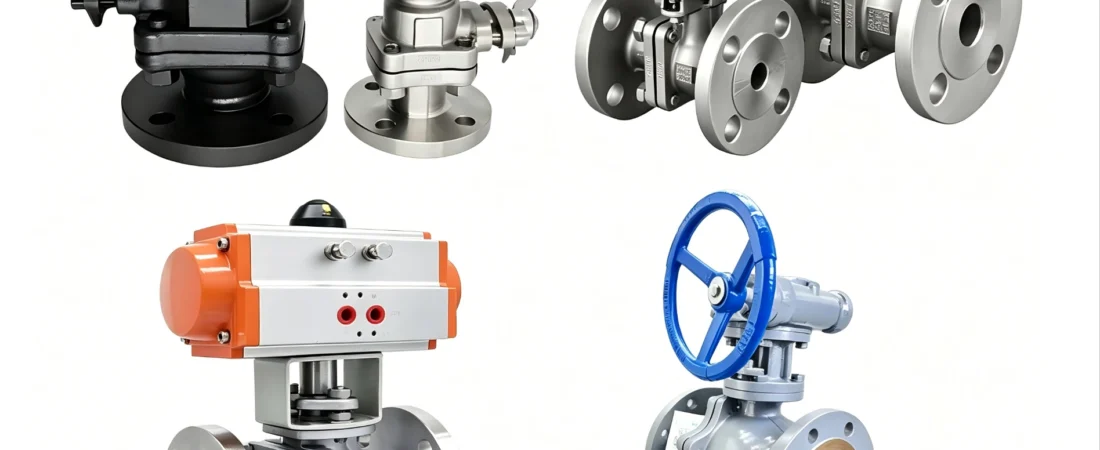
Flanged Ball Valve: Pressure Ratings, Materials & Applications
The complete 2026 guide to flanged ball valves — 1-piece vs 2-piece vs 3-piece body design, full port vs reduced port, pressure ratings PN16 / PN40 / Class 150 / 300 / 600, seat materials PTFE / RPTFE / PEEK / NBR / Viton / metal, floating vs trunnion ball, body materials WCB / CF8 / CF8M / 2205 duplex, common applications, pros and cons, and a buying checklist for Southeast Asia and the Middle East industrial projects.
* Standard lead time depends on order quantity and destination country. 5–10 days to Southeast Asia, 15–20 days to the Middle East.

Quick Answer
A flanged ball valve is the tightest-shutoff industrial valve on the market — bubble-tight, 90° turn, low pressure drop — but it is an OPEN / CLOSED valve, never a throttling one. For most general oil, gas, water, and chemical shutoff up to DN200 / Class 300, a 2-piece floating ball in WCB (carbon steel) or CF8M (316 stainless) with RPTFE seat is the value pick. Specify 1-piece for budget clean-water service, 3-piece for hygienic or frequently-serviced lines, and trunnion ball for DN150+ / Class 600+ where operating torque would otherwise be too high. For seawater, brackish water, or coastal atmospheric exposure, NEVER use WCB — use CF8M (316) for short-term or 2205 / super-duplex for long-term exposure, because 304 and carbon steel pit rapidly in chloride service.
Key Takeaways
- Shutoff: Ball = bubble-tight · gate / butterfly = good but can weep.
- Body design: 2-piece = best value for general industry · 3-piece = serviceable in-line.
- Seat: PTFE = 200°C · RPTFE = 250°C · PEEK = 300°C · metal = 600°C+.
- Seawater? → CF8M or 2205 duplex. WCB and even 304 will pit within 1–2 years.
On This Page
1. What Is a Flanged Ball Valve?
A flanged ball valve uses a perforated ball to control flow — turn the handle 90° and the hole lines up with the pipe to open, or rotate 90° to block flow. The “flanged” design means the valve has bolted flanges on both ends, so it bolts directly to matching pipe flanges (instead of being sandwiched like wafer valves).
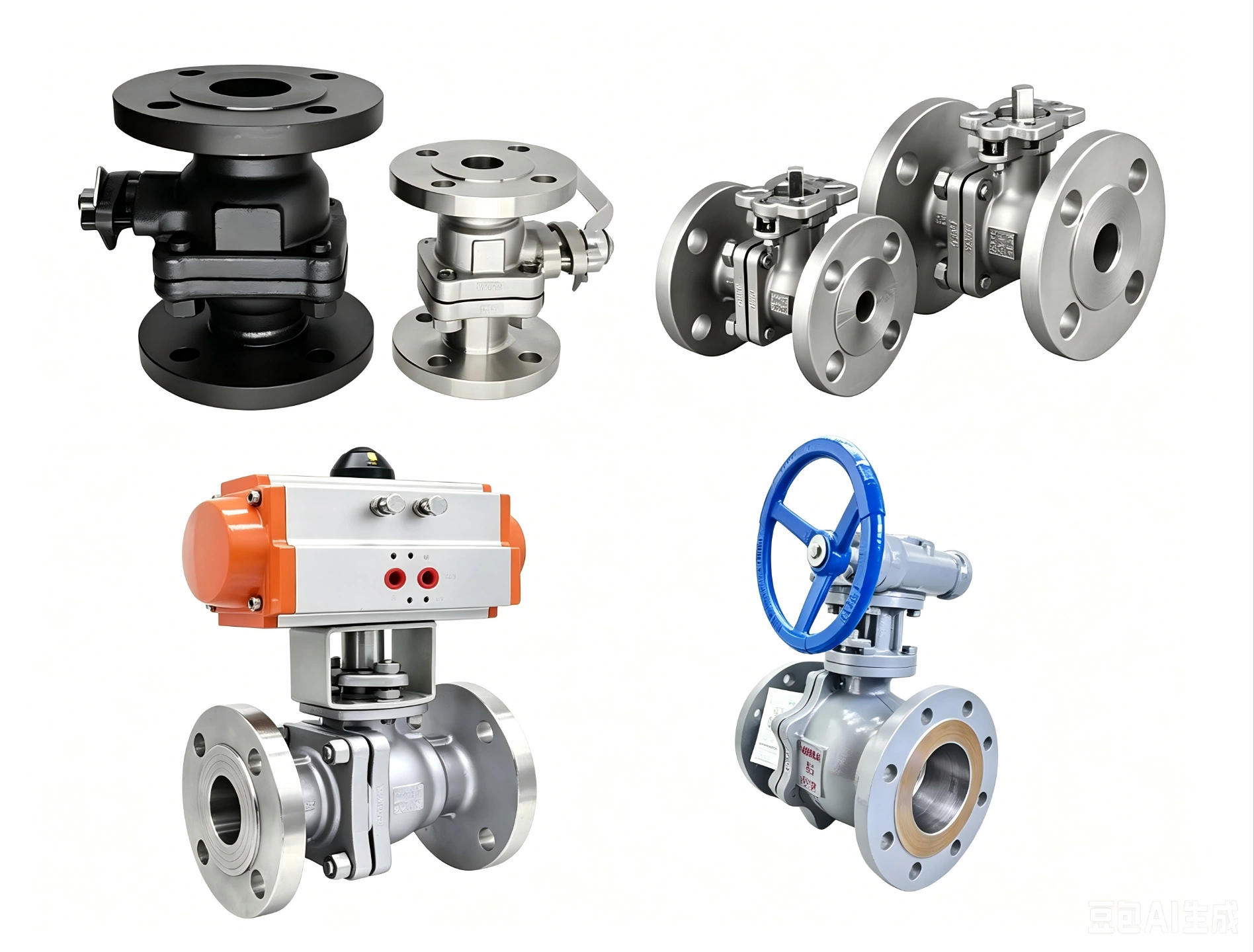
Flanged ball valves are the gold standard for tight shutoff — when closed, they provide bubble-tight, unlike gate valves or butterfly valves which can weep a little. See our pneumatic and electric actuated ball valves for automated applications.
2. Body Design: 1-Piece vs 2-Piece vs 3-Piece
| Design | Relative Cost | Repairable In Line? | Best For |
|---|---|---|---|
| 1-Piece (cast) | Lowest | No (disposable) | General water, budget, small sizes |
| 2-Piece | Medium | Partially (body can be removed from flange) | Most common, general industry, oil & gas |
| 3-Piece | Higher | Yes (center section comes out without removing flanges) | High maintenance, corrosive media, hygienic |
Most popular choice: 2-piece flanged ball valve (roughly 70% of all ball valves sold). It’s the best balance of cost and repairability. Go 3-piece only if you need to service the valve regularly without disconnecting the flanges. For small tight-shutoff applications, also see our threaded NPT / BSPP ball valves.
3. Full Port vs Reduced Port
| Type | Port Size | Pressure Drop | Relative Cost | Best For |
|---|---|---|---|---|
| Full Port | Same as pipe inner diameter | Near zero | Higher | Pigging, slurry, high flow, minimal pressure loss |
| Reduced Port | ~80% of pipe diameter | Low | Lower | General shutoff, cost-sensitive applications |
Rule of thumb: For most industrial shutoff applications, reduced port is fine and saves roughly 20–30%. Use full port only if you need to pig the line, handle slurry, or have strict pressure-drop requirements.
4. Pressure Ratings & Materials
| Pressure Rating | Body Material | Ball Material | Seat Material |
|---|---|---|---|
| PN16 / Class 150 | WCB (carbon steel) / CF8M (316 SS) | Stainless 304 / 316 | PTFE / RPTFE |
| PN40 / Class 300 | WCB / CF8M | Stainless 316 / chrome-plated | RPTFE / PEEK (high temp) |
| Class 600 | WCB / CF8M / WC6 | Stainless 316 / stellite-coated | RPTFE / PEEK / metal seat (high temp) |
5. Seat Materials: Temperature & Chemical Resistance
| Seat Material | Temperature Range | Best For |
|---|---|---|
| PTFE (Teflon) | -200°C to +200°C | Most chemicals, general industry, food / pharma |
| RPTFE (Reinforced PTFE) | -200°C to +250°C | Higher pressure / temperature, better wear |
| PEEK | -100°C to +300°C | High temperature, high pressure, harsh chemicals |
| NBR (Buna-N) | -20°C to +90°C | Oil, fuel, water (lower temp) |
| Viton (FKM) | -20°C to +180°C | Oil, fuel, high temp, chemicals |
| Metal Seat (Stellite) | Up to +600°C+ | Steam, high temp, abrasive media (not bubble-tight) |
The seat (the soft ring that seals against the ball) is the most important wear part — it determines temperature range and chemical compatibility.
6. Floating vs Trunnion Ball Valves
| Type | How It Works | Size Range | Best For |
|---|---|---|---|
| Floating Ball | Ball floats, pushed by upstream pressure against downstream seat | Up to DN200 (8″) | Small sizes, low pressure, most general applications |
| Trunnion Ball | Ball fixed on a stem (trunnion), seats move against ball | DN150 and up (6″+) | Large sizes, high pressure, low operating torque |
Rule of thumb: For sizes under DN200, floating ball is standard and lower cost. For DN150 and above, trunnion ball is required — otherwise the torque to turn the ball becomes too high for handwheel or actuator.
7. Worked Example: Sohar Oman Seawater Cooling Line Failure
Step 1 — Problem
A 1,000 MW combined-cycle power plant in the Sohar Industrial Port, Oman, uses seawater (3.5% salinity, 30°C) for main condenser cooling. The cooling-water intake system had 8 × DN100 PN16 flanged ball valves on the condenser tube-side isolation lines. During a planned outage after 12 months of operation, the maintenance team found: (1) all 8 valves weeping around the body-flange gasket; (2) pitting corrosion on the internal body visible through the stem packing; (3) salt crystals forming around the stem; (4) on disassembly, the internal wetted surfaces had deep pitting (0.5–1.0 mm) and the ball was covered in rust. The plant had to reduce load by roughly 15% because condenser backpressure was rising.
Step 2 — Root cause analysis
The EPC contractor, to save cost, had specified WCB carbon steel flanged ball valves for seawater service. WCB is carbon steel with essentially no corrosion resistance — in seawater at 30°C, the corrosion rate is 0.2–0.5 mm per year. After 12 months, the wetted body had thinned enough to start pitting, and the carbon steel ball had rusted, destroying the seat seal. The correct material for seawater service is CF8M (cast 316 stainless) body with 316 ball and RPTFE seats — 316 has 2% molybdenum specifically to resist chloride pitting. Even 304 is not enough; 2205 duplex is preferred for long-term seawater exposure.
Step 3 — Correct retrofit
All 8 × DN100 PN16 valves were replaced with CF8M (316 stainless) 2-piece flanged ball valves, full port, RPTFE seats, anti-static stem design. Same face-to-face dimension per EN 558-1 Series 1, same flange drilling per EN 1092-1 PN16 — no pipe modification needed.
Step 4 — Outcome
• The CF8M retrofit was a bolt-in swap on the existing flanges — no piping work, half a day per valve during scheduled outages
• The weeping stopped immediately; condenser backpressure returned to normal within a week of recommissioning
• The plant recovered the 15% load reduction it had been forced into
• The lower-grade WCB spec that looked attractive on the procurement PO turned out to be a small fraction of the cost of a single load-reduction event, and nothing compared with the avoided risk of a WCB valve failing fully open during seawater isolation
• Lesson: seawater, brackish water, coastal atmospheric service, or any chloride-containing medium — must use CF8M (316) or 2205 duplex. WCB is for clean oil, gas, and non-corrosive water only.
Why EPC Contractors Specify Flanged Ball Valves with Chuanglan
1-piece / 2-piece / 3-piece · floating and trunnion · WCB / CF8 / CF8M / 2205 duplex · DN15–DN600 · PN16–Class 1500
Manual handle, gear, pneumatic or electric actuator · anti-static stem · hydrocarbon-service tested on request · ISO 15156 sour-service trim
API 6D · API 608 · EN ISO 17292 · full EN 10204 3.1 MTC · third-party inspection (SGS / BV / Intertek) available
Need Help Selecting the Right Flanged Ball Valve?
Tell us your pipe size, pressure rating, medium (water / seawater / oil / gas / chemical), temperature, and whether you need manual or pneumatic / electric actuation — our engineers will recommend the right spec within 24 hours.
Get Free Sizing Report → WhatsApp us8. Common Applications
- Oil & gas — pipeline shutoff, production platforms, refineries
- Chemical processing — corrosive chemicals, acids, solvents
- Water & wastewater — treatment plants, distribution networks
- HVAC & building services — heating / cooling water shutoff
- Power generation — steam, condensate, cooling water
- Food & beverage — see sanitary ball valves (3-A compliant, tri-clamp ends)
- Pharma & biotech — CIP / SIP compatible, PTFE seats
9. Pros & Cons of Flanged Ball Valves
Pros:
- Bubble-tight shutoff (best of any valve type)
- Fast operation (90° turn)
- Low pressure drop (especially full port)
- Works for almost any fluid (with the right seat material)
- Compact and lightweight compared to gate valves
- Easy to automate (pneumatic / electric actuator)
Cons:
- Not good for throttling (seat gets damaged if partially open for long)
- Seat material limits temperature (PTFE max ~200°C)
- Higher torque for large / high-pressure valves (needs actuator)
- Higher cost than butterfly valves for large sizes
- Not recommended for slurries (ball can get stuck with solids)
10. Buying Checklist
When you send an RFQ for a flanged ball valve, include:
- Size (DN / inch)
- Pressure rating (PN / Class)
- Body material (WCB / CF8 / CF8M / 2205 duplex)
- Ball material (stainless 304 / 316, chrome-plated)
- Seat material (PTFE / RPTFE / PEEK / metal)
- Port type (full port / reduced port)
- Body design (1-piece / 2-piece / 3-piece)
- Floating vs trunnion (for large sizes)
- Actuation (manual handle / gear / pneumatic / electric)
- End flange standard (EN 1092 / ASME B16.5 / JIS)
- Standard (API 6D / API 608 / EN ISO 17292 / hydrocarbon-service)
11. Southeast Asia & Middle East Market Notes
For clients in Southeast Asia (Thailand, Vietnam, Indonesia, Malaysia, Philippines), flanged ball valves are the workhorse of process plants: Thai and Malaysian refineries (PTT, Petronas) specify WCB flanged ball valves per API 6D for oil / gas service with ISO 15156 trim; Indonesian chemical plants (Cikarang, Karawang) specify CF8M ball valves for corrosive acid / alkali service; Vietnamese water-treatment plants use cast-iron ball valves for clean water but specify CF8M for any chemical-dosing line. The most common failure in tropical Southeast Asia is using WCB valves on coastal or high-humidity service — the body rusts from the outside even if the medium is clean water. Always specify epoxied or CF8M bodies for coastal plants. For food and beverage, always use the sanitary tri-clamp ball valve version with 3A style design, not industrial flanged.
For clients in the Middle East (Saudi Arabia, UAE, Qatar, Kuwait, Oman, Bahrain), flanged ball valves are specified by Saudi Aramco, ADNOC, SABIC, Qatar Energy, and Shell. Middle East oil / gas gathering and separation stations require trunnion-mounted ball valves per API 6D, Class 1500 / 2500, with ISO 15156 sour-service trim, hydrocarbon-service tested, and anti-static stem. SWRO desalination plants (Jubail, Yanbu, Ras Al Khair, Taweelah, Sohar) universally specify 2205 duplex or super-duplex flanged ball valves on seawater / brine lines — WCB and even 316L are not sufficient for long-term Gulf seawater exposure. The Sohar case above is typical. Power plants (SEC, DEWA, ADWEA) use WCB ball valves for steam and condensate with PEEK or metal seats (200°C+). The extreme 50°C summer ambient requires valves to be derated for ambient temperature.
Chuanglan Valve supplies flanged ball valves (1-piece / 2-piece / 3-piece, floating and trunnion, WCB / CF8 / CF8M / 2205), pneumatic / electric actuated ball valves, threaded NPT / BSPP ball valves, and sanitary tri-clamp ball valves — with full EN 10204 3.1 MTC certificates, API 6D / API 608 / EN ISO 17292 compliance, and third-party inspection (SGS / BV / Intertek). Serving EPC Contractors Across Southeast Asia & Middle East · ISO 9001:2015 · Established in 2009 · MOQ 1 piece.
Common Mistakes to Avoid
- Specifying 304 stainless for coastal or chloride service. If your project is in Southeast Asia (coastal, cooling tower, deicing salts) or the Middle East (desalination, SWRO, humid Gulf climate), 304 will pit within 1–3 years. Specify CF8M (316) or duplex 2205.
- Ignoring pressure-temperature derating. PN16 / Class 150 ratings apply at room temperature only. At 200°C the allowable pressure drops by roughly 40–50%. Always check the manufacturer’s P-T chart before specifying for steam, hot oil, or thermal fluid.
- Buying on price without MTC verification. “Stainless steel” is not enough — ask for EN 10204 3.1 MTC tied to the heat number, and arrange PMI (XRF) witness at the factory if the price is 20% below market. 304 passed off as 316L is the single most common failure in this industry.
- Forgetting face-to-face and flange drilling. A “PN16” wafer valve from one manufacturer may not match the existing flange drilling or face-to-face of another. Always confirm dimensions against EN 558 / API 609 / ASME B16.10 before replacing an installed valve.
FAQ
What is the difference between floating and trunnion ball valves?
In a floating ball valve, the ball is not fixed — upstream pressure pushes it against the downstream seat to create the seal. This works well for sizes up to DN200 at Class 150 / 300. In a trunnion ball valve, the ball is fixed to a bottom trunnion shaft, and the two side seats move inward against the ball. Trunnion design is used for sizes DN150 and above, high pressure (Class 600+), and high temperature — it cuts operating torque by roughly 50–70%, so gear or actuator operation is much easier.
Can a ball valve be used for throttling or flow control?
No. Ball valves are designed for open / closed service. Holding a ball valve partially open for long periods causes high-velocity flow to impinge on the seat edge, causing seat erosion, chatter, and premature failure. For throttling, use a globe valve, a butterfly valve (mid-flow range), or a dedicated control valve with pneumatic / electric actuator and characterized trim.
What is the maximum temperature for a PTFE ball valve?
Standard PTFE seats are rated up to 200°C (with derating at pressure above PN16). For higher temperatures use RPTFE (250°C), PEEK (300°C), or metal-to-metal seats (up to 600°C+). Always check the temperature-pressure derating curve on the manufacturer’s datasheet — a PN40 valve at 200°C is not rated for 40 bar, typically derated to 20–25 bar.
Why does a 3-piece ball valve cost more than a 2-piece?
A 3-piece ball valve has three separate body sections (two end caps + center body). You can unbolt the center section and remove it from the line without disconnecting the flanges — this is essential for hygienic service (cleaning, inspection), high-maintenance corrosive service, or when the valve is hard to access. A 2-piece valve must be unbolted from the pipe to service. For most general industrial service, 2-piece is the best value.
How do I choose between full port and reduced port?
Use full port if (1) you need to pig the line, (2) you handle slurry or solids, (3) pressure drop is critical (pump-energy cost), or (4) the line is sized for future flow increases. Use reduced port for standard shutoff service — it costs 20–30% less, is lighter and shorter face-to-face, and the pressure drop (roughly 0.5 bar at design flow) is negligible for most applications.
What body material should I use for seawater service?
Never use WCB carbon steel for seawater — it will pit within 1–2 years. Use CF8M (cast 316 stainless) for short-term service, or 2205 duplex (or super-duplex 2507) for long-term seawater exposure (>5 years). Even 304 stainless is not enough for seawater because it lacks molybdenum. This is the #1 most common ball-valve spec mistake in coastal power and desalination plants.
What is the lead time from Chuanglan for flanged ball valves?
Standard sizes (DN15–DN200, PN16 / Class 150, WCB or CF8M, 2-piece, manual) are in stock and ship in 7–15 days. Large trunnion sizes (DN250+), Class 300 / 600 / 1500, 2205 duplex, ISO 15156 sour service, hydrocarbon-service tested, and pneumatic / electric actuation take 25–35 days. Full EN 10204 3.1 MTC and dimensional drawings are included with every shipment.
References & Standards
- API 6D: Pipeline Valves (ball, gate, plug, check)
- API 608: Metal Ball Valves — Flanged, Threaded, and Welding-End
- ISO 10497: Hydrocarbon-service testing for Soft-Seated Ball Valves
- EN ISO 17292: Metal ball valves for petroleum, petrochemical, and allied industries
- ASME B16.34: Valves — Flanged, Threaded, and Welding-End
- ISO 15156: Sour-service materials for oil & gas production
Related Products
Continue Reading
Request a Quotation — Reply Within 24 Hours
Send your line size, pressure rating, medium and quantity. Our engineers come back with price, drawing and lead time — no obligation.