
How to Choose the Right Ball Valve for Your Application
The 2026 engineer’s guide to ball valve selection: 6 key factors (size & pressure, body material, end connection, seat material, floating vs trunnion, actuation), the 4 main ball valve types, seat-temperature limits, and a worked example of a Malaysian petrochemical hot-oil line where a PTFE-seated ball valve failed at 280°C because the engineer only specified “stainless ball valve” and forgot the seat.
* Standard lead time depends on order size and destination. 5–10 days to Southeast Asia, 15–20 days to the Middle East.

Quick Answer
Choosing the right ball valve comes down to 6 factors: (1) size & pressure rating (DN + PN or Class), (2) body material (brass / CF8 / CF8M / WCB / 2205 duplex), (3) end connection (threaded / flanged / tri-clamp / welded), (4) seat material (PTFE / RTFE / NBR / Viton / metal — the #1 spec error), (5) floating vs trunnion ball (floating for small / low pressure, trunnion for large / high pressure), (6) actuation (manual handle / gear / pneumatic / electric). The four main ball valve types are threaded (small process lines), flanged (industrial piping), actuated (automatic control), and sanitary (food / pharma). The single most common selection mistake is specifying “stainless ball valve” without naming the seat material — PTFE seats are limited to ~180–200°C continuous, so any application above that temperature (hot oil, saturated steam, thermal fluid) requires a metal-seat (stellite-coated) ball valve.
Key Takeaways
- Seat temperature = the hidden spec: PTFE max 180–200°C continuous, metal seat needed above that
- Body matches media: brass = general water · CF8 (304) = general · CF8M (316) = corrosive · WCB = oil & gas · 2205 = seawater
- Connection matches line size: threaded ≤DN50 · flanged DN50+ · tri-clamp = hygienic · welded = permanent
- Floating vs trunnion: floating ≤DN100 / Class 300 · trunnion DN150+ / high pressure / throttling
On This Page
What Is a Ball Valve?
A ball valve uses a spherical ball with a through-hole (bore) that rotates 90° around a stem to start, stop, or throttle flow. When the bore lines up with the pipeline, flow is full-bore and unobstructed; when the ball is rotated 90°, the bore is perpendicular and flow is stopped. Ball valves are among the most dependable quarter-turn shutoff valves available, offering bubble-tight sealing, low torque, and long service life. But choosing the right ball valve requires careful consideration of several key factors.
The 6 Key Selection Factors
1. Size & Pressure Rating
Start with line size (DN or inch) and pressure rating (PN10/16/40 or Class 150/300/600). Ball valve price grows exponentially with size — see our ball valve sizing guide for the full calculation. Pressure rating determines wall thickness, stem diameter, and seat design.
2. Body Material
The body material must match the fluid, temperature, and external environment:
| Body Material | Best For | Avoid |
|---|---|---|
| Brass | General water, HVAC, utility, low-cost | Corrosive chemicals, seawater, high temp |
| CF8 (304) | General industry, water, mild chemicals | Seawater, chloride-rich, strong acids |
| CF8M (316) | Corrosive chemicals, coastal, food pharma | Extreme sour service (use 2205 or duplex) |
| WCB (carbon steel) | Oil & gas, steam, high-pressure water | Corrosive or coastal service |
| 2205 Duplex | Seawater, chloride, desalination | high temp (over 250°C) |
See our 304 vs 316L stainless steel and WCB vs CF8 vs CF8M guides for the deeper dive.
3. End Connection
| Connection | Best For | Size Range |
|---|---|---|
| Threaded (NPT / BSP) | Small process lines, utility systems | DN15–DN50 (1/2″–2″) |
| Flanged (ASME / DIN / JIS) | Industrial piping, oil & gas, large size | DN25–DN600+ |
| Tri-clamp (ferrule) | Sanitary food / pharma, CIP/SIP | DN25–DN150 |
| Butt-weld | Permanent installations, high pressure | DN15–DN300 |
4. Seat Material (most often missed)
The seat is the soft (or metal) ring that seals against the ball. It is the single most failure-prone part of a ball valve. See the seat temperature table below.
5. Floating vs Trunnion Ball
See the dedicated section below.
6. Actuation
Manual lever for small sizes and occasional operation. Gear operator for DN100+ or high torque. Pneumatic or electric actuator for automatic / remote / fast-cycle operation. See our pneumatic vs electric actuator guide for selection.
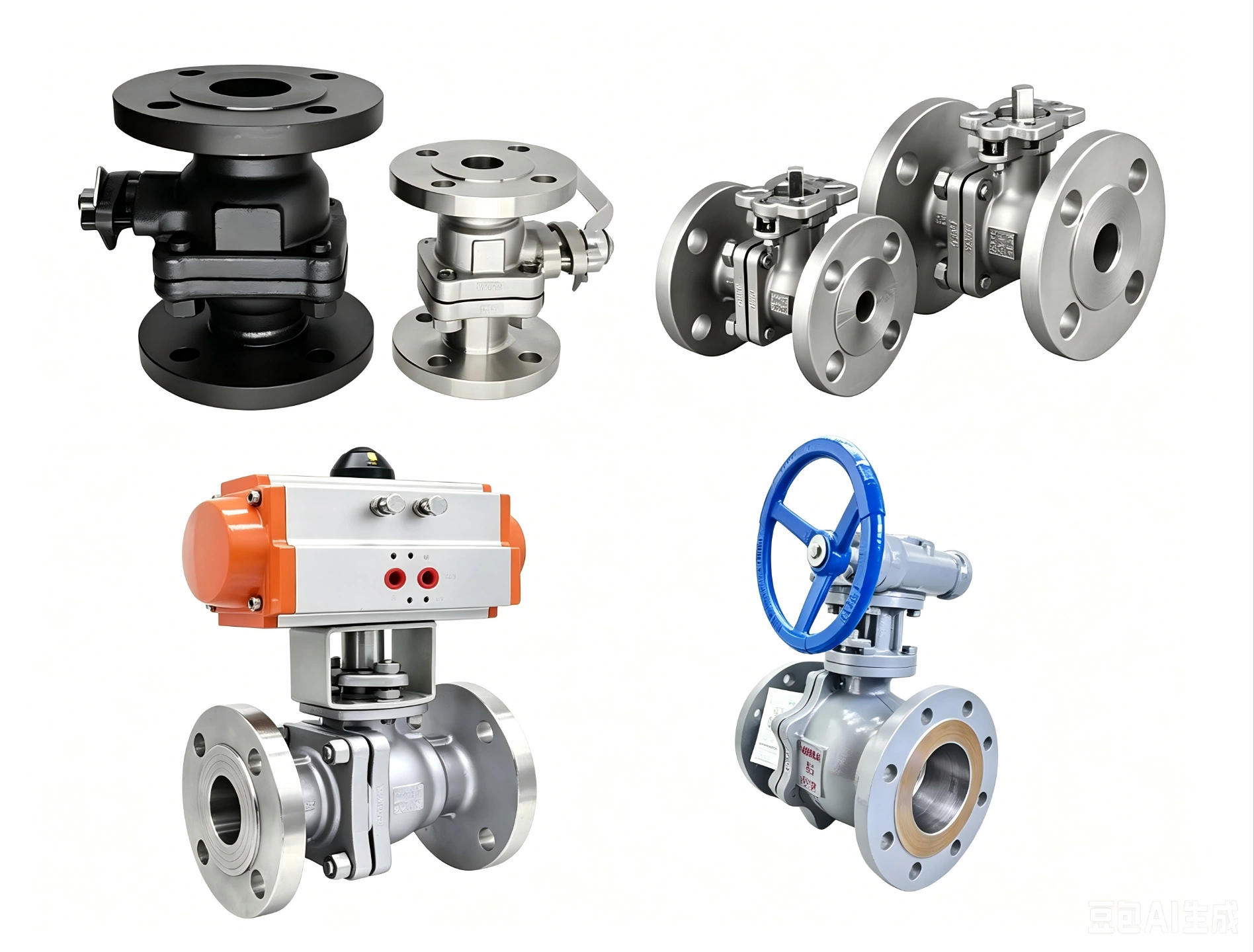
Main Ball Valve Types
| Type | Typical Application | Size Range |
|---|---|---|
| Threaded Ball Valve | Small process lines, utility systems, compressed air, water | DN15–DN50 |
| Flanged Ball Valve | Industrial piping, oil & gas, chemical, power | DN25–DN600+ |
| Actuated Ball Valve | Automatic process control, remote operation, fast cycling | DN15–DN300 |
| Sanitary Ball Valve | Food, beverage, pharmaceutical, biotech (CIP/SIP) | DN25–DN150 |
See also: ball vs gate valve, ball vs butterfly valve, and ball valve pressure rating guide.
Seat Material Temperature Limits
This table is the most important reference in this article. If your operating temperature exceeds the seat rating, the seat will extrude, melt, or cold-flow — and the valve will leak.
| Seat Material | Continuous Temp | Best For |
|---|---|---|
| NBR (Buna-N) | -20°C to 80°C | Water, oil, general utility |
| EPDM | -30°C to 140°C | Hot water, steam, chemicals, food |
| PTFE (Teflon) | -200°C to 180–200°C | Corrosive chemicals, general pharma, food |
| RTFE (reinforced PTFE) | -200°C to 200°C | Higher pressure than PTFE, less cold-flow |
| Viton (FKM) | -15°C to 200°C | Oil, fuel, petroleum |
| Metal (Stellite-coated) | -200°C to 600°C+ | Hot oil, saturated steam, thermal fluid, abrasive service |
Rule of thumb: if your process is above 200°C, do not order PTFE-seated ball valves — specify metal-seat (stellite-coated ball and seat rings). PTFE is the default seat for 90% of ball valves, but it is also the #1 spec error on high-temperature lines.
Floating vs Trunnion Ball
Ball valves come in two mechanical designs:
| Feature | Floating Ball | Trunnion Ball |
|---|---|---|
| Ball support | Ball floats between seats (no bottom stem) | Ball held by top and bottom trunnions (shafts) |
| Size range | DN15–DN100 (1/2″–4″) | DN50–DN1200+ (2″–48″+) |
| Pressure class | Up to Class 300 | Class 150–Class 2500+ |
| Torque | Lower (small valve) | Higher (trunnion reduces seat friction) |
| Best for | Small / medium size, low-medium pressure | Large size, high pressure, throttling |
See our floating vs trunnion ball valve guide for the full comparison.
Worked Example: Malaysian Hot-Oil Seat Failure
Step 1 — Problem
A Penang (Malaysia) specialty-chemical plant ran a thermal-oil (hot-oil) circulation loop at 280°C and 6 bar, used to heat a reactor train. The EPC’s mechanical engineer specified 8× DN50 flanged ball valves on the hot-oil return line. The RFQ line simply said: “Stainless steel ball valve, DN50, PN16, flanged.” The supplier delivered standard CF8M ball valves with PTFE seats — the default configuration for any “stainless ball valve” order. The plant commissioned the line, and within 3 weeks, two of the eight valves started leaking at the body-flange joint. On inspection, the PTFE seats had extruded out of the seat ring — the hot oil had softened the PTFE, and line pressure pushed the seat material out. The leaking valves were shut off, but the hot-oil loop was down for 6 days during peak production.
Step 2 — Root cause analysis
The EPC engineer had specified the body material (stainless) and size (DN50) but had not specified the seat material. The supplier, following standard practice, fitted PTFE seats — the default for stainless ball valves. PTFE’s continuous temperature limit is 180–200°C; at 280°C, PTFE cold-flows (extrudes) under line pressure. The valve body itself (CF8M) was fine at 280°C; the failure was entirely in the seat. The root cause was a specification gap: “stainless ball valve” is not a complete spec — you must name the seat.
Step 3 — Correct retrofit
Chuanglan Valve supplied 8× DN50 flanged ball valves in CF8M body with metal-seat (stellite-coated ball and seat rings) rated to 425°C continuous, PN16, flanged ends. The metal-seat design uses hardfaced (stellite 6) ball and seat rings instead of soft PTFE — the seal is metal-to-metal, which handles high temperature and some solids. The plant replaced all 8 valves during a scheduled 4-day shutdown, with no further leakage in the 18 months since. The EPC updated their project standard: “Hot-oil / thermal-fluid lines above 200°C: always specify metal-seat (stellite) ball valve, never PTFE.”
Step 4 — Outcome
• No further seat extrusion or leakage in the 18 months since the retrofit.
• The plant’s maintenance team now keeps 2 spare metal-seat ball valves in the warehouse as critical spares (against a 5-day delivery lead time from China).
• Lesson: when you specify a ball valve, the RFQ must include size, pressure, body material, seat material, end connection, and actuation. “Stainless ball valve” alone is not enough — the supplier will default to PTFE, and PTFE will fail on any line above 200°C.
How Chuanglan Specs Every Ball Valve Quote
8 spec fields on every RFQ: size · pressure · body material · end connection · seat material · ball type (floating / trunnion) · actuation · special certification
PTFE / RTFE / EPDM / Viton / metal-seat (stellite) all in stock — no default PTFE on high-temp lines
Floating ball DN15–DN100, trunnion DN50–DN600 — single source for both designs
MTC EN 10204 3.1 heat-number-tied certificate on every order; optional SGS / BV / Intertek / Lloyd’s PMI XRF witness
MOQ 1 piece for stock items, 7–15 day standard delivery, OEM / ODM from large volume
Not Sure Which Ball Valve Seat Your Process Needs?
Send us your line size, pressure, fluid, operating temperature, and end connection — our engineers will spec the right body + seat + ball type and reply within 24 hours.
Get Free Sizing Report → WhatsApp usSoutheast Asia & Middle East Market Notes
For clients in Southeast Asia, ball valve selection is dominated by HVAC (chilled / hot water), water treatment, food & beverage, and general chemical processing. The #1 spec error we see on incoming RFQs from Jakarta, Bangkok, HCMC, and Kuala Lumpur mechanical contractors is omitting the seat material — they write “stainless ball valve” and the supplier defaults to PTFE, which is fine for chilled water (6–12°C) but fails on hot-water loops above 80°C (use EPDM) or on saturated steam (use metal seat). We now add a free seat-temperature check to every ball valve quote before sending it back.
For clients in the Middle East (Saudi Arabia, UAE, Qatar, Kuwait, Oman, Bahrain), ball valve selection is dominated by oil & gas (Aramco SAES, ADNOC ICV, KNPC, QatarEnergy), desalination (SWCC, Taweelah, Ras Al Khair), and district cooling (Tabreed, QCool, Marafiq). Oil & gas EPCs require trunnion ball valves in WCB or CF8M with ISO 15156 for sour service, and metal-seat / hydrocarbon-service certification on hydrocarbon lines. Desalination SWCC contractors require 2205 duplex body with EPDM or HYR-seat for seawater service — CF8M on seawater pits within 1-2 years. District cooling uses CF8M flanged ball valves with EPDM seat on closed chilled-water loops.
Chuanglan Valve ships threaded ball valves, flanged ball valves, actuated ball valves, and sanitary ball valves in brass / CF8 / CF8M / WCB / 2205, with PTFE / RTFE / EPDM / Viton / metal-seat options, full EN 10204 3.1 MTC, and optional third-party inspection. Serving EPC Contractors Across Southeast Asia & Middle East · ISO 9001:2015 · Established in 2009 · MOQ 1 piece, 7–15 day standard delivery.
Common Mistakes to Avoid
- Specifying 304 stainless for coastal or chloride service. If your project is in Southeast Asia (coastal, cooling tower, deicing salts) or the Middle East (desalination, SWRO, humid Gulf climate), 304 will pit within 1–3 years. Specify CF8M (316) or duplex 2205.
- Ignoring pressure-temperature derating. PN16 / Class 150 ratings apply at room temperature only. At 200°C the allowable pressure drops by roughly 40–50%. Always check the manufacturer’s P-T chart before specifying for steam, hot oil, or thermal fluid.
- Buying on price without MTC verification. “Stainless steel” is not enough — ask for EN 10204 3.1 MTC tied to the heat number, and arrange PMI (XRF) witness at the factory if the price is 20% below market. 304 passed off as 316L is the single most common failure in this industry.
- Forgetting face-to-face and flange drilling. A “PN16” wafer valve from one manufacturer may not match the existing flange drilling or face-to-face of another. Always confirm dimensions against EN 558 / API 609 / ASME B16.10 before replacing an installed valve.
FAQ
How do I choose the right ball valve size?
Start with your line size (DN or inch) and pressure rating (PN or Class). Ball valves are typically sized to match the line — DN50 line uses DN50 ball valve. For throttling service, calculate the required Cv (flow coefficient) and size the valve to the Cv, not the line size. See our ball valve sizing guide for the full Cv calculation.
What is the difference between floating and trunnion ball valves?
Floating ball valves use a ball that floats between the seats (no bottom shaft) — simple, low cost, up to DN100 / Class 300. Trunnion ball valves use a ball held by top and bottom shafts (trunnions) — used for DN50+ / high pressure / Class 600+ / throttling service. Trunnion valves require lower torque to operate at high pressure.
Which seat material should I use for hot oil at 280°C?
You need a metal-seat (stellite-coated) ball valve. PTFE and RTFE are limited to 180–200°C continuous — above that, the seat will cold-flow and leak. Metal seats (hardfaced stellite 6 on ball and seat rings) handle temperatures up to 600°C+ and some solids. This is exactly the Malaysian hot-oil worked example above.
Can I use a stainless ball valve on seawater service?
Standard CF8 (304) will pit on seawater within 1-2 years. CF8M (316) is acceptable for brackish water but not direct seawater. For direct seawater (desalination, open cooling tower), use 2205 duplex body. See our seawater valve guide for the full material comparison.
What does “full port” vs “reduced port” mean?
Full-port (full-bore) ball valve has a ball bore equal to the line ID — minimal pressure drop, easy to pig. Reduced-port (reduced-bore) has a ball bore one size smaller than the line — lower cost, higher pressure drop. Most industrial shutoff valves use full port; reduced port is for cost-sensitive utility service.
What is a hydrocarbon-service ball valve?
A hydrocarbon-service ball valve (tested per ISO 10497) is designed to retain sealing capability after exposure to fire — soft seats melt, but the metal body and emergency graphite seal maintain a tight shutoff. Required on hydrocarbon / oil & gas lines per most EPC standards (Aramco, ADNOC, KNPC).
What is the lead time for ball valves from Chuanglan?
Standard stock items (DN15–DN100, CF8M, PN16, PTFE seat, flanged / threaded) ship in 5–10 days to Southeast Asia and 15–20 days to the Middle East. Custom configurations (2205 duplex, metal-seat, trunnion, API 6D hydrocarbon-service, ISO 15156 sour service) take 25–35 days. MOQ 1 piece for stock items.
References & Standards
Related Products
Continue Reading
Request a Quotation — Reply Within 24 Hours
Send your line size, pressure rating, medium and quantity. Our engineers come back with price, drawing and lead time — no obligation.
Get a Ball Valve Quote with Full Seat + Body Spec
MOQ: 1 piece · ISO 9001:2015 · EN 10204 3.1 MTC included · shell and seat pressure tested
Southeast Asia: Indonesia, Malaysia, Thailand, Vietnam, Myanmar, Singapore, Philippines
Middle East: Saudi Arabia, UAE, Qatar, Kuwait, Oman, Bahrain
Other Regions: Europe, North America, South America, Africa, Australia
Delivery: 5–10 days to Southeast Asia · 15–20 days to the Middle East · 25–35 days to Europe / the Americas
Payment: T/T 30% deposit + 70% before shipment · L/C at sight · Warranty: 12 months after shipment for material and manufacturing defects · Packing: export plywood case / fumigation-free pallet · Shipping: FOB Ningbo/Shanghai · Documents: EN 10204 3.1 MTC + packing list + commercial invoice · Third-party inspection welcome: SGS / Bureau Veritas / Intertek
Get Free Quote »