
Steam Strainer Orientation: How to Install Y Strainers Correctly for Steam Systems
The complete 2026 guide to steam strainer orientation — horizontal vs vertical, drain plug position, flow direction, blow-down connections, and the mistakes that cause water hammer and frequent clogging.
* Standard lead time depends on order quantity and destination country. 5–10 days to Southeast Asia, 15–20 days to the Middle East.

Quick Answer
For saturated steam service: install the Y strainer horizontally with the pocket pointing to the SIDE (not down, not up) and the flow arrow matching steam direction. Always add a 1/2″ blow-down ball valve on the drain plug, and use 20–30 mesh screen on old carbon steel mains — not 60+. Vertical downward flow is never acceptable. Clean the screen when differential pressure exceeds 0.3 bar (5 PSI).
Key Takeaways
- Steam = horizontal, pocket to the side: downward-pointing pockets trap condensate and cause water hammer; upward pockets let debris fall back into the line.
- Never vertical downward flow: gravity packs the screen solid in days. If vertical is unavoidable, use upward flow (velocity >25 m/s) — or switch to a basket strainer.
- Blow-down valve is non-negotiable: a 1/2″ ball valve on the drain plug turns cleaning from a 1.5-hour shutdown into a 5-minute weekly blow-down.
- Old carbon steel mains start at 20–30 mesh: 60+ mesh clogs weekly on rust-shedding pipe. Clean at ΔP >0.3 bar (5 PSI), not on a calendar.
On This Page
1. Which Way Should a Steam Strainer Face?
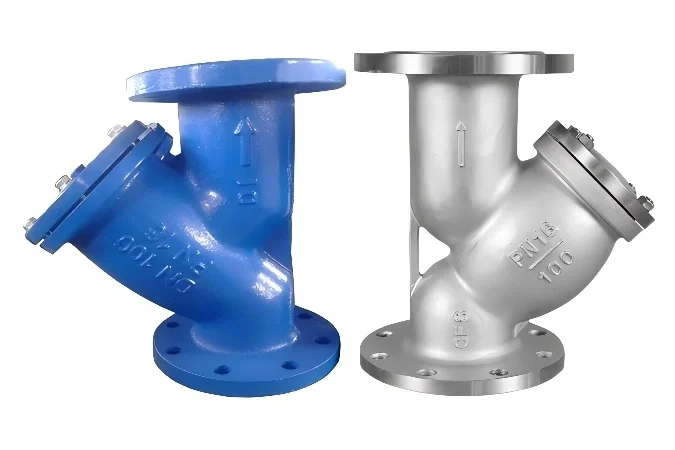
Installing your stainless steel Y strainer in the correct orientation is critical for steam system performance. The standard rule for saturated steam lines: the strainer must be installed horizontally, with the drain plug pointing horizontally to the side (not straight down), and the flow arrow on the body matching the steam flow direction.
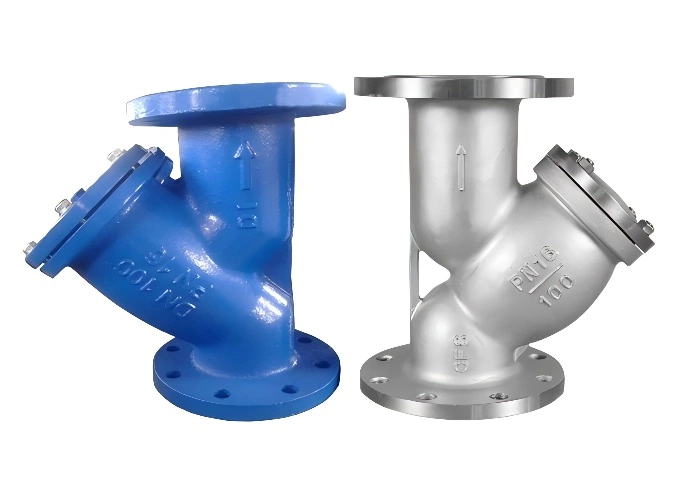
Side-mounting the pocket lets condensate, pipe scale and welding debris collect in the pocket while free condensate drains along the pipe bottom. A downward-pointing pocket in a steam line traps condensate and causes water hammer. Get orientation wrong and the strainer will clog every few weeks, back up pressure, and potentially damage downstream steam traps, control valves and heat exchangers.
2. Why Orientation Matters for Steam Systems
Steam lines carry not just dry steam but also condensate, rust particles from the pipe wall, and welding scale. If the strainer is installed with the pocket upward or on vertical downward flow, condensate and scale collect in the screen instead of draining out, causing:
- Frequent clogging (screen fills in days instead of months)
- Pressure loss across the line (reduced steam pressure at end users)
- Water hammer when accumulated condensate is suddenly swept by fast-moving steam
- Damaged downstream equipment — steam traps, control valves, ball valves and heat exchanger tube sheets
3. Horizontal vs Vertical Installation
| Service | Pocket orientation | Vertical line | Key point |
|---|---|---|---|
| Steam, horizontal main | Pocket to the side | Avoid | Pocket stays dry, condensate drains freely, longest screen life |
| Steam, vertical riser | Not recommended | Use a basket or tee arrangement | A side pocket cannot stay dry on a vertical steam line |
| Hot water / liquid | Pocket down | Acceptable, pocket down | Debris settles directly into the screen |
| Cold water | Pocket down or side | Acceptable | Standard orientation for most water systems |
| Compressed air / gas | Pocket side or down | Acceptable | Side pocket preferred on long horizontal runs |
| Orientation | Recommended? | Reason |
|---|---|---|
| Horizontal, pocket to the side | Best practice for steam | Debris settles in pocket, condensate drains freely, longest screen life |
| Horizontal, pocket straight down | Water / gas service OK | Acceptable for liquid lines but causes condensate pooling in steam |
| Horizontal, pocket up | Never | Debris falls back into the line, screen never cleans itself |
| Vertical, flow upward | Acceptable with high velocity | Only if steam velocity keeps debris against screen; requires frequent cleaning |
| Vertical, flow downward | Never | Debris falls directly into the screen and packs it solid |
Strainer Orientation by Service
4. Quick Installation Checklist
- Align the stamped flow arrow on the strainer body with steam flow direction
- Mount horizontally on pipe runs, drain plug facing horizontally to the side for steam service
- Leave 2–3 pipe diameters of straight run before and after the strainer to avoid turbulence
- Install a blow-down valve on the drain plug for easy cleaning without shutting down the system
- Install a differential pressure gauge across the strainer to know when to clean
- Keep a spare screen on site — cleaning downtime is usually 15–30 minutes
5. Worked Example: Steam Main Retrofit (Bangkok Food Plant)
Let’s walk through a real steam system retrofit at a food processing plant in Bangkok, Thailand.
Step 1 — Problem
A 4″ (DN100) saturated steam main at 10 bar carries steam to a sterilizer. The existing Y strainer was installed with the pocket pointing straight downward, and the plant reported screen clogging every 2 weeks and a steam trap that failed every 3 months.
Step 2 — Diagnosis
Site inspection found: pocket angle was wrong for steam (should be horizontal to the side), no blow-down valve, no differential pressure gauge, and the screen was 60 mesh (too fine for a 20-year-old carbon steel steam main that was shedding rust).
Step 3 — Retrofit
• Reinstalled the Y strainer with pocket pointing horizontally to the side (horizontal run)
• Replaced 60 mesh screen with 30 mesh (600 μm) — coarser, handles rust scale better
• Added a 1/2″ ball valve on the drain plug for weekly blow-down without shutdown
• Installed a differential pressure gauge across the strainer inlet/outlet
Step 4 — Result after 3 months
• Screen clogging: from every 2 weeks → every 4–5 months
• Steam trap failures: from every 3 months → zero failures
• Steam pressure at sterilizer: stable at 9.8 bar (was fluctuating 8.5–9.5 bar)
• Blow-down time: 5 minutes per week vs 1.5 hours screen cleaning every 2 weeks
Why EPC Contractors Buy Steam Y Strainers from Chuanglan
WCB / 304 / 316L Y strainers for steam up to 425°C, threaded, socket-weld and flanged from DN15 to DN300
20 / 30 / 60 mesh screens in stock, optional blow-down and differential pressure taps pre-drilled
ISO 9001:2015, shell and seat pressure tested, EN 10204 3.1 MTC, SGS / BV / Intertek inspection available
Need Help with Your Steam Strainer Installation?
Send us your steam pressure, pipe size and current orientation — our engineers will advise on the correct install, mesh and blow-down setup within 24 hours.
Get Free Sizing Report → WhatsApp us6. Common Orientation Mistakes
Mistake 1: Installing the pocket upward. Debris falls back into the steam line instead of collecting in the pocket. The strainer looks installed correctly but never actually catches anything.
Mistake 2: Installing on vertical downward flow. Gravity pushes debris directly into the screen. It clogs in days. If you must install vertically, flow must go upward — and even then, prefer a basket strainer.
Mistake 3: Installing pocket straight down on steam lines. This is the classic “it looks right” mistake. On steam, downward-pointing pockets trap condensate at the lowest point and cause water hammer. Side-mount the pocket for steam service.
Mistake 4: Forgetting the blow-down valve. Without a drain valve on the plug, every cleaning requires shutting down the line and opening the strainer. A small 1/2″ ball valve pays for itself in the first quarter.
Mistake 5: Using the wrong mesh for old steam mains. A 10-year-old carbon steel pipe sheds rust scale. A 100 mesh screen will clog weekly. Start with 20–30 mesh on old lines, move finer only after the pipe has been flushed.
7. Southeast Asia & Middle East Market Notes
Steam systems are everywhere in Southeast Asia and the Middle East — food processing, palm oil mills, textile dyeing, refineries, district heating. Two regional considerations drive steam strainer installation practice:
- Southeast Asia food & beverage (Thailand, Vietnam, Indonesia, Malaysia): Sterilizers, autoclaves and CIP systems run saturated steam at 4–10 bar. Plants prefer 304 stainless Y strainers with 30 mesh screens for cleanability and wash-down resistance. Palm oil mills in Sumatra and Peninsular Malaysia run high-pressure steam (PN40) to sterilizers — specify WCB carbon steel bodies with 60 mesh screens to handle palm fibre scale.
- Middle East refineries and petrochemical (Saudi, UAE, Qatar): Process steam at 20–40 bar for heat exchangers and tracing. Carbon steel (WCB) Y strainers with 80 mesh screens are standard. Specify flanged ends ANSI B16.5 Class 300, and always install a blow-down valve — desert plants cannot afford unplanned shutdowns.
Chuanglan Valve supplies steam-rated Y strainers to food processors, palm oil mills and refineries across Southeast Asia and the Middle East, with MOQ 1 piece and 7–15 day delivery. Every unit ships with EN 10204 3.1 MTC and a 100% pressure test certificate.
Serving EPC Contractors Across Southeast Asia & Middle East · ISO 9001:2015 · Established in 2009
Common Mistakes to Avoid
- Specifying 304 stainless for coastal or chloride service. If your project is in Southeast Asia (coastal, cooling tower, deicing salts) or the Middle East (desalination, SWRO, humid Gulf climate), 304 will pit within 1–3 years. Specify CF8M (316) or duplex 2205.
- Ignoring pressure-temperature derating. PN16 / Class 150 ratings apply at room temperature only. At 200°C the allowable pressure drops by roughly 40–50%. Always check the manufacturer’s P-T chart before specifying for steam, hot oil, or thermal fluid.
- Buying on price without MTC verification. “Stainless steel” is not enough — ask for EN 10204 3.1 MTC tied to the heat number, and arrange PMI (XRF) witness at the factory if the price is 20% below market. 304 passed off as 316L is the single most common failure in this industry.
- Forgetting face-to-face and flange drilling. A “PN16” wafer valve from one manufacturer may not match the existing flange drilling or face-to-face of another. Always confirm dimensions against EN 558 / API 609 / ASME B16.10 before replacing an installed valve.
Steam lines usually have a check valve ahead of the trap set, and its mounting rules are not the strainer rules. See check valve installation orientation on steam and condensate lines.
FAQ
Can a Y strainer be installed vertically on a steam line?
Only with upward flow and only if steam velocity exceeds 25 m/s. For downward vertical flow, never use a Y strainer — install a basket strainer instead. Best practice for steam is always horizontal with the pocket pointing to the side.
Which way should the drain plug face on a steam Y strainer?
Horizontally to the side, not straight down. Downward pockets in steam lines trap condensate and cause water hammer. Side-mounting lets condensate drain along the pipe bottom while debris collects in the pocket.
Do I need a blow-down valve on a steam strainer?
Yes. A small 1/2″ or 3/4″ ball valve on the drain plug lets you blow accumulated condensate and scale out weekly without shutting down the line. Without it, every cleaning requires a full shutdown and manual screen removal.
What mesh size is best for saturated steam?
20–30 mesh (600–850 μm) for general steam service on new or flushed piping. Use 60–80 mesh only for protecting sensitive instruments or control valves. On old carbon steel mains, start with 20 mesh to avoid weekly clogging.
How often should I clean a steam Y strainer?
Use a differential pressure gauge as the trigger, not the calendar. Typical interval: every 3–6 months on well-flushed systems, every 2–4 weeks on new piping. Clean when ΔP rises above 0.3 bar (5 PSI) across the strainer.
What material should I use for steam Y strainers?
Carbon steel (WCB) bodies are standard for steam up to 425°C. Use 304 (CF8) or 316 (CF8M) stainless only if the steam carries corrosive chemicals or is in a food/pharmaceutical wash-down environment.
How close can a steam strainer be installed to a valve or elbow?
Leave 2–3 pipe diameters of straight run upstream and 1–2 downstream. Installing too close to an elbow, control valve or tee causes turbulence that vibrates the screen and accelerates wear.
References & Standards
- ASME B16.34: Valves — Flanged, Threaded, and Welding End
- MSS SP-80: Y-Strainers — Dimensions, testing and marking
- API 598: Valve Inspection and Testing
- EN 12516: Industrial valves — Shell design strength
- EN 10204 3.1: Metallic products — inspection documents (MTC)
Related Products
Continue Reading
Request a Quotation — Reply Within 24 Hours
Send your line size, pressure rating, medium and quantity. Our engineers come back with price, drawing and lead time — no obligation.
Get a Quote for Your Steam Strainer Project
MOQ: 1 piece · ISO 9001:2015 · 3.1 MTC included · shell and seat pressure tested
Southeast Asia: Indonesia, Malaysia, Thailand, Vietnam, Singapore, Philippines, Myanmar
Middle East: Saudi Arabia, UAE, Qatar, Kuwait, Oman, Bahrain
Other Regions: Europe, North America, South America, Africa, Australia
Delivery: 5–10 days to Southeast Asia · 15–20 days to the Middle East · 25–35 days to Europe / the Americas
Payment: T/T 30% deposit + 70% before shipment · L/C at sight · Warranty: 12 months after shipment for material and manufacturing defects · Packing: export plywood case / fumigation-free pallet · Shipping: FOB Ningbo/Shanghai · Documents: EN 10204 3.1 MTC + packing list + commercial invoice · Third-party inspection welcome: SGS / Bureau Veritas / Intertek
Contact Our Engineers »