
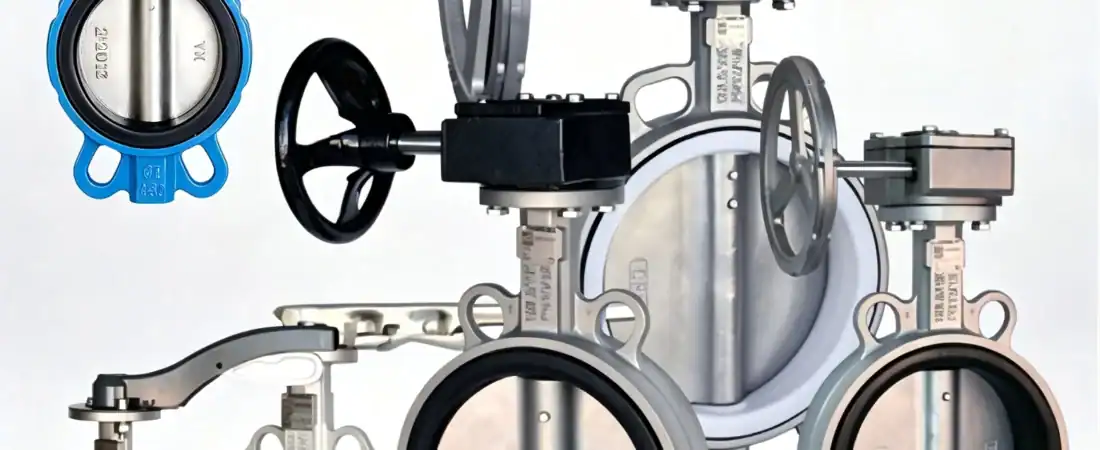
Wafer Butterfly Valve: A Complete Guide for Buyers
The complete 2026 buyer’s guide to wafer butterfly valves — what they are, wafer vs flanged comparison, key specifications to RFQ (size, pressure, body, disc, liner, actuation), liner material guide (EPDM / NBR / Viton / PTFE / silicone), body material options (cast iron / ductile iron / stainless), common applications, pros and cons, buying mistakes to avoid, and Southeast Asia / the Middle East market notes for water treatment, HVAC, and petrochemical projects.
* Standard lead time depends on order quantity and destination country. 5–10 days to Southeast Asia, 15–20 days to the Middle East.

Quick Answer
A wafer butterfly valve is a thin, compact, quarter-turn valve sandwiched between two pipe flanges — the lowest-cost and lightest option for large-size (DN100+) isolation and mid-flow throttling on water, HVAC, cooling-tower, and mild chemical service. For most general water duty, specify ductile-iron (GGG50) epoxy-coated body, 316 stainless disc, EPDM liner, PN16. Upgrades to make in coastal / the Middle East service: (1) never cast iron — it rusts in Gulf humidity; (2) never standard EPDM on chlorinated cooling water — use peroxide-cured EPDM; (3) never cast-iron disc — it pits within 1–2 years. For seawater / brine, step up to 2205 duplex body and disc. Wafer is the value pick for space-limited large lines; use flanged butterfly when the valve must be removed without disturbing adjacent flanges.
Key Takeaways
- Body: Ductile iron (GGG50) epoxy-coated = standard · cast iron = budget indoor only · CF8M / 2205 = corrosive / seawater.
- Liner: EPDM = water · NBR = oil · Viton = high temp / chemical · PTFE = strong acid · silicone = food.
- Chlorinated cooling water? → Peroxide-cured EPDM, not standard EPDM.
- Throttling: Butterfly = good in 30–70% open band; avoid sustained operation below 20% open.
On This Page
1. What Is a Wafer Butterfly Valve?
| Feature | Wafer Butterfly Valve | Flanged Butterfly Valve |
|---|---|---|
| Face-to-Face Length | compact (EN 558 Series 20) | Longer (EN 558 Series 14) |
| Weight | Light (30–50% lighter) | Heavier |
| Installation | Between two flanges (bolts pass through) | Bolted directly to pipe flanges |
| Relative Cost | Lower | Higher |
| Best For | Space-limited installations, large sizes | Maintenance removal, high pressure |
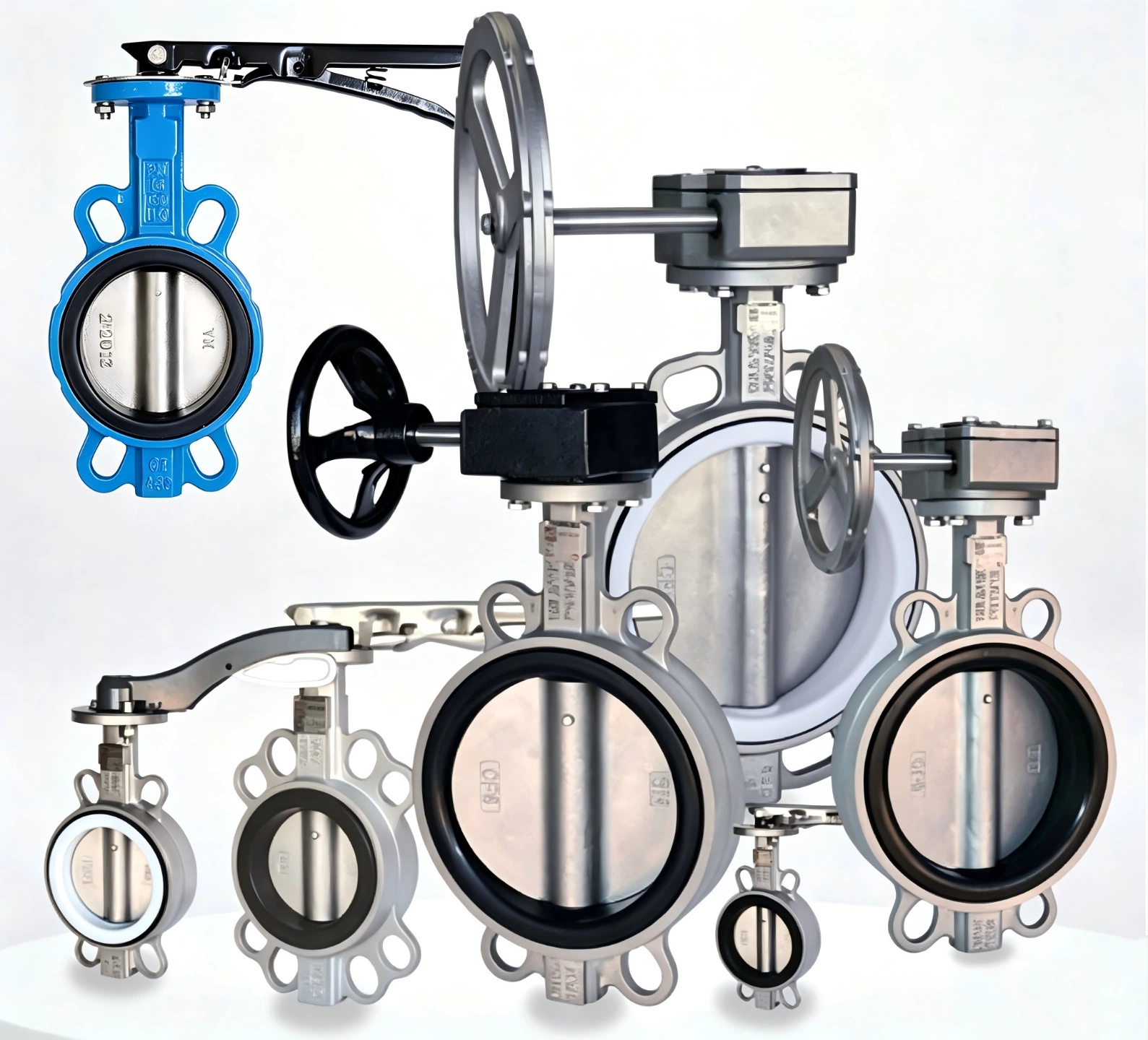
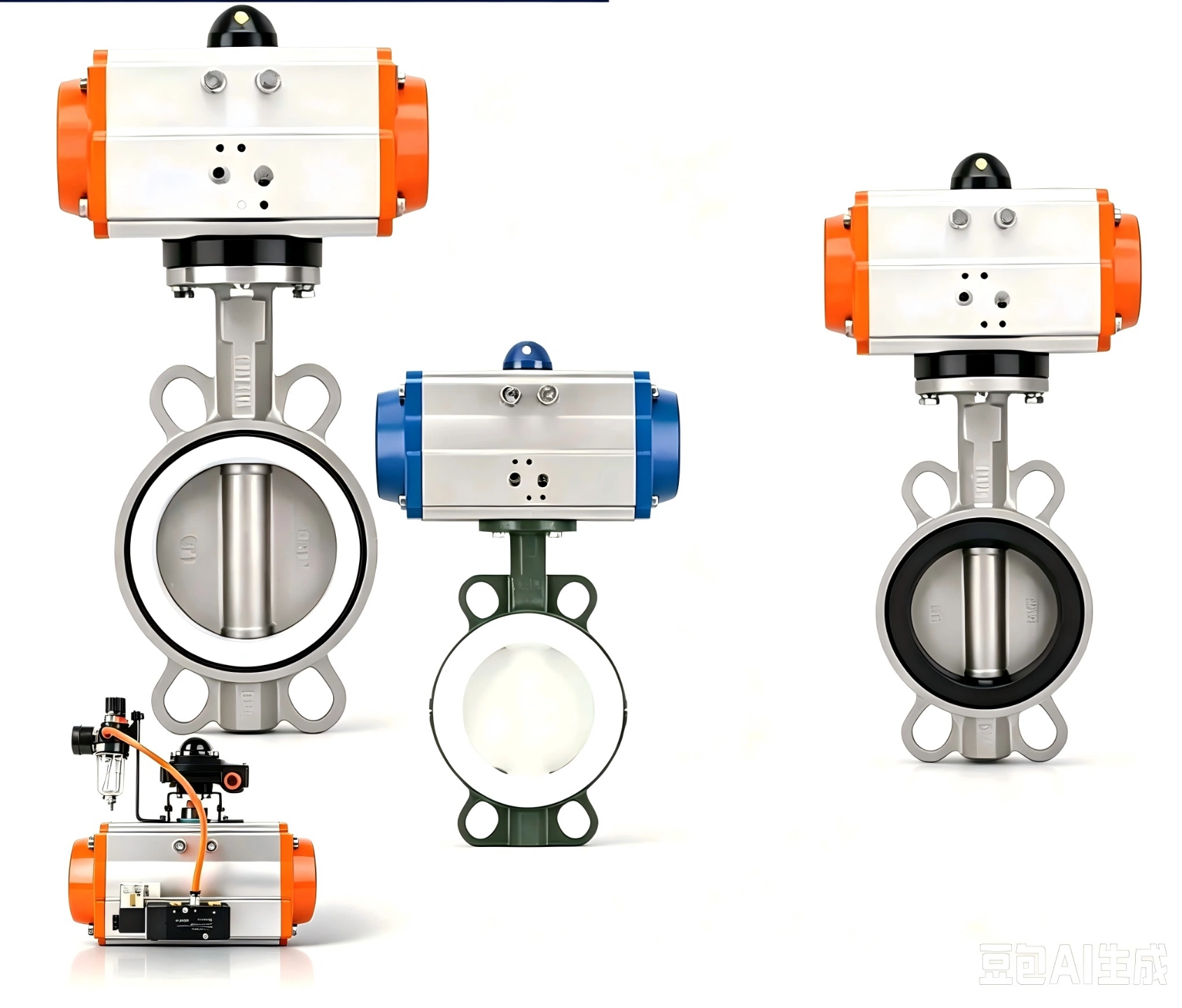
A wafer butterfly valve is a quarter-turn valve that uses a circular disc (the “butterfly”) to control flow. The disc rotates 90 degrees to open or close the valve. “Wafer” means it’s designed to be sandwiched between two pipe flanges — it’s compact and compact. For automated applications, see our pneumatic wafer butterfly valves.

2. Key Specifications to Specify in the RFQ
| Specification | What to Specify | Example |
|---|---|---|
| Size | Nominal diameter (DN) | DN100 (4″) |
| Pressure Rating | PN or Class | PN16 / Class 150 |
| Body Material | Cast iron / ductile iron / stainless | Ductile iron (GGG50) / CF8M |
| Disc Material | Same as body, or coated (nickel, PTFE) | CF8M / 316 SS |
| Liner Material | EPDM / NBR / PTFE / Viton | EPDM (for water) |
| Actuation | Handle / gear / pneumatic / electric | Handle lever / gear operator |
| Standard | EN 593 / API 609 / ASME B16.5 | EN 593 / API 609 |
When you send an RFQ for a wafer butterfly valve, include these specifications — otherwise you’ll get wrong quotes:
3. Liner Material Guide: Which One Do You Need?
The liner is the most important part of a wafer butterfly valve — it’s what seals against the disc. Choose the wrong liner and the valve will fail quickly.
| Liner Material | Temperature Range | Best For |
|---|---|---|
| EPDM | -40°C to +120°C | Water, HVAC, swimming pools, CIP |
| NBR (Buna-N) | -20°C to +90°C | Oil, fuel, grease, hydraulic fluid |
| Viton (FKM) | -20°C to +180°C | High temperature, chemicals, oil |
| PTFE | -50°C to +200°C | Strong chemicals, corrosive media |
| Silicone | -60°C to +200°C | Food, beverage, high-temp CIP |
Most common choice: EPDM liner for water and general industry (roughly 70% of applications). NBR for oil and fuel. PTFE for chemicals. For hygienic food / beverage service, always use the sanitary butterfly valve with tri-clamp ends and silicone liner.
4. Body Material Options
| Body Material | Relative Cost | Best For |
|---|---|---|
| Cast Iron (GG25) | Lowest | HVAC, indoor water treatment, clean dry air |
| Ductile Iron (GGG50) | Medium | Most common, PN16 / PN25, general industry |
| Stainless Steel CF8 / CF8M | Higher | Corrosive, food / pharma, outdoor / coastal |
Rule of thumb: For most industrial applications, ductile-iron body + EPDM liner + stainless disc is the best value. Upgrade to stainless body only if you need corrosion resistance. For large transmission mains, also see flanged butterfly valves for easier maintenance removal.
5. Worked Example: Dammam Cooling Water Line Failure
Step 1 — Problem
A petrochemical plant in Dammam, Saudi Arabia (SABIC affiliate, Eastern Province) operated a 12,000 m³/h cooling-water system serving three reactor trains. The cooling-water line (treated seawater-influenced makeup, chlorinated to 2 ppm free chlorine) used 12 × DN250 PN16 wafer butterfly valves on the heat-exchanger isolation lines. The EPC contractor had specified the lowest-cost cast-iron (GG25) wafer butterfly valves with standard EPDM liner and cast-iron disc. After 14 months of operation, maintenance found: (1) 8 valves weeping at the body-flange joint; (2) external rust on the cast-iron bodies (Dammam ambient 50°C in summer, 80% humidity from the Gulf); (3) EPDM liners hardened and cracked around the bore (chlorine attack); (4) cast-iron discs pitted. During a routine inspection, one valve failed to seal, sending warm cooling water back into a reactor train. The reactor had to be shut down for 18 hours.
Step 2 — Root cause analysis
Three spec mistakes compounded:
• Cast-iron body (GG25) instead of ductile iron (GGG50) — cast iron is brittle and rusts badly in coastal Middle East humidity. Ductile iron is roughly 3–5× stronger and can be epoxy-coated for outdoor service.
• Cast-iron disc instead of 316 stainless — a cast-iron disc in chlorinated cooling water pits within 12–18 months.
• Standard EPDM liner instead of peroxide-cured EPDM — 2 ppm free chlorine attacks standard EPDM, hardening and cracking it.
The lower unit price looked attractive on the procurement PO, but it set up a single-point failure on reactor isolation.
Step 3 — Correct retrofit
All 12 × DN250 PN16 wafer butterfly valves were replaced with: ductile-iron GGG50 body (epoxy-coated 250 micron), CF8M 316 stainless disc, peroxide-cured EPDM liner (chlorine-resistant), 316 SS shaft, gear operator. Same wafer dimensions per EN 558 Series 20 and EN 1092 PN16 flange drilling — no pipe modification needed.
Step 4 — Outcome
• The retrofit was a bolt-in swap on the existing flanges — half a day per valve during scheduled outages
• Weeping stopped immediately; external rust did not return after the epoxy coating cured
• Cooling-water temperature returned to spec and reactor isolation held tight through the next summer peak
• The valve upgrade was a small fraction of the cost of a single 18-hour reactor trip and the associated production loss
• Lesson: for outdoor the Middle East service, chlorinated cooling water, or any coastal application — never use cast-iron body. Specify ductile iron (GGG50) epoxy-coated body, 316 stainless disc, and peroxide-cured EPDM (or Viton) liner.
Why EPC Contractors Specify Wafer Butterfly Valves with Chuanglan
Wafer / flanged / lug-type · ductile iron / CF8M / 2205 duplex · DN50–DN1600 · PN10–PN40 / Class 150–300
EPDM / peroxide EPDM / NBR / Viton / PTFE / silicone / Hypalon liners · manual gear, pneumatic or electric actuator
EN 593 · API 609 · AWWA C504 · full EN 10204 3.1 MTC · third-party inspection (SGS / BV / Intertek) on request
Need Help Selecting the Right Wafer Butterfly Valve?
Tell us your pipe size, pressure, medium (water / cooling tower / HVAC / chemical), temperature, ambient conditions (outdoor / coastal / desert), and whether you need manual or pneumatic actuation — our engineers will recommend the right spec within 24 hours.
Get Free Sizing Report → WhatsApp us6. Common Applications
Wafer butterfly valves are used in almost every industry:
- Water treatment plants — inlet / outlet, filtration, chemical dosing
- HVAC systems — chilled water, hot water, condenser water
- Chemical industry — corrosive fluids (with PTFE liner)
- Food & beverage — milk, beer, juice (with silicone / EPDM liner, sanitary version)
- Power plants — cooling water, condensate, auxiliary systems
- Mining & slurry — slurry, sludge, viscous media
- Marine — seawater, bilge, ballast (with 316 SS body)
7. Pros & Cons of Wafer Butterfly Valves
Pros:
- Lowest cost of any isolation valve (especially large sizes)
- Lightweight and compact
- Easy to install (sandwiched between flanges)
- Fast operation (90° turn)
- Good for throttling flow in the mid-range
- Large sizes available (up to DN1200+)
- Low maintenance
Cons:
- Not bubble-tight shutoff (minor leakage possible)
- Disc is in the flow path (pressure drop)
- Lower pressure rating (usually max PN40 / Class 300)
- Not good for high-cycle operation
- Liner material limits temperature and chemical resistance
8. Common Buying Mistakes to Avoid
Mistake 1: Buying based on price only. Low-cost wafer butterfly valves often use thin castings and poor-quality liners that harden and crack in 1–2 years. Spend a little more for ductile-iron body and a good EPDM liner — it lasts 10+ years.
Mistake 2: Wrong liner for the medium. EPDM is fine for water, but it swells in oil. If you’re handling oil or fuel, use NBR or Viton liner. Always specify the liner material, not just “butterfly valve”. For chlorinated cooling-tower water, specify peroxide-cured EPDM.
Mistake 3: Forgetting the flange standard. Wafer butterfly valves must match your flange standard (EN 1092, ASME B16.5, JIS B2220). The bolt-hole circle must line up. Always specify your flange standard when ordering.
9. Southeast Asia & Middle East Market Notes
For clients in Southeast Asia (Thailand, Vietnam, Indonesia, Malaysia, Philippines), wafer butterfly valves are the standard for municipal water (MWA Bangkok, PWA Thailand, Saigon Water, PDAM Jakarta, Syarikat Air Johor) in sizes DN200–DN1200 — ductile-iron body, EPDM liner, 316 disc, gear operator. The tropical humidity (30°C+, 80% RH) means cast-iron bodies rust externally within 2–3 years; always specify epoxy-coated ductile iron for outdoor installations. Thai and Malaysian HVAC contractors use wafer butterfly valves on chilled-water systems (EPDM liner is correct; NBR is wrong for water). Indonesian palm-oil mills specify Viton liners for oil service and PTFE liners for acid-based cleaning. Vietnamese water-treatment plants increasingly specify wafer butterfly valves over gate valves for large isolation (roughly 50% lower cost, lighter, easier to install). For food and beverage, use sanitary tri-clamp butterfly valves with silicone liner, not industrial flanged.
For clients in the Middle East (Saudi Arabia, UAE, Qatar, Kuwait, Oman, Bahrain), wafer butterfly valves are specified by Saudi Aramco, SABIC, SEC, DEWA, ADNOC, Qatar Energy. Middle East water-transmission networks (NWC Saudi, DEWA Dubai, ADWEA Abu Dhabi) use large-size wafer butterfly valves (DN600–DN1600) on transmission mains — epoxy-coated ductile iron, EPDM liner, 316 disc, gear operator. The 50°C summer ambient and Gulf humidity demand external epoxy coating and UV-resistant liners. Cooling-tower systems (common in petrochemical and power plants) require peroxide-cured EPDM liner to resist 2–5 ppm chlorine. SWRO desalination plants (Jubail, Yanbu, Ras Al Khair, Taweelah, Sohar) use 2205 duplex or super-duplex wafer butterfly valves on seawater / brine lines — cast iron and even 316 are not sufficient. The Dammam case above is typical for the Eastern Province.
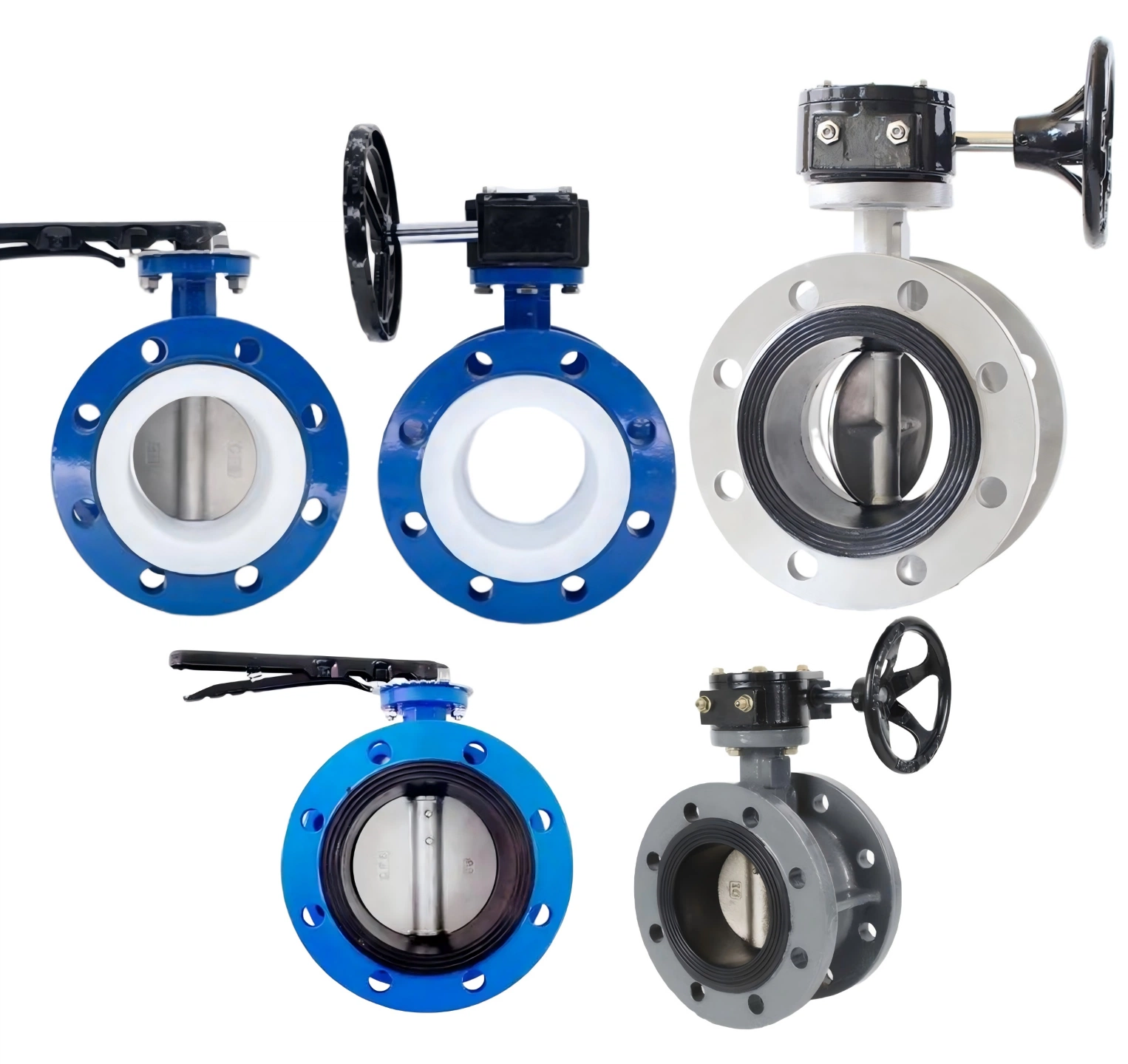
Chuanglan Valve supplies wafer butterfly valves (cast iron / ductile iron / CF8M, EPDM / NBR / Viton / PTFE / silicone liners), pneumatic wafer butterfly valves, flanged butterfly valves, and sanitary tri-clamp butterfly valves — with full EN 10204 3.1 MTC certificates, EN 593 / API 609 compliance, and third-party inspection (SGS / BV / Intertek). Serving EPC Contractors Across Southeast Asia & Middle East · ISO 9001:2015 · Established in 2009 · MOQ 1 piece.
FAQ
What is the difference between wafer and flanged butterfly valves?
Wafer butterfly valves are thin (EN 558 Series 20) and sandwiched between two pipe flanges — they are 30–50% lighter and lower cost. Flanged butterfly valves have their own flanges and bolt directly to the pipe — they are easier to remove for maintenance, have longer face-to-face (EN 558 Series 14), and can hold higher pressure. Use wafer for large space-limited installations; use flanged when the valve needs regular removal or when one side of the flange must be isolated independently.
What pressure rating do wafer butterfly valves come in?
Standard wafer butterfly valves are rated PN10 / PN16 / Class 150 for most sizes (DN50–DN600). PN25 / Class 300 versions are available for larger sizes (DN300+). PN40 / Class 600 is uncommon for wafer design above DN200 — for higher pressure use flanged or double-offset butterfly valves. Always check the manufacturer’s pressure-temperature derating curve for high-temperature service.
Can a wafer butterfly valve be used for throttling or flow control?
Yes — butterfly valves are one of the best throttling valve types in the mid-flow range (30–70% open). They have a stable flow characteristic and handle a wide range of flow coefficients. However, avoid sustained operation below 20% open (high velocity causes disc vibration and seat erosion) and above 90% (no control benefit). For precise continuous modulation, use a pneumatic actuator with positioner.
Why does my wafer butterfly valve leak when closed?
Common causes: (1) liner hardened / cracked from age, heat, or chemical attack — replace liner; (2) disc pitted or coated with debris — clean or replace disc; (3) valve not centered between flanges (wafer must be perfectly aligned) — realign and evenly torque bolts; (4) flange gasket pushed into bore during installation — use the correct wafer gasket; (5) body warped from over-torqued flange bolts — torque in diagonal sequence per spec.
What liner should I use for cooling tower water with chlorine?
Standard EPDM liner attacks from free chlorine (>1 ppm) within 1–2 years. Specify peroxide-cured EPDM (chlorine-resistant, rated for 5 ppm chlorine) or, for extreme chlorine service, Hypalon (CSM) liner. Avoid NBR or Viton — they do not handle chlorinated water well. The disc must be 316 stainless (not cast iron or ductile iron) to resist pitting.
Can a wafer butterfly valve be installed vertically?
Yes — wafer butterfly valves work in any orientation (horizontal, vertical, inverted). Unlike swing check valves, butterfly-valve operation does not depend on gravity. The only consideration is that heavier large-size valves (DN600+) need external support to prevent the flange from carrying the valve weight. Stem-up orientation is preferred for manual operation, but not required.
What is the lead time from Chuanglan for wafer butterfly valves?
Standard sizes (DN50–DN300, PN16, ductile iron, EPDM, 316 disc, handle / gear) are in stock and ship in 7–15 days. Large sizes (DN350–DN1200), CF8M stainless bodies, PTFE / Viton / silicone liners, pneumatic or electric actuation, ISO 15156 sour service, and 2205 duplex for seawater take 15–30 days. Full EN 10204 3.1 MTC and dimensional drawings are included with every shipment.
References & Standards
- API 609: Butterfly Valves: Double- Flanged, Lug, and Wafer Type
- EN 593: Industrial valves — metallic butterfly valves for general applications
- AWWA C504: Rubber-Seated Butterfly Valves (water service)
- EN 558: Dimensions of face-to-face and end-to-end lengths (Series 14 flanged, Series 20 wafer)
- EN 1092: Flanges and their joints — circular flanges for PN-rated pipework
- ISO 15156: Sour-service materials for oil & gas production
Related Products
Continue Reading
Request a Quotation — Reply Within 24 Hours
Send your line size, pressure rating, medium and quantity. Our engineers come back with price, drawing and lead time — no obligation.