
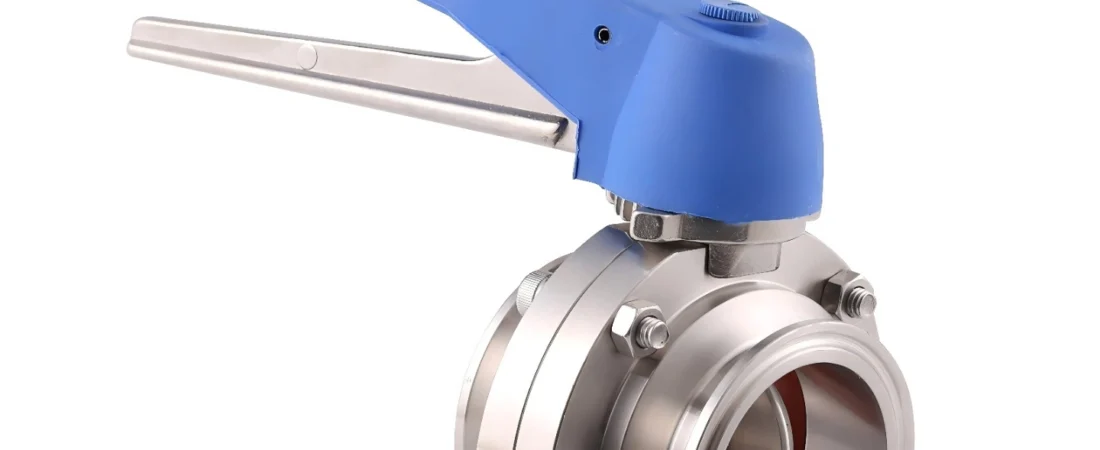
Sanitary Butterfly Valve: Tri-Clamp, CIP/SIP & 3A Guide
The complete 2026 guide to hygienic sanitary butterfly valves — tri-clamp vs weld, EPDM / silicone / PTFE liners, actuation options, 3A / EHEDG hygienic design, CIP / SIP compatibility, and buying checklist for dairy, beverage, pharma and biotech projects in Southeast Asia and the Middle East.
* Standard lead time depends on order quantity and destination country. 5–10 days to Southeast Asia, 15–20 days to the Middle East.

Quick Answer
A sanitary butterfly valve is a 316L, electropolished (Ra ≤ 0.4 μm), tri-clamp butterfly valve with an FDA 21 CFR 177 style EPDM / silicone / PTFE liner — designed for dairy, beverage, pharma and biotech lines. For about 90% of hygienic projects, the manual tri-clamp valve with an EPDM liner (DN40–DN100) is the default. Use pneumatic actuation for automated CIP / SIP sequencing, and switch to a sanitary ball valve only when you need tight shutoff or PN25+ pressure. Never use an industrial wafer butterfly valve with bolted flanges on a hygienic line — the bolt holes trap product and cannot be CIP cleaned.
Key Takeaways
- Connection: tri-clamp = 90% of hygienic use · butt-weld = pharma / WFI only · industrial wafer = avoid.
- Liner: EPDM = CIP (80–90 °C) · silicone = SIP (121–130 °C) · PTFE = chemicals · FKM = oils / fats.
- Pressure: PN10 / PN16 standard (drops to ~8–10 bar at 121 °C SIP) · PN25+ → use sanitary ball valve.
- CIP position: hold disc at 30–40% open during CIP — fully closed creates a dead leg.
On This Page
1. What Is a Sanitary Butterfly Valve?
Sanitary butterfly valves are the most common valve in food, beverage, and pharmaceutical piping systems — they’re compact, lightweight, easy to clean, and work for large-diameter hygienic piping. But there are specific hygienic design requirements that regular industrial butterfly valves don’t meet. As a sanitary valve manufacturer with export experience since 2009, we’ll walk you through everything you need to know.
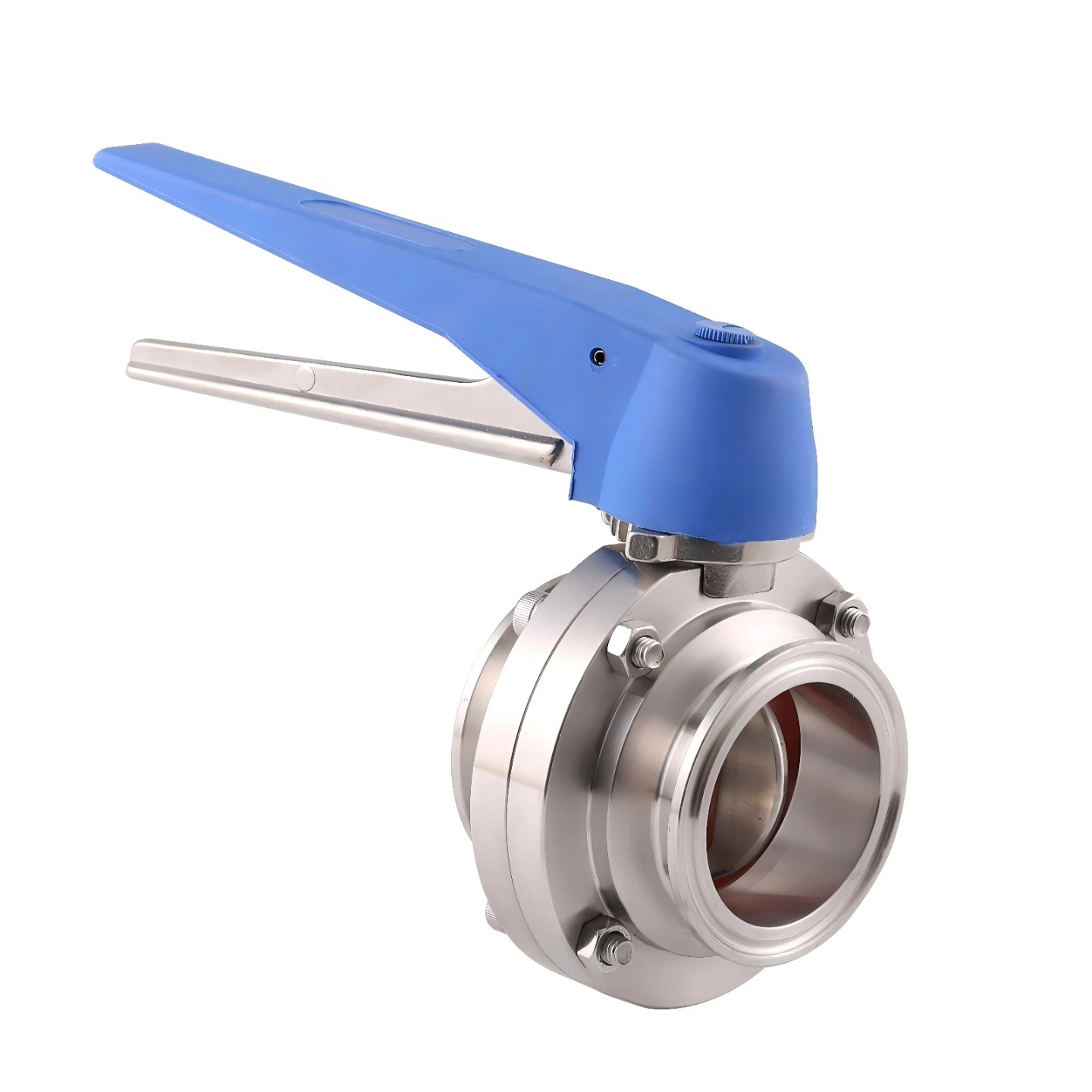
A sanitary butterfly valve is a wafer-style butterfly valve designed for hygienic applications (food, beverage, pharma, biotech). It looks like a regular butterfly valve, but with key hygienic design differences:
- All wetted parts are 316L stainless steel
- Internal surfaces electropolished (Ra ≤ 0.4 μm food / Ra ≤ 0.25 μm pharma)
- No crevices or dead legs — nowhere for product to trap
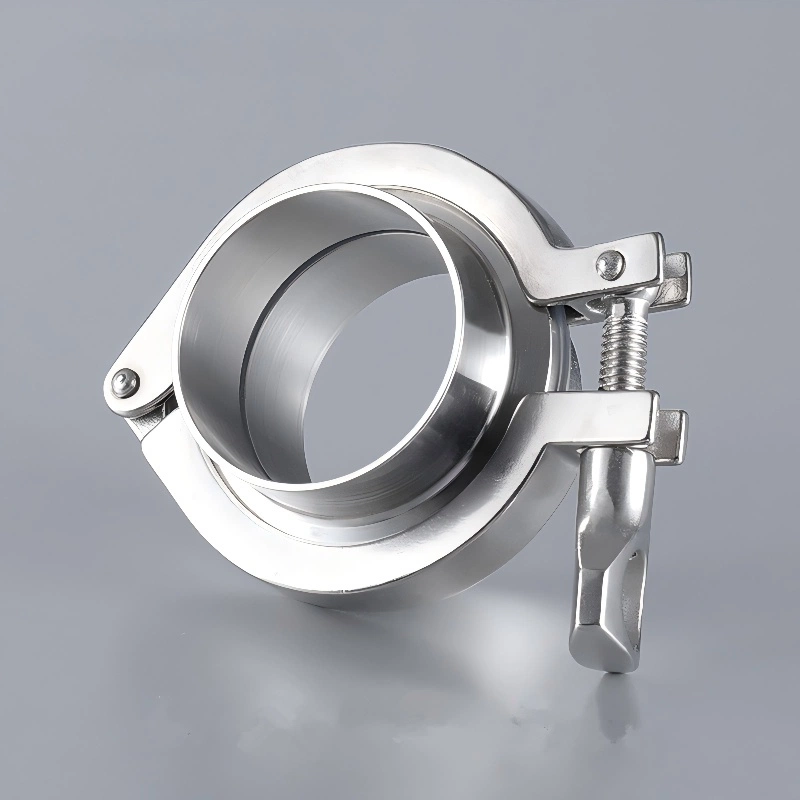
- Tri-clamp end connections (no threaded flanges)
- FDA 21 CFR 177 style EPDM, silicone, or PTFE liner
- 3A or EHEDG rated hygienic design
Sanitary butterfly valves are ideal for large-diameter hygienic piping (DN25–DN300), where ball valves would be disproportionately expensive. They’re the standard in dairy, beer, juice, and biotech processing. For non-hygienic industrial service, see our wafer butterfly valves.
2. Wafer vs Tri-Clamp vs Weld
| Connection Type | Description | Best For |
|---|---|---|
| Tri-Clamp | Sanitary clamp ends, gasket between clamps | Most common · food & beverage · easy disassembly |
| Weld (Butt-Weld) | Welded directly to pipe, permanent joint | Pharma, biotech, ultra-hygienic systems |
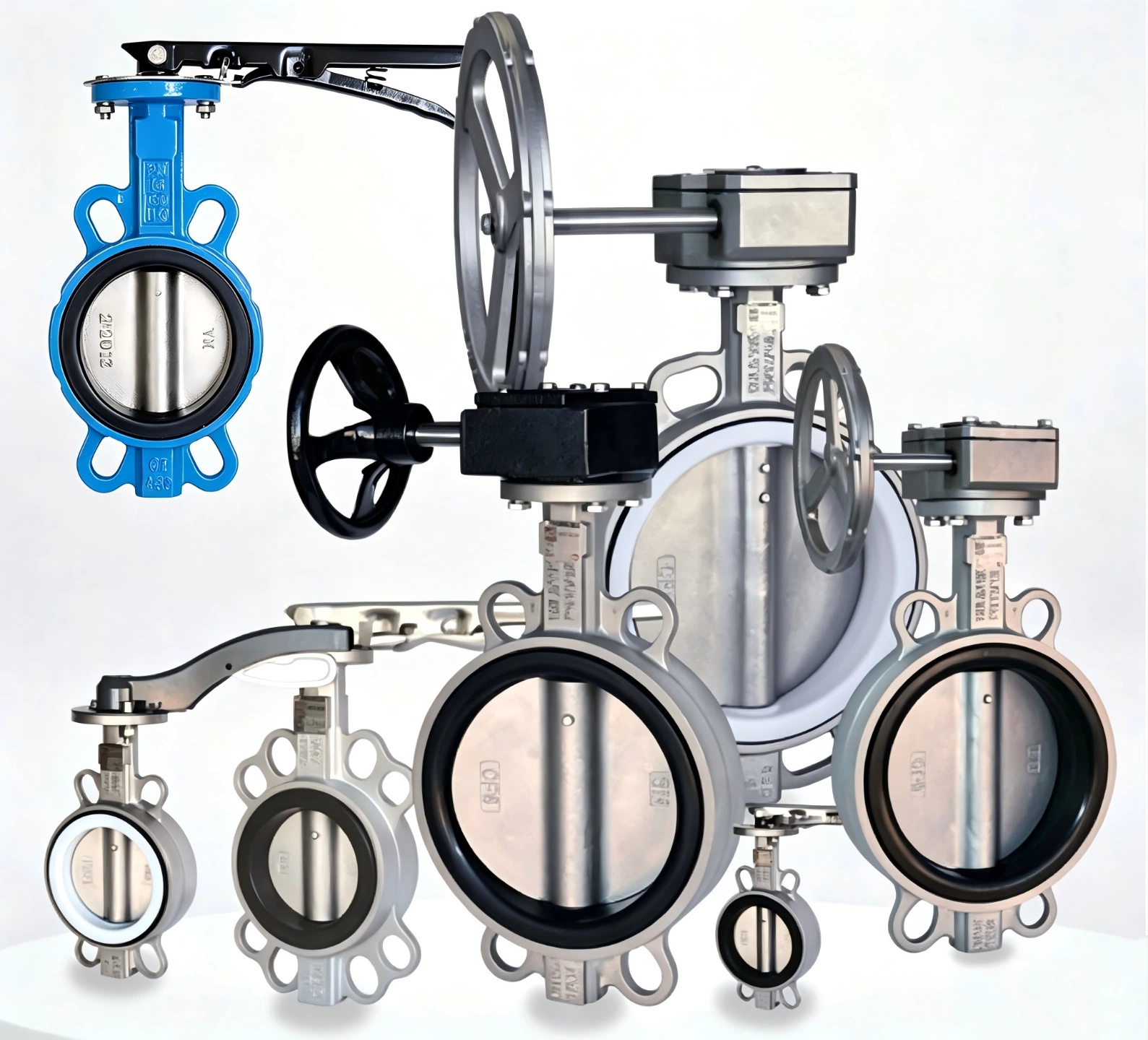
| Wafer (Industrial) | Sandwiched between flanges, bolt holes | Not recommended for hygienic use — crevices |
Most common choice: Tri-clamp sanitary butterfly valve (about 90% of all sanitary butterfly valves sold). Easy to install, remove, and clean. Use weld only for pharma / biotech where permanent joints are required. Pair with sanitary unions and fittings.
3. Liner (Seat) Materials
| Liner | Temperature Range | FDA 21 CFR 177 | Best For |
|---|---|---|---|
| EPDM | −40 °C to +150 °C | Yes | Dairy, beer, juice, CIP cleaning (most common) |
| Silicone (VMQ) | −60 °C to +200 °C | Yes | High-temperature CIP, hot filling, ovens |
| PTFE | −200 °C to +200 °C | Yes | Chemicals, high temperature, abrasive products |
| FKM (Viton) | −20 °C to +180 °C | Yes | Oils, fats, acidic products |
Most common choice: EPDM liner for dairy, beer, juice, and general CIP (about 80% of applications). Silicone for ultra-high temperature / SIP. PTFE for chemicals. FKM for oily / fatty products (e.g. palm oil food lines).
4. Hygienic Design Requirements
Not all “sanitary” butterfly valves are actually hygienic. Look for these design features:
- Full port design — no step between pipe and valve bore
- Electropolished internal surface — Ra ≤ 0.4 μm (food) / Ra ≤ 0.25 μm (pharma)
- No crevices — no gaps where product can trap
- Seat is flush with pipe wall — no dead space behind seat
- Tri-clamp ends — no threads, no bolt holes in product contact area
- 3A or EHEDG certification — third-party verified hygienic design
Avoid: Industrial wafer butterfly valves with bolt holes in the body — they have crevices where bacteria can grow, and they’re not truly hygienic.
5. Worked Example: Dairy Plant CIP Valve Retrofit (Chiang Mai, Thailand)
Step 1 — Problem
A 200,000 L/day dairy plant in Chiang Mai, Thailand had recurring bacterial contamination in their pasteurized milk line. Monthly swab tests at the CIP return valve position kept showing total plate count (TPC) above 10 CFU/cm² — the limit was 1 CFU/cm². Two batches of yogurt (3,000 L each) had to be discarded — a measurable loss of product.
Step 2 — Root cause
The plant was using DN80 (3″) industrial wafer-style butterfly valves (cast-iron body, NBR liner, bolted flange ends). Audit found: (1) bolt holes in the body trapped milk residue and were impossible to CIP clean; (2) NBR liner was not FDA 21 CFR 177 style and had degraded; (3) the body was not electropolished — Ra measured 1.6 μm, well above the 0.4 μm hygienic requirement.
Step 3 — Retrofit
• Replaced 12 × DN80 industrial wafer valves with 316L sanitary tri-clamp butterfly valves (EPDM liner, Ra 0.4 μm electropolished)
• Upgraded 4 of them to pneumatic actuated sanitary butterfly valves for automated CIP sequencing
• Paired with matching 316L tri-clamp unions for easy disassembly inspection
• Added sanitary check valves on the CIP return to prevent backflow
Step 4 — Result after 6 months
• Swab tests: TPC consistently below 1 CFU/cm² — zero contamination incidents
• CIP cycle time reduced from 45 min to 30 min (smooth internal surfaces clean faster)
• The plant recovered the lost product and production time entirely
• Total retrofit cost was recovered in roughly 3 months of avoided batch discards
Why EPC Contractors Specify Sanitary Butterfly Valves with Chuanglan
316L sanitary butterfly valves · DN25–DN300 · tri-clamp / weld ends · EPDM / silicone / PTFE / FKM liners
Manual handle, worm gear, pneumatic rack-and-pinion, or pneumatic + positioner · 3A / EHEDG / DIN 11850
ISO 9001:2015 · shell and seat pressure tested · EN 10204 3.1 MTC · FDA 21 CFR 177 style liner certificates
Need a Sanitary Butterfly Valve Quote?
Send us your size, liner material, connection type, and actuation preference — our engineers will recommend the right configuration within 24 hours.
Get Free Sizing Report → WhatsApp us6. Actuation Options
| Actuation | Best For | Notes |
|---|---|---|
| Handle (Manual) | Small sizes, occasional operation | Cheapest, simple, no air needed |
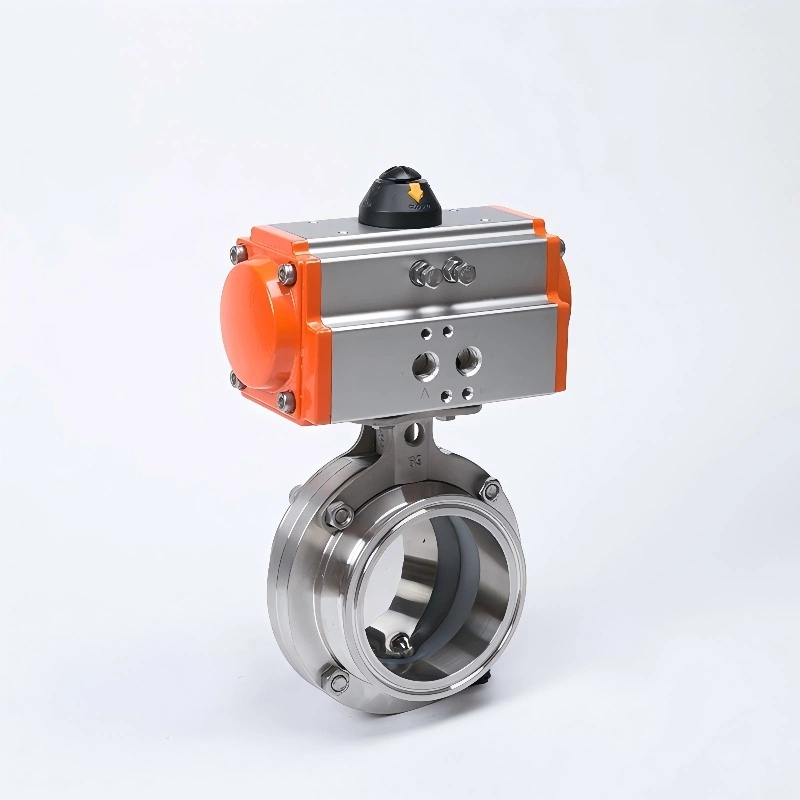
| Pneumatic Actuator | Automated CIP / SIP, production lines | Most common automated option for sanitary valves |
| Pneumatic + Positioner | Flow control / throttling | Modulates flow (0–100%) for blending, dosing |
| Worm Gear | Large sizes (DN150+), high torque | Manual but easier for large valves |
For automated CIP / SIP systems, pneumatic sanitary butterfly valves are the standard. For tight shutoff in dosing applications, also see our sanitary ball valves and pneumatic sanitary ball valves.
7. CIP & SIP Compatibility
Sanitary butterfly valves must be compatible with CIP (Clean-In-Place) and SIP (Sterilize-In-Place):
CIP (Clean-In-Place): Cleaned in place with hot water (80–90 °C), caustic soda (NaOH 2–5%), and acid (nitric). EPDM and silicone liners are resistant to these chemicals.
SIP (Sterilize-In-Place): Sterilized with saturated steam at 121 °C for 30+ minutes. EPDM and silicone liners withstand repeated SIP cycles. PTFE is also fine but harder on the liner.
Important: When the valve is fully closed during CIP / SIP, the liner and disc are exposed to cleaning chemicals. Make sure the liner material is compatible with your cleaning chemicals. Also hold the disc at 30–40% open during CIP so cleaning solution reaches both sides.
8. Southeast Asia & Middle East Market Notes
For clients in Southeast Asia (Thailand, Vietnam, Indonesia, Malaysia, Philippines) working on dairy, beer, juice, and food processing, 316L tri-clamp sanitary butterfly valves with EPDM liners are the default. Thai dairy plants (Chiang Mai, Khon Kaen), Vietnamese breweries (Ho Chi Minh, Da Nang), and Malaysian palm-oil food-grade processing all specify 3A or DIN 11850 compliant sanitary butterfly valves. Indonesian pharma projects (Jakarta) increasingly request electropolished Ra ≤ 0.25 μm with silicone liners for WFI loops.
For clients in the Middle East (Saudi Arabia, UAE, Qatar, Kuwait, Oman, Bahrain) working on dairy (Almarai and similar), bottled water, juice, and pharma, 316L is the default due to the coastal saline environment. Saudi Vision 2030 local food manufacturing projects commonly specify EHEDG rated sanitary butterfly valves with full 3.1 material certificates. UAE dairy and juice plants (Dubai, Abu Dhabi) also require repeated SIP cycles at 130 °C — specify silicone or PTFE liners for those applications.
Chuanglan Valve supplies the full range of sanitary butterfly valves, plus matching pneumatic sanitary butterfly valves, sanitary ball valves, pneumatic sanitary ball valves, sanitary 3-way ball valves, sanitary check valves, sanitary unions, and sight glasses. Serving EPC Contractors Across Southeast Asia & Middle East · ISO 9001:2015 · Established in 2009 · MOQ 1 piece.
Common Mistakes to Avoid
- Specifying 304 stainless for coastal or chloride service. If your project is in Southeast Asia (coastal, cooling tower, deicing salts) or the Middle East (desalination, SWRO, humid Gulf climate), 304 will pit within 1–3 years. Specify CF8M (316) or duplex 2205.
- Ignoring pressure-temperature derating. PN16 / Class 150 ratings apply at room temperature only. At 200°C the allowable pressure drops by roughly 40–50%. Always check the manufacturer’s P-T chart before specifying for steam, hot oil, or thermal fluid.
- Buying on price without MTC verification. “Stainless steel” is not enough — ask for EN 10204 3.1 MTC tied to the heat number, and arrange PMI (XRF) witness at the factory if the price is 20% below market. 304 passed off as 316L is the single most common failure in this industry.
- Forgetting face-to-face and flange drilling. A “PN16” wafer valve from one manufacturer may not match the existing flange drilling or face-to-face of another. Always confirm dimensions against EN 558 / API 609 / ASME B16.10 before replacing an installed valve.
FAQ
What is the difference between a sanitary butterfly valve and an industrial butterfly valve?
Sanitary butterfly valves use 316L electropolished bodies (Ra ≤ 0.4 μm), tri-clamp ends, FDA 21 CFR 177 style liners, and no crevices. Industrial butterfly valves use cast iron / ductile iron bodies with flanged / wafer ends and bolt holes — they are not suitable for food, beverage, or pharma because bacteria can grow in the crevices.
What size range do sanitary butterfly valves come in?
Standard sizes are DN25–DN300 (1″ to 12″). The most common sizes are DN40, DN50, DN80, and DN100 (1.5″, 2″, 3″, 4″). Larger sizes (DN150–DN300) are typically used in bulk milk transfer, brewery wort lines, and large biotech reactors.
Can I use a sanitary butterfly valve for throttling (flow control)?
Yes, but with a pneumatic actuator + positioner (not manual handle). Sanitary butterfly valves have good throttling characteristics between 30–70% open. Below 20% open, the disc is near the seat and velocity creates excessive wear. For tight throttling or dosing, use a sanitary ball valve or globe valve instead.
How often should I replace the EPDM liner?
Most breweries and dairy plants replace the EPDM liner every 12-24 months depending on CIP frequency. Inspect every 6 months for cracks, swelling, or hardening. Silicone liners last 18-36 months. PTFE liners last 3-5 years but are more expensive.
What pressure rating do sanitary butterfly valves have?
Standard sanitary butterfly valves are rated PN10 / PN16 (10–16 bar) at room temperature. At 121 °C SIP, the rating drops to about 8–10 bar. For higher pressure (PN25+), use a sanitary ball valve instead — butterfly valves are not suitable for high-pressure service.
Do sanitary butterfly valves need to be fully open or fully closed during CIP?
For effective CIP cleaning, the valve disc should be held at about 30–40% open so cleaning solution flows through and contacts both sides of the disc and liner. Fully closed valves create a dead leg on one side. Automated pneumatic valves can be sequenced to hold 30% open during CIP.
What is the lead time from Chuanglan?
Manual tri-clamp sanitary butterfly valves (DN40–DN100, EPDM liner, 316L body) are in stock and ship in 7–15 days. Pneumatic actuated versions, silicone / PTFE liners, electropolished Ra 0.25 μm, and custom sizes (DN150–DN300) take 15–30 days. Full EN 10204 3.1 MTC and FDA 21 CFR 177 declarations included.
References & Standards
- 3-A Sanitary Standards for valves and fittings (3-A 62-xx)
- EHEDG: Hygienic design of valves and flexible hoses
- DIN 11850: Stainless steel tubes and fittings for food / pharmaceutical industries
- ASME BPE: Bioprocessing Equipment standard
- FDA 21 CFR 177.2600: Rubber articles intended for repeated use (liner / gasket compliance)
Related Products

Continue Reading
Request a Quotation — Reply Within 24 Hours
Send your line size, pressure rating, medium and quantity. Our engineers come back with price, drawing and lead time — no obligation.